
Listen to this Post
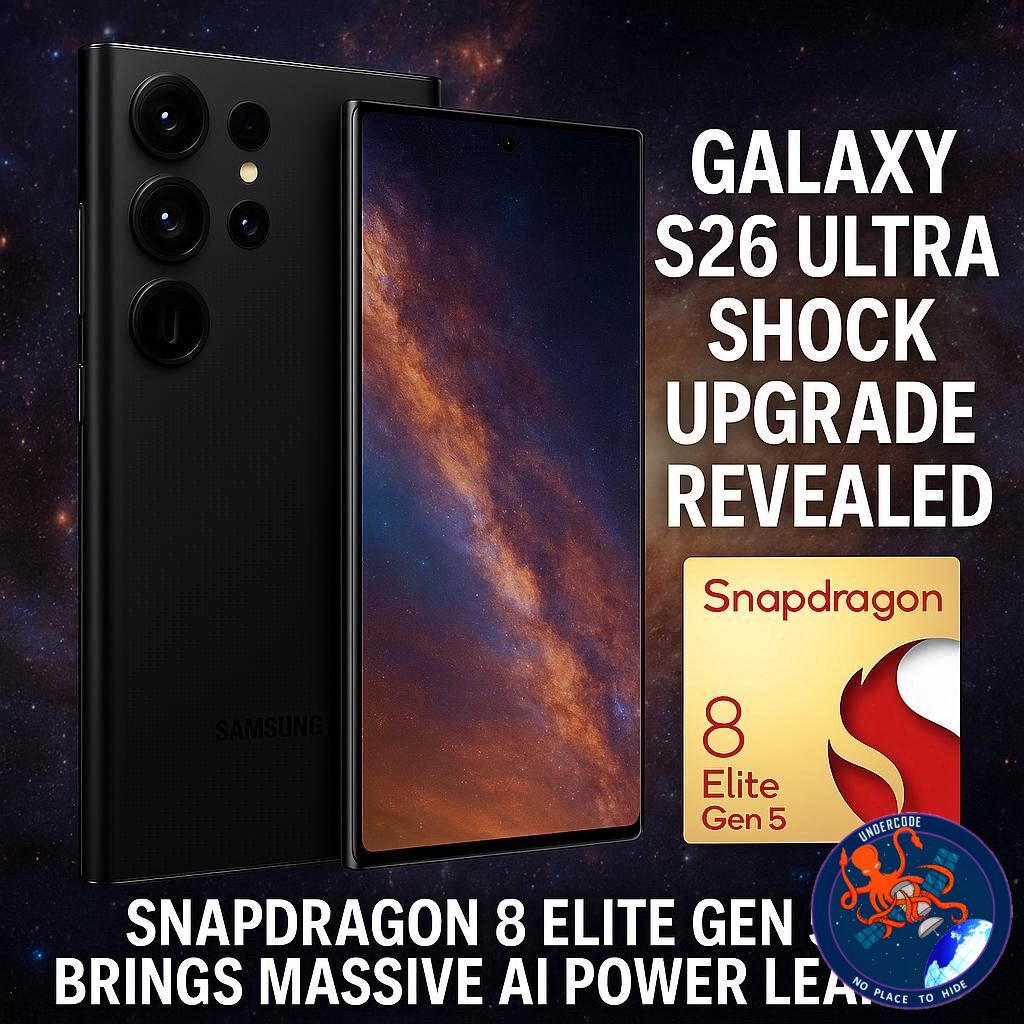
Introduction: A New Performance Era for Samsung’s Ultra Flagship
The arrival of the Samsung Galaxy S26 Ultra signals a major shift in smartphone performance expectations, driven by Qualcomm’s latest Snapdragon 8 Elite Gen 5 for Galaxy chipset. Samsung is not just upgrading raw speed this year—it is reshaping how on-device AI, gaming performance, and thermal efficiency come together in a single device. With claims of up to 39% faster AI processing, 24% improved GPU performance, and 19% stronger CPU output compared to the previous generation, the S26 Ultra positions itself as a power-focused flagship built for the AI-first era.
Full Summary: Snapdragon 8 Elite Gen 5 Redefines Galaxy Performance (Approx. )
The Samsung Galaxy S26 Ultra is powered by the Snapdragon 8 Elite Gen 5 for Galaxy, Qualcomm’s newest flagship processor.
This chip is a direct successor to the Snapdragon 8 Elite used in the Galaxy S25 Ultra.
It delivers a significant leap in performance across AI, graphics, and general processing.
AI workloads are now up to 39% faster than before.
GPU performance sees an improvement of around 24%.
CPU speed increases by roughly 19%, making everyday tasks feel more responsive.
A major highlight is the upgraded Neural Processing Unit (NPU).
This NPU is designed specifically for Galaxy AI features.
It allows more tasks to run directly on-device instead of relying on the cloud.
Features like Now Brief and Now Bar respond faster and more smoothly.
The chip is built on an advanced 3nm process.
This improves power efficiency while maintaining high performance.
Users benefit from better battery optimization during heavy workloads.
Samsung also improved heat management in the S26 Ultra.
A larger vapor chamber cooling system has been introduced.
This helps reduce thermal throttling during gaming and AI tasks.
The Snapdragon 8 Elite Gen 5 also enhances camera processing.
It supports advanced selfie AI for improved skin tone accuracy.
It also boosts low-light performance and image processing speed.
Privacy Display functionality runs more smoothly due to higher bandwidth.
Multitasking becomes more efficient with improved RAM management.
The 1TB variant of the S26 Ultra includes 16GB RAM.
Other models typically come with 12GB RAM.
This allows more apps and AI processes to stay active simultaneously.
Overall, the chipset improves speed, efficiency, AI capabilities, and thermal stability.
It positions the S26 Ultra as one of the most powerful smartphones Samsung has ever created.
What Undercode Say: The Real Meaning Behind Samsung’s AI Power Leap
AI Is No Longer a Feature — It Is the Core Engine
The biggest shift in the Samsung Galaxy S26 Ultra is not raw speed, but architectural philosophy. Samsung is clearly moving from “AI as an add-on” to “AI as the operating backbone.” With a 39% jump in NPU performance, the device is designed to process intelligence locally rather than depending on cloud servers. This reduces latency and improves privacy, but it also signals a long-term strategy: Samsung wants Galaxy AI to behave like an always-on assistant rather than a triggered tool.
Snapdragon 8 Elite Gen 5: A Silent but Massive Upgrade
The Snapdragon 8 Elite Gen 5 for Galaxy is not just a generational upgrade—it is a rebalancing of computing priorities. Instead of focusing purely on CPU gains, Qualcomm is aggressively shifting power into AI acceleration and efficiency. This explains why CPU gains are relatively modest compared to AI performance. It reflects the industry trend where smartphones are becoming inference machines rather than just execution devices.
Thermal Engineering Becomes a Competitive Weapon
Samsung’s decision to expand the vapor chamber cooling system shows a deeper truth: performance is no longer just about chips, but about sustained output. Without thermal improvements, peak gains mean little in real usage. By preventing throttling during gaming, 8K video processing, and AI workloads, Samsung is effectively ensuring the chip’s theoretical gains translate into real-world consistency.
On-Device AI Changes User Expectations
With more processing handled locally, features like Now Brief and Now Bar become faster and more persistent. This shifts user expectations toward real-time intelligence rather than delayed responses. The device begins to behave less like a smartphone and more like a predictive computing assistant. However, full independence from cloud services is still not possible, meaning hybrid AI remains essential.
RAM Strategy Signals Heavy Multitasking Future
The inclusion of 16GB RAM in the 1TB model highlights a future where AI processes run continuously in the background. This is not just about opening apps faster—it is about maintaining multiple AI-driven workflows simultaneously. The phone is being designed for users who expect persistent AI memory, image processing, and contextual assistance running in parallel.
Gaming and Creator Workloads Enter a New Phase
GPU improvements of 24% may seem incremental, but combined with better thermal stability, they create a smoother long-session experience. For mobile gamers and content creators, sustained performance matters more than peak numbers. This positions the S26 Ultra as a hybrid device for entertainment and productivity rather than just communication.
Efficiency Over Raw Power Is the Real Story
The 3nm architecture reinforces a broader industry transition: efficiency is now just as important as speed. Instead of chasing extreme frequency jumps, chipmakers are focusing on balancing performance per watt. This is critical for battery life, especially as AI workloads continue to grow in complexity.
🔍 Fact Checker Results: Reality vs Marketing Claims
Performance Claims Are Theoretical Peaks
The reported 39% AI and 24% GPU improvements likely represent benchmark peaks under controlled conditions, not everyday sustained performance.
On-Device AI Still Depends on Cloud Support
Despite stronger NPU processing, many Galaxy AI features still require network connectivity for full functionality.
Cooling Improvements Are Real but Limited
A larger vapor chamber improves thermal performance, but it cannot completely eliminate throttling under extreme workloads.
📊 Prediction: Where Samsung’s AI Strategy Is Heading Next
The Samsung Galaxy S26 Ultra marks the beginning of a full transition toward AI-native smartphones, where processing power is no longer measured only in speed but in intelligence density. Future Galaxy devices are likely to push even more computation into NPUs, reducing reliance on traditional CPU-heavy architecture. This could eventually lead to phones that behave more like adaptive personal systems, learning user behavior in real time and predicting actions before input occurs. However, the biggest challenge will remain balancing battery life with always-on AI processing, which may define the next generation of mobile innovation.
🕵️📝Let’s dive deep and fact‑check.
References:
Reported By: www.sammobile.com
Extra Source Hub (Possible Sources for article):
https://www.github.com
Wikipedia
OpenAi & Undercode AI
Image Source:
Unsplash
Undercode AI DI v2
Bing
🔐JOIN OUR CYBER WORLD [ CVE News • HackMonitor • UndercodeNews ]
📢 Follow UndercodeNews & Stay Tuned:
𝕏 formerly Twitter 🐦 | @ Threads | 🔗 Linkedin | 🦋BlueSky | 🐘Mastodon


