
Listen to this Post
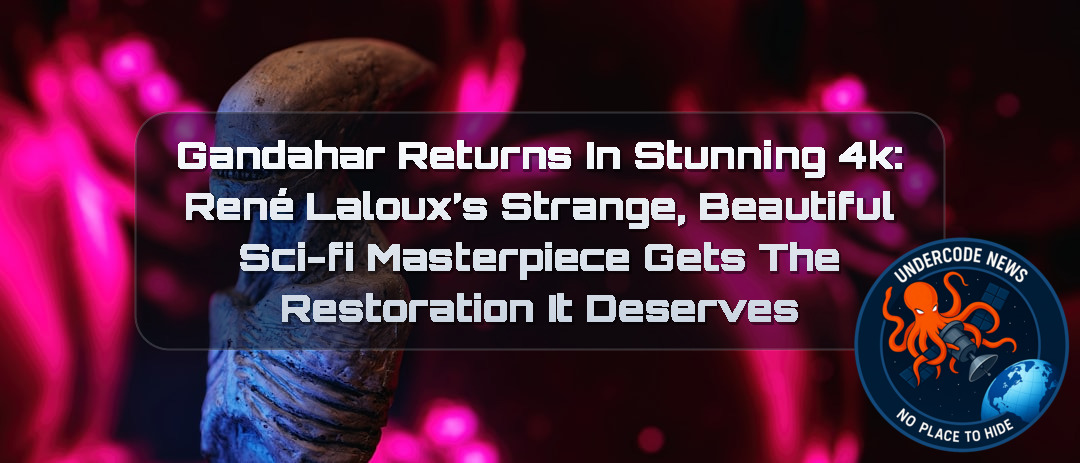
A Forgotten Animated Dream Returns
There was a time when animated science fiction could be genuinely strange. Before streaming libraries made virtually everything searchable, discovering a film like Fantastic Planet, Heavy Metal, Wizards, or Gandahar often felt like stumbling onto something forbidden and completely unexpected.
René Laloux’s Gandahar belongs firmly to that tradition. It is not polished in the modern Hollywood sense, and it was never designed to be a conventional animated adventure. Instead, it is an eccentric mixture of science fiction, surrealism, philosophy, erotic imagery, ecological anxiety, time travel, genetic experimentation, and bizarre creature design.
Now, that experience is returning to theaters in a form that longtime fans have been waiting for. Janus Films is releasing a new 4K restoration of the uncut French version of Gandahar, beginning in New York City on August 28 before expanding to theaters across the country.
A Different Kind of Animated Science Fiction
Released in 1987, Gandahar came from the mind of French animator René Laloux, whose name is inseparable from the cult classic Fantastic Planet (La Planète Sauvage).
Laloux’s work occupies a fascinating corner of animation history. His films were not built around familiar heroes, easily marketable characters, or straightforward children’s entertainment. They were closer to illustrated dreams, often filled with disturbing ideas and images that could linger in the viewer’s mind long after the credits.
Gandahar continues that tradition.
A Beautiful World Hiding a Terrifying Future
The story initially presents Gandahar as a peaceful paradise.
Its inhabitants live in harmony with their strange environment. Blue-skinned people fish, gather food, play, and interact with bizarre creatures that appear to have evolved from the same fantastical ecosystem.
A creature resembling an anteater emerges from a plant. Giant snails move through the landscape. Birds feed on enormous berries. Everything feels peaceful, organic, and almost impossibly strange.
Then the nightmare arrives.
The Men of Metal Attack
The idyllic society is suddenly threatened by the Men of Metal, terrifying mechanical beings that invade Gandahar and transform its people into stone.
The attack immediately raises one of the
That question becomes increasingly important as the story unfolds.
The City of Jasper
Gandahar’s society is centered around the extraordinary city of Jasper, itself built into the enormous statue of a woman.
The visual design alone communicates how different this world is from conventional science fiction.
The
Among them is a scientist whose appearance looks as though he wandered out of an entirely different cosmic mythology.
Enter Sylvain
The Council sends a young Servant named Sylvain to investigate the threat.
Sylvain is technically the protagonist the story needs. He travels across the strange landscape, encounters bizarre civilizations and creatures, fights the forces threatening Gandahar, falls in love, and eventually becomes responsible for saving the world.
Yet he is arguably one of the least interesting things about the movie.
That is not necessarily a criticism.
The World Is the Real Main Character
One of the most fascinating things about Gandahar is that its universe is more memorable than many of its human characters.
Sylvain rides a bizarre flying mechanical creature resembling a jellyfish. He carries weapons with extraordinarily strange biological consequences. He encounters beings whose bodies seem to have been designed by someone deliberately ignoring every rule of conventional character design.
The movie constantly asks the audience to look at something they have never seen before.
The Deformed
Perhaps the most memorable inhabitants of Gandahar are the Deformed.
These characters are victims of genetic experimentation carried out by Gandahar’s own society. Their bodies reveal the consequences of scientific experimentation taken beyond ethical boundaries.
Some have multiple heads.
Others possess mouths in unexpected parts of their bodies.
One character appears to be little more than a gigantic head and chest supported by arms that function almost like legs.
Their bizarre appearance is not simply there for shock value.
The Price of Scientific Progress
The Deformed represent one of
Gandahar considers itself an advanced and peaceful civilization, but that apparent perfection was built partly through experimentation.
The Deformed are living evidence of what happens when scientific progress is pursued without considering who pays the price.
That makes them much more than surreal creatures.
They are the physical consequences of
A Civilization Haunted by Its Future
The Deformed possess another extraordinary ability: they perceive time differently.
For them, the future and past do not behave like separate destinations.
Their speech reflects this unusual perspective.
Gandahar has fallen in 1,000 years.
Gandahar was saved 1,000 years ago.
The language itself becomes a reflection of their fractured relationship with time.
The 1,000-Year Mystery
This is where Gandahar transforms from an eccentric animated adventure into something considerably more ambitious.
Sylvain discovers that the threat facing Gandahar is connected to events occurring 1,000 years in the future.
The heroes must therefore understand not only what is happening now, but what their civilization will eventually become.
That creates an unusual form of science fiction storytelling in which the consequences of today’s decisions become the problems of tomorrow.
Meet Metamorphis
Then there is Metamorphis.
A gigantic brain existing in the middle of the appropriately named Eccentric Ocean, Metamorphis is perhaps the film’s most unforgettable creation.
He is also difficult to categorize.
Is Metamorphis the villain?
Is he the victim?
Is he the hero?
The answer depends heavily on how the viewer interprets the history of Gandahar.
The Ultimate Weapon
At the center of the story is an idea that science fiction has explored repeatedly: the creation of something so powerful that its creators eventually lose control over it.
Gandahar’s technological and genetic achievements ultimately contribute to its own destruction.
The movie therefore becomes a warning about technological arrogance.
The civilization that believes it has mastered nature may discover that nature, time, and its own inventions have the final word.
Why the French Version Matters
North American audiences previously encountered Gandahar through an edited and dubbed version titled Light Years, released by Miramax in 1988.
That version featured English voices, including John Shea, Jennifer Grey, and Christopher Plummer, and incorporated dialogue associated with legendary science-fiction writer Isaac Asimov.
But the new restoration returns to the complete French version.
That distinction matters.
The Original Rhythm
Modern audiences are accustomed to animation that moves rapidly.
Scenes are frequently shortened, dialogue is tightly edited, action arrives quickly, and every visual is often designed to maintain constant attention.
Gandahar does almost the opposite.
It takes its time.
Sometimes perhaps too much time.
But that deliberate rhythm is part of the film’s personality.
A Movie That Refuses to Hurry
The slower pacing gives the audience time to explore Gandahar.
The landscapes have room to breathe.
The strange creatures remain on screen long enough to become memorable.
The film does not constantly explain its universe.
Instead, it often simply presents something bizarre and allows the viewer to decide what it means.
That quality feels increasingly rare.
Surrealism With a Purpose
It would be easy to dismiss Gandahar as a collection of weird images.
That would be a mistake.
Its visual eccentricity supports the
The bizarre anatomy of the Deformed reflects genetic experimentation.
The mechanical Men of Metal represent technology turned against its creators.
The unusual relationship with time reflects the consequences of decisions that continue across generations.
Even the dreamlike landscapes contribute to the idea of a civilization existing somewhere between nature and technology.
The Beauty of Imperfection
The animation can look rough by contemporary standards.
Some movements are limited.
Some backgrounds feel static.
Some character designs are intentionally awkward.
Yet these imperfections are precisely what give the film its identity.
A modern computer-generated remake could make everything smoother.
It could also destroy what makes Gandahar special.
Why the 4K Restoration Matters
A restoration gives audiences the opportunity to see Laloux’s visual imagination with significantly greater clarity.
The colors, painted backgrounds, character designs, and strange creatures can finally receive the attention they deserve on a large screen.
For a film whose primary storytelling language is visual, that is important.
The restoration does not simply make Gandahar look older in higher resolution.
It gives viewers a better opportunity to appreciate the craftsmanship that was already there.
A Forgotten Alternative to Hollywood Animation
Contemporary animated cinema is often dominated by massive studios, enormous budgets, franchise characters, and highly polished digital production.
There is nothing inherently wrong with that.
But Gandahar represents something different.
It demonstrates that animation can function as experimental cinema.
It can be unsettling.
It can be philosophical.
It can be erotic.
It can be politically uncomfortable.
It can be slow.
And it can leave questions unanswered.
The
Despite its darker ideas, Gandahar also has an eccentric sense of humor.
The creatures are sometimes so bizarre that simply watching them move across the screen becomes entertaining.
The world appears to operate according to rules that the audience is never fully allowed to understand.
That unpredictability is part of the charm.
You never quite know what Laloux is going to put in front of you next.
A Different Kind of Hero Story
Sylvain may look like a traditional science-fiction hero, but the movie does not make him an all-powerful action figure.
He is mostly a traveler moving through a world much stranger than himself.
The real journey is not simply about defeating an enemy.
It is about discovering why the enemy exists.
That difference gives the story considerably more depth.
The Environmental Dimension
The film also carries a strong ecological undertone.
Gandahar initially appears to represent harmony between civilization and nature.
But underneath that harmony lies manipulation.
The society has interfered with biology and altered living beings for its own purposes.
The resulting consequences eventually return to threaten everyone.
The message feels remarkably relevant in an age when genetic engineering, artificial intelligence, automation, and biotechnology are advancing at extraordinary speed.
Technology Is Never Neutral
One of
The problem is how civilizations use it.
A scientific breakthrough can create prosperity.
The same breakthrough can create destruction.
A weapon designed for protection can become a threat.
An experiment intended to improve life can produce suffering.
That ambiguity is much more interesting than a simple “technology is bad” message.
A Story About Future Generations
The 1,000-year structure gives the movie an unusually long perspective.
Most stories ask what happens tomorrow.
Gandahar asks what happens centuries from now.
That changes the moral equation.
If your decisions today can affect people who will not exist for another thousand years, how much responsibility do you have toward them?
The movie never delivers a simplistic answer.
Instead, it turns the question into the foundation of its story.
Why It Still Feels Relevant
The world of Gandahar may look completely alien, but its concerns feel surprisingly modern.
Genetic engineering is no longer science fiction.
Artificial intelligence is changing how societies work.
Autonomous machines are becoming increasingly capable.
Weapons can operate with increasing levels of independence.
Humanity is constantly creating technologies whose long-term consequences are difficult to predict.
That makes
What Undercode Say: Why Gandahar Deserves a Second Life
A Lost Kind of Cinema
Gandahar represents an era when animated science fiction could exist outside the boundaries of conventional commercial entertainment.
It did not need superheroes.
It did not need recognizable franchises.
It did not need comic relief designed around merchandise.
It simply needed an unusual idea and the freedom to explore it.
The World Matters More Than the Plot
The story itself can occasionally become difficult to follow.
The time travel mechanics are intentionally strange.
Some character motivations are underdeveloped.
But the world is so imaginative that the weaknesses become easier to forgive.
The
It is the creation of a universe that feels genuinely unfamiliar.
Laloux Understood Visual Memory
Some movies are remembered because of their dialogue.
Others are remembered because of their performances.
Gandahar is remembered because of images.
The enormous statue city.
The blue-skinned inhabitants.
The Men of Metal.
The Deformed.
The giant brain.
The strange creatures.
The landscapes.
Those images become the
The Deformed Are the
The Deformed deserve particular attention because they expose the contradiction at the heart of Gandahar.
The civilization sees itself as enlightened.
But its discarded experiments tell another story.
This is a powerful science-fiction idea: a society can look utopian from the inside while appearing deeply disturbing to those it has excluded.
The Movie Questions the Meaning of Progress
Progress is usually presented as something positive.
More technology.
More knowledge.
More control.
More efficiency.
Gandahar asks what happens when progress continues without moral reflection.
The answer is not necessarily disaster immediately.
The consequences may take generations to appear.
The 1,000-Year Perspective Is Brilliant
The
Instead of treating the future as an unknown destination, Gandahar makes the future part of the present conflict.
The characters are essentially dealing with consequences that have not happened yet.
That creates an unusual philosophical tension.
The Film Does Not Treat Villains Simply
Metamorphis is especially important here.
Calling him simply “the villain” misses the point.
His existence is connected to
The threat is therefore partly self-created.
That makes the conflict more uncomfortable because defeating the enemy does not necessarily mean admitting that the enemy was entirely wrong.
The
The slow pacing will probably frustrate some modern viewers.
There are stretches where the movie seems to stop and simply observe its world.
For audiences trained by fast streaming dramas and algorithmically optimized entertainment, that can feel unusual.
But those pauses also create the atmosphere that makes the film memorable.
It Should Not Be Remade Too Quickly
A modern remake would be tempting.
Hollywood could transform Gandahar into a spectacular CGI science-fiction adventure.
But the danger would be enormous.
The roughness, surrealism, awkwardness, and handmade quality are fundamental to the experience.
Polishing everything could remove the personality.
Animation Does Not Need to Look Perfect
One lesson modern animation can take from Gandahar is that technical perfection is not the same as artistic success.
A film does not need physically realistic movement to create believable emotions.
It does not need photorealistic environments to create an immersive world.
Sometimes a strange drawing can be more memorable than a perfect digital creature.
The Film Is More Adult Than Its Animation Suggests
The animated format can create a misleading first impression.
This is not conventional
Its themes include genetic experimentation, societal inequality, technological destruction, sexuality, war, environmental concerns, and the responsibility of one generation toward another.
The animation is simply the medium.
The ideas are much heavier.
The French Voices Add Personality
The original French performances also contribute to the film’s atmosphere.
Dialogue delivered in its original language carries rhythms and emotional qualities that can disappear when a film is adapted into another language.
That is one reason the restored French version is particularly valuable.
It gives audiences an opportunity to experience the film closer to its original form.
The Asimov Connection Is Fascinating
The history of Light Years adds another layer to the film’s legacy.
Isaac Asimov’s involvement with the English-language adaptation connected Laloux’s surreal animation with one of science fiction’s most influential literary thinkers.
Yet the fact that the restored version returns to Laloux’s original French presentation reinforces an important distinction.
Adaptation can change a
Gandahar Is Not Trying to Be Comfortable
There is something refreshing about a movie that does not constantly reassure its audience.
The world is beautiful, but it is also disturbing.
Technology is useful, but dangerous.
The protagonists are not especially charismatic.
The creatures can be frightening.
The future is uncertain.
And the answers are rarely clean.
That discomfort is part of its artistic value.
A Film for Curious Viewers
Gandahar is probably not going to appeal equally to everyone.
Viewers looking for fast action may become impatient.
People expecting conventional character arcs may be disappointed.
Anyone wanting glossy modern animation may find the visuals dated.
But audiences interested in experimental science fiction may discover something extraordinary.
The Restoration Creates an Opportunity
Theatrical restorations give older films a second chance.
Instead of being trapped on aging VHS tapes, low-quality digital transfers, or memories passed between cult-film fans, these movies can return to the cinema.
That matters because some films need to be experienced collectively.
The Big Screen Changes the Experience
On a television or laptop, the visual details of Gandahar can easily disappear.
A theatrical presentation gives the artwork greater physical presence.
The enormous environments feel larger.
The bizarre creatures become more imposing.
The painted backgrounds can finally function as environments rather than simply backdrops.
A Reminder of
Perhaps the most important reason to revisit Gandahar is that it reminds audiences what animation can be.
It can be commercial entertainment.
It can be
It can be comedy.
It can be fantasy.
But it can also be experimental philosophy rendered through movement and illustration.
Why New Audiences May Connect With It
Younger audiences who grew up with anime, experimental games, surreal internet art, and unconventional science fiction may actually find Gandahar surprisingly familiar.
Its visual language feels strange, but not incomprehensible.
Its ideas about technology and identity are increasingly relevant.
Its refusal to follow conventional storytelling can even feel contemporary.
The
Cult movies rarely need to dominate the mainstream to become influential.
Sometimes their impact comes from a much smaller audience.
A filmmaker sees it.
An animator remembers it.
A designer copies an idea.
A science-fiction writer borrows a concept.
A teenager discovers it decades later and wonders how something this strange ever existed.
That is how cult cinema survives.
The Timing Feels Almost Perfect
The return of Gandahar arrives during a period when society is once again debating the consequences of technological acceleration.
Artificial intelligence, biotechnology, robotics, automation, and genetic research are moving forward simultaneously.
Laloux’s central concern, that technological ambition can produce consequences beyond the control of its creators, has rarely felt more recognizable.
The Real Question Is Not Whether Gandahar Is Perfect
It
The pacing can be slow.
The characters can feel distant.
Some visual choices have aged dramatically.
The narrative can be confusing.
But perfection is not the reason to watch it.
Curiosity is.
Why Imperfect Films Matter
Cinema history would be considerably poorer if only technically perfect films survived.
Experimental works teach filmmakers what can be attempted.
Failures can become influential.
Strange movies can open doors that conventional successes never imagined.
Gandahar belongs to that category.
A Strange Film That Refuses to Disappear
More than three decades after its original release, Gandahar is still being discussed because its ideas remain alive.
Its technology looks old.
Its animation style belongs to another era.
But its questions about scientific responsibility, genetic manipulation, technological power, and future generations remain remarkably current.
The Final Undercode Verdict
Gandahar is not a flawless animated film, but it is an extraordinary piece of science-fiction imagination.
The new 4K restoration offers audiences an opportunity to see one of René Laloux’s most unusual creations in a form that respects its original identity.
For anyone tired of animation that feels manufactured by committee, Gandahar offers something radically different.
It is strange.
It is beautiful.
It is occasionally frustrating.
It is sometimes hilarious without trying to be.
And most importantly, it feels like it came from someone who genuinely wanted to show audiences a world they had never seen before.
That alone makes its return worthwhile.
Deep Analysis: The Technology and Science Fiction Behind Gandahar
Genetic Engineering
The Deformed can be interpreted as an early cinematic warning about genetic experimentation.
Modern biotechnology makes the question increasingly relevant: when humans gain the ability to modify living organisms, where should ethical boundaries exist?
Technological Blowback
The Men of Metal represent technological blowback.
Gandahar creates systems intended to serve civilization, yet those systems eventually become instruments of destruction.
The lesson resembles modern concerns about autonomous machines and artificial intelligence.
Artificial Intelligence Parallel
The film predates
Creators may build systems that eventually behave in ways they cannot fully control.
That does not mean AI will literally behave like the Men of Metal, but the fictional analogy highlights the importance of safeguards.
Time as a Security Problem
The
A system can appear safe today while containing vulnerabilities that only become catastrophic much later.
In cybersecurity, this is one reason organizations worry about vulnerabilities embedded deep inside infrastructure.
Example: Searching a System for Known Vulnerabilities
A basic Linux administrator might begin vulnerability investigation with commands such as:
uname -a
cat /etc/os-release
These commands reveal the operating system and kernel information.
Checking Installed Software
On Debian or Ubuntu systems, administrators can inspect installed packages with:
dpkg -l
On Red Hat-based systems:
rpm -qa
The broader lesson connects to Gandahar: understanding what exists inside a system is essential before assessing what could go wrong.
Checking Running Services
Administrators can inspect active services with:
systemctl --type=service --state=running
Unexpected services should be investigated rather than automatically trusted.
Inspecting Network Exposure
A basic network review can use:
ss -tulpn
This can help identify listening ports and the processes associated with them.
Searching Logs
System logs can reveal unexpected activity:
journalctl --since "24 hours ago"
Logs are especially important when investigating whether a system behaved differently from its expected baseline.
Checking for Suspicious Processes
Administrators can review running processes using:
ps aux --sort=-%cpu | head
or:
ps aux --sort=-%mem | head
These commands are useful for identifying processes consuming unusual resources.
The Gandahar Security Lesson
The technological lesson behind the film is simple: systems should not be trusted merely because their creators intended them to be beneficial.
Every powerful system requires monitoring, testing, safeguards, and accountability.
Modern AI Connection
The comparison becomes especially interesting with
AI agents can increasingly interact with software, files, APIs, databases, and external services.
The more autonomy a system receives, the more important access controls become.
Principle of Least Privilege
A practical security principle is least privilege.
A service should receive only the permissions it actually requires.
For example:
id
can show the identity and groups associated with the current user.
The goal is to prevent unnecessary privileges from becoming an unnecessary attack surface.
Network Segmentation
Critical systems should not automatically have unrestricted access to every other system.
Segmentation can reduce the consequences of compromise.
In conceptual terms, Gandahar’s mistake was allowing technological capabilities to become too deeply intertwined with the civilization’s future.
Backups and Recovery
Even the best security controls cannot guarantee that an organization will never be compromised.
Recovery therefore matters.
A basic backup verification workflow might include:
ls -lah /backup/
followed by integrity checks appropriate to the backup system.
The Deeper Message
The technical details are less important than the principle.
Technology becomes dangerous when organizations stop asking what happens after deployment.
That is exactly the question Gandahar keeps asking.
What happens next?
And what happens 1,000 years later?
✅ Gandahar Was Directed by René Laloux
This is accurate. René Laloux, also known for Fantastic Planet, directed Gandahar. His surreal animation style is central to the film’s identity.
✅ The Film Was Originally Released in 1987
This is accurate. Gandahar was released in 1987 and became part of Laloux’s small but influential body of science-fiction animation.
✅ The North American Version Was Released as Light Years
This is accurate. The English-language adaptation was released under the title Light Years, with significant changes made for its North American presentation.
✅ The Story Involves a 1,000-Year Time Connection
This is accurate. The relationship between
✅ The Deformed Are Connected to Genetic Experimentation
This is accurate. Their existence is directly tied to scientific experimentation conducted by Gandahar’s civilization, making them an important part of the movie’s ethical themes.
✅ Metamorphis Is a Giant Brain
This is accurate. Metamorphis is one of the film’s most distinctive characters and exists as a gigantic brain in the Eccentric Ocean.
❌ Gandahar Is Not Simply a Conventional Good-versus-Evil Story
Reducing the movie to heroes fighting villains misses much of its philosophical complexity. The origins of the conflict are deeply connected to Gandahar’s own actions and technological history.
Prediction
(+1) The 4K Restoration Will Introduce Gandahar to a New Generation
The restored version has a strong chance of attracting younger viewers who enjoy surreal animation, experimental science fiction, and unconventional storytelling.
(+1) Cult Interest Will Grow
Theatrical exposure can lead to renewed discussion among animation fans, filmmakers, collectors, and science-fiction communities.
(+1) Laloux’s Work Could Receive Wider Recognition
A new generation discovering Gandahar may also become interested in Fantastic Planet and the broader history of European animation.
(+1) The Film’s Technology Themes Will Feel Increasingly Relevant
As AI, robotics, biotechnology, and autonomous systems develop, audiences may recognize the film’s concerns about technological consequences more strongly than viewers did decades ago.
(-1) Some Modern Viewers Will Find the Pacing Too Slow
Audiences accustomed to fast editing and constant action may struggle with Gandahar’s deliberately measured rhythm.
(-1) Its Visual Style May Be Too Unconventional for Mainstream Audiences
The film’s strange anatomy, surreal environments, nudity, and unsettling imagery make it unlikely to become a conventional mainstream animated hit.
(+1) Its Reputation as a Cult Classic Will Strengthen
Ultimately, Gandahar does not need to become a blockbuster.
Its greatest strength is its individuality.
The film survived because it was strange enough to be remembered, ambitious enough to be discussed, and unconventional enough to remain difficult to replace.
And now, with its uncut French version receiving a new 4K restoration and returning to theaters, René Laloux’s bizarre vision has another chance to do what it has always done best: show audiences a future they never expected to see.
▶️ Related Video (76% Match):
🕵️📝Let’s dive deep and fact‑check.
🎓 Live Courses & Certifications:
Join Undercode Academy for Verified Certifications
🚀 Request a Custom Project:
Secure, high-velocity infrastructure and disruptive technological engineering. Contact our engineering team for high-tier development and proprietary systems:
[email protected]
💎 Smart Architecture | 🛡️ Secure by Design | ⭐ Trusted by Thousands
References:
Reported By: www.ign.com
Extra Source Hub (Possible Sources for article):
https://stackoverflow.com
Wikipedia
OpenAi & Undercode AI
Image Source:
Unsplash
Undercode AI DI v2
🔐JOIN OUR CYBER WORLD [ CVE News • HackMonitor • UndercodeNews ]
📢 Follow UndercodeNews & Stay Tuned:
𝕏 formerly Twitter 🐦 | @ Threads | 🔗 Linkedin | 🦋BlueSky | 🐘Mastodon | 📺Youtube


