
Listen to this Post
Introduction
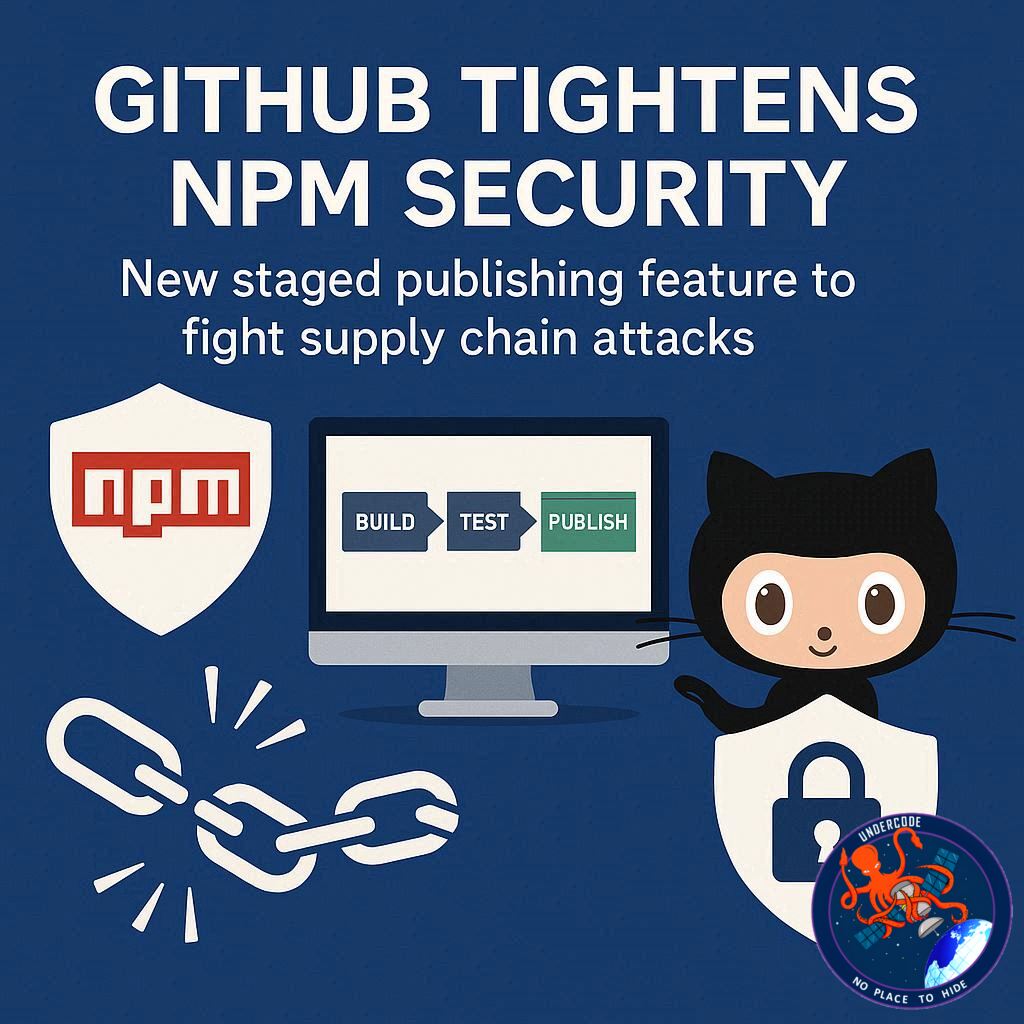
As software supply chain attacks continue to explode across the open-source ecosystem, GitHub has announced a major security upgrade for npm aimed at stopping malicious packages before they reach developers. The new feature, called “staged publishing,” introduces an additional human verification step that forces maintainers to explicitly approve package releases before they become publicly available on the npm registry.
The move comes during a period of growing concern around compromised CI/CD pipelines, poisoned open-source packages, dependency confusion attacks, and automated malware campaigns targeting developers worldwide. By enforcing stronger controls around package publication, GitHub is attempting to close one of the most abused attack surfaces in modern software development.
The update also includes new installation restriction flags designed to limit risky package sources, giving developers more granular control over how dependencies are installed. Together, these changes signal a broader shift toward zero-trust security practices within the npm ecosystem.
GitHub Introduces Staged Publishing for npm
GitHub officially rolled out staged publishing as a generally available feature for npm package maintainers. Instead of allowing a package to become instantly available after publishing, the system now places the package into a temporary staging queue.
A human maintainer must then manually approve the release using two-factor authentication before the package becomes downloadable through npmjs.com.
This additional checkpoint is designed to ensure what GitHub calls “proof of presence,” meaning an actual authorized maintainer must verify the publication process even if the release originated from an automated CI/CD workflow.
The approach specifically targets attacks where threat actors compromise automated pipelines or abuse stolen tokens to silently publish malicious package updates without the maintainer realizing it.
How the New npm Publishing Process Works
Under the staged publishing workflow, developers first upload a prebuilt tarball package to a staging environment instead of directly publishing it live.
The package remains inaccessible to users until a maintainer successfully completes a 2FA challenge and approves the release.
GitHub says the feature works alongside trusted publishing systems that use OpenID Connect (OIDC) authentication, creating an extra layer of verification even for fully automated deployment environments.
To use staged publishing, maintainers must satisfy several requirements:
Required Conditions for Staged Publishing
The maintainer must already have publishing access to the package
The package must already exist on the npm registry
Two-factor authentication must be enabled on the maintainer account
Brand-new packages currently cannot use staged publishing
Developers must also update to npm CLI version 11.15.0 or newer to access the feature.
The publishing command is straightforward:
npm stage publish
This command uploads the package into the staging queue rather than immediately releasing it to the public registry.
New npm Installation Security Flags Added
GitHub also introduced three new installation source flags designed to restrict non-registry package installations.
These new flags expand security controls beyond the previously existing –allow-git option.
Newly Added Security Flags
--allow-file
--allow-remote
--allow-directory
Each flag controls a different package source type:
Flag Purpose
–allow-file Allows installs from local tarballs or file paths
–allow-remote Allows installs from remote URLs and HTTPS tarballs
–allow-directory Allows installs from local directories
The objective is to force developers to explicitly allow risky installation methods instead of permitting them silently by default.
This model follows the principle of explicit trust boundaries, reducing accidental exposure to malicious dependency sources.
Why GitHub Is Making These Changes
The timing is not accidental.
Open-source ecosystems are currently facing an unprecedented wave of software supply chain attacks. Threat actors increasingly target npm because compromising a single popular package can potentially infect thousands or even millions of downstream applications.
GitHub specifically referenced the cybercriminal group known as TeamPCP, which has reportedly been involved in widespread package poisoning campaigns.
Researchers observed attackers abusing compromised maintainer credentials, automated release systems, and dependency chains to spread malware at scale.
Many of these attacks operate in a self-perpetuating cycle. Once attackers compromise one developer environment, they harvest tokens and credentials to compromise additional packages, creating a cascading ecosystem infection.
The npm ecosystem remains one of the highest-value targets because of its enormous popularity in JavaScript development and enterprise applications.
What Undercode Says:
Human Approval Is Becoming Mandatory Security
The most important takeaway from GitHub’s staged publishing rollout is the growing industry realization that automation alone is no longer trustworthy.
For years, developers optimized CI/CD pipelines for speed and convenience. The assumption was that automated publishing reduced human error and improved deployment efficiency.
Attackers adapted faster than expected.
Modern supply chain compromises now routinely target automation itself. Once malicious actors steal a token or compromise a GitHub Action workflow, they can silently push poisoned packages directly into production ecosystems.
GitHub’s new staged publishing model reintroduces deliberate human verification into the release pipeline.
That single design decision dramatically changes attacker economics.
2FA Alone Is Not Enough Anymore
Many organizations believed enabling 2FA solved the package hijacking problem.
It did not.
Attackers increasingly bypass authentication protections through session theft, token exfiltration, malicious browser extensions, compromised developer laptops, or CI/CD secrets leakage.
Staged publishing changes the equation because it requires active approval at release time rather than only during login authentication.
This “proof of presence” concept is critical.
Even if a threat actor steals deployment credentials, they still cannot instantly publish malicious packages without triggering an approval request.
npm Remains a Prime Cybercrime Battlefield
The npm ecosystem has evolved into one of the internet’s largest software supply chain attack surfaces.
Millions of developers install dependencies automatically without deeply auditing package contents.
Attackers understand this perfectly.
Malicious npm packages often disguise themselves as:
Utility libraries
Typosquatted packages
Dependency updates
Fake security tools
Build optimization plugins
Once installed, these packages can:
Steal environment variables
Exfiltrate API tokens
Inject backdoors
Hijack wallets
Deploy remote access malware
The danger increases exponentially when compromised packages belong to trusted maintainers with massive downstream adoption.
The New Install Flags Are Quietly Important
The additional npm install flags may appear minor compared to staged publishing, but they represent a major philosophical shift.
GitHub is moving npm toward explicit trust validation.
Instead of allowing remote package sources implicitly, developers must now deliberately authorize potentially dangerous installation paths.
This follows security principles already common in hardened Linux environments and enterprise infrastructure systems.
Expect future npm releases to continue tightening package source validation rules.
Open Source Security Is Entering a New Era
The software industry is transitioning from convenience-first development toward security-first development.
That transformation will likely continue over the next several years.
Developers should expect:
Mandatory signed packages
Hardware-backed authentication
Stricter maintainer identity verification
Enhanced package reputation systems
Behavioral malware scanning during publishing
Real-time dependency risk scoring
GitHub’s staged publishing system may eventually become the standard model across open-source registries including PyPI, RubyGems, Cargo, and Maven.
The age of blind trust in automated package publishing is ending.
Deep analysis :
Update npm CLI
npm install -g npm@latest
Verify npm version
npm -v
Publish package using staging
npm stage publish
Enable npm 2FA
npm profile enable-2fa auth-and-writes
Check authenticated npm user
npm whoami
Audit dependencies
npm audit
Automatically fix vulnerabilities
npm audit fix
Verify package integrity
npm pack --dry-run
Inspect installed dependencies
npm ls
Block remote package installs
npm config set allow-remote false
Example secure CI/CD environment variable handling
export NODE_AUTH_TOKEN=your_secure_token
GitHub Actions OIDC example
permissions:
id-token: write
contents: read
Scan for secrets before publish
gitleaks detect
Dependency confusion detection
npm doctor
Lock dependency versions
npm ci
Generate SBOM
cyclonedx-npm --output-file sbom.json
Verify package signatures
sigstore verify identity
Fact Checker Results
🔍 ✅ GitHub officially launched staged publishing for npm as a generally available feature requiring maintainer approval with 2FA before public release.
🔍 ✅ npm CLI version 11.15.0 or newer is required to use the npm stage publish command and staging workflow.
🔍 ✅ GitHub also introduced new install restriction flags including –allow-file, –allow-remote, and –allow-directory to strengthen dependency installation controls.
Prediction
📊 The next major evolution in npm security will likely involve mandatory cryptographic signing for all high-download packages.
📊 Enterprise organizations may soon require human approval gates for every production dependency release, especially in regulated industries.
📊 Supply chain attacks targeting CI/CD pipelines are expected to increase throughout 2026 as attackers shift focus away from traditional phishing toward developer infrastructure compromise.
🕵️📝Let’s dive deep and fact‑check.
References:
Reported By: thehackernews.com
Extra Source Hub (Possible Sources for article):
https://www.twitter.com
Wikipedia
OpenAi & Undercode AI
Image Source:
Unsplash
Undercode AI DI v2
Bing
🔐JOIN OUR CYBER WORLD [ CVE News • HackMonitor • UndercodeNews ]
📢 Follow UndercodeNews & Stay Tuned:
𝕏 formerly Twitter 🐦 | @ Threads | 🔗 Linkedin | 🦋BlueSky | 🐘Mastodon | 📺Youtube


