
Listen to this Post
 Introduction: A New Wave of Supply-Chain Threats in Open Source
Open-source ecosystems have become one of the most powerful engines driving modern software development. Millions of developers rely daily on shared libraries, repositories, and extensions to accelerate coding and innovation. However, this openness also creates a massive attack surface for cybercriminals. When attackers manage to compromise widely used packages, the consequences can ripple through thousands of downstream projects and organizations.
A recently resurfaced campaign known as GlassWorm demonstrates how dangerous these attacks can be. Security researchers have uncovered a large-scale operation targeting multiple developer platforms simultaneously. By infiltrating repositories, publishing malicious packages, and hiding malware within legitimate codebases, attackers are attempting to steal credentials, cryptocurrency wallet data, and other sensitive developer information.
The latest discovery reveals that the campaign is far larger and more coordinated than previously observed. Hundreds of packages across multiple platforms have been compromised, and the attackers are using sophisticated methods such as blockchain-based command-and-control infrastructure to coordinate their malware operations.
A Massive Multi-Platform Supply Chain Campaign
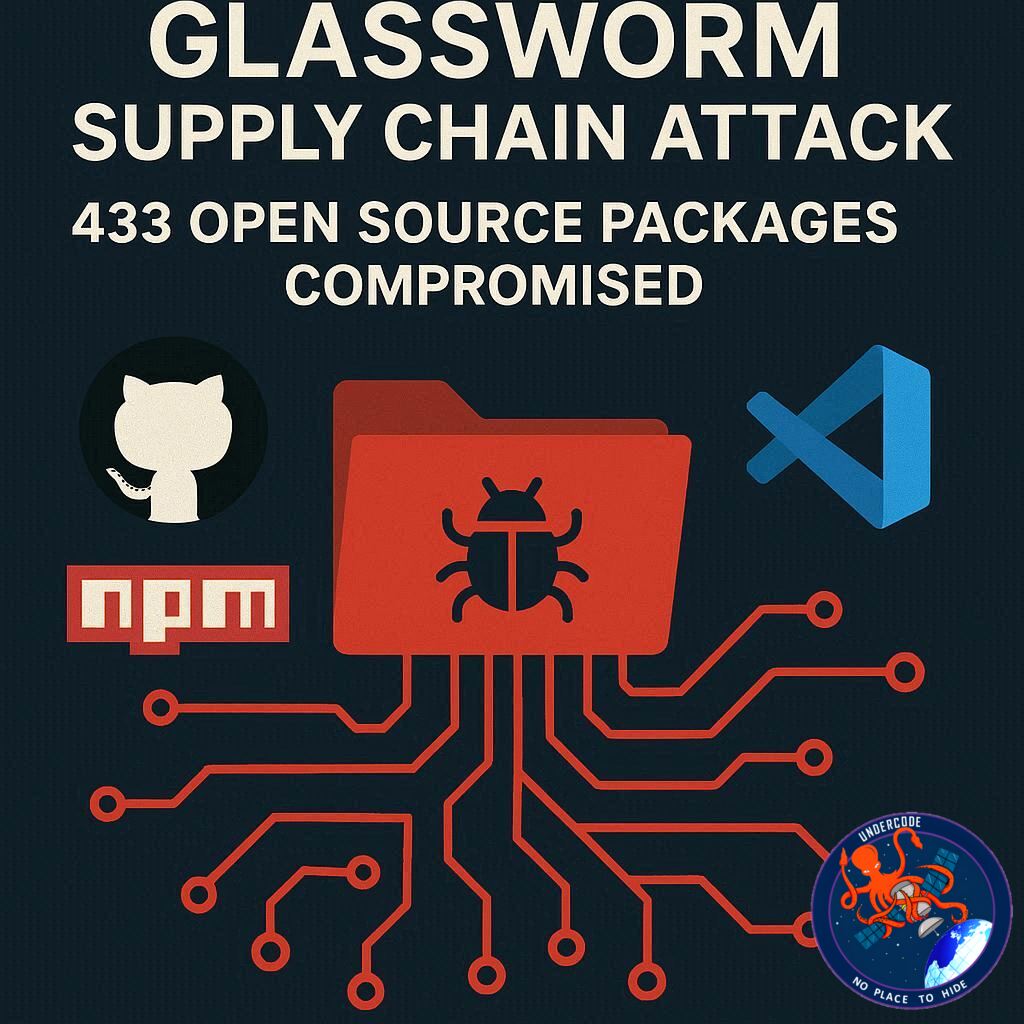
The GlassWorm campaign has resurfaced with a coordinated attack that has compromised hundreds of software components across several developer platforms. Security researchers from Aikido Security, Socket, Step Security, and the OpenSourceMalware community collaborated to analyze the activity and discovered 433 compromised components during the latest wave.
Investigators concluded that these attacks were orchestrated by a single threat actor due to several shared characteristics across the malware samples. The campaign consistently uses the same Solana blockchain address for command-and-control communication. In addition, the malicious payloads show identical structures and behaviors across multiple infected packages, and the infrastructure supporting the attacks is reused throughout the campaign.
GlassWorm was initially discovered in October of the previous year. During its early stages, the attackers used invisible Unicode characters to hide malicious code inside legitimate-looking packages. This hidden code allowed the malware to steal cryptocurrency wallet data and developer credentials without being easily detected by traditional security tools.
Since then, the campaign has evolved in both scope and sophistication. Earlier waves already targeted extensions on the Visual Studio Code marketplace and the OpenVSX extension registry. Security researcher John Tuckner from Secure Annex helped uncover how compromised extensions could reach developers through these official marketplaces.
The malware operators also began targeting macOS users by distributing trojanized versions of popular cryptocurrency wallet clients such as Trezor and Ledger. These fake clients enabled attackers to capture wallet credentials and other sensitive data.
The newest wave, however, is far larger than previous ones. Researchers discovered the following compromised assets across the open-source ecosystem:
200 GitHub Python repositories
151 GitHub JavaScript and TypeScript repositories
72 Visual Studio Code / OpenVSX extensions
10 npm packages
The attack typically begins with compromised GitHub accounts. Once attackers gain access, they force-push malicious commits into existing repositories. These changes may appear legitimate to casual observers but contain hidden payloads designed to execute once developers install or run the code.
After the repositories are compromised, malicious packages and extensions are published across multiple distribution platforms. The attackers deliberately hide harmful instructions using obfuscation techniques such as invisible Unicode characters, allowing the malware to bypass many automated security scans.
One of the most unusual aspects of the GlassWorm campaign is its use of blockchain technology for command-and-control communication. Instead of relying on traditional servers, the malware checks the Solana blockchain every five seconds for instructions embedded within transactions.
Between November 27, 2025, and March 13, 2026, researchers observed 50 blockchain transactions related to the campaign. These transactions often contained memo fields that provided updated payload URLs. When the malware reads these instructions, it downloads a Node.js runtime and executes a JavaScript-based information-stealing program.
The stolen data can include cryptocurrency wallet information, login credentials, developer access tokens, SSH keys, and environment configuration data. Such information is extremely valuable to attackers because it can enable further compromises of developer accounts, cloud environments, and production systems.
Researchers examining the malware code found comments written in Russian, suggesting the involvement of Russian-speaking threat actors. Additionally, the malware intentionally avoids running on systems configured with a Russian language locale. While these clues provide hints about the attackers’ background, security experts caution that they are not sufficient for definitive attribution.
To detect potential infections, Step Security recommends that developers inspect their projects for the suspicious variable “lzcdrtfxyqiplpd,” which acts as a marker for the GlassWorm malware. They also advise checking for the presence of a file named ~/init.json, which the malware uses to maintain persistence.
Other warning signs include unexpected Node.js installations within home directories, suspicious i.js files in recently cloned projects, and anomalies in Git commit histories, such as mismatches between author and committer timestamps.
What Undercode Say:
The Open-Source Trust Model Is Under Pressure
The GlassWorm campaign highlights a critical challenge facing modern software development. Open-source ecosystems operate on a foundation of trust. Developers rely on community packages and extensions without always verifying their security. This model works efficiently for innovation but becomes dangerous when attackers exploit it.
Supply-chain attacks have become one of the most effective cyberattack strategies because compromising one package can affect thousands of downstream projects. If a widely used library becomes malicious, organizations unknowingly import the threat directly into their development pipelines.
Blockchain-Based Command and Control Changes the Game
One of the most innovative aspects of the GlassWorm operation is its use of blockchain infrastructure for command-and-control communication. Traditional malware relies on centralized servers that can be detected, blocked, or seized by authorities.
By embedding instructions in blockchain transactions, attackers create a decentralized control channel that is far harder to disrupt. Even if security teams discover the malware, shutting down the control infrastructure becomes much more complicated because blockchain networks cannot simply be taken offline.
This approach demonstrates how cybercriminals are increasingly leveraging emerging technologies to improve resilience and stealth.
Developers Are Becoming Prime Targets
Historically, cyberattacks focused primarily on end users or enterprise networks. Today, developers themselves have become high-value targets. Access to developer environments can grant attackers entry into cloud systems, private repositories, CI/CD pipelines, and production infrastructure.
If attackers steal SSH keys or API tokens from developers, they may be able to inject malicious code directly into software products used by millions of users. This makes developer security one of the most important layers of modern cybersecurity.
Obfuscation Techniques Are Growing More Sophisticated
The use of invisible Unicode characters in source code demonstrates how subtle modern malware techniques have become. Such characters are difficult to detect visually and can bypass many automated scanning tools.
These techniques exploit the fact that developers rarely inspect every character within a dependency’s codebase. Attackers are effectively hiding malware in plain sight within trusted repositories.
Supply Chain Monitoring Must Become Standard Practice
The GlassWorm campaign reinforces the need for continuous monitoring of open-source dependencies. Organizations should track package integrity, monitor commit histories, and analyze behavior during installation.
Security tools designed specifically for dependency analysis are becoming essential for modern development workflows. Without them, identifying malicious packages before they execute becomes extremely difficult.
The Future of Open-Source Security
The long-term solution will likely involve stronger package verification, improved repository authentication, and automated dependency scanning integrated directly into development environments.
Developers and organizations must adopt a “zero trust” mindset toward open-source dependencies. Even trusted repositories should be monitored for suspicious changes or unauthorized commits.
Fact Checker Results
✅ Security researchers confirmed 433 compromised components linked to the GlassWorm campaign.
✅ Evidence shows malware uses the Solana blockchain for command-and-control instructions.
❌ Attribution to Russian threat actors remains unconfirmed and based only on circumstantial indicators.
Prediction
🔮 Supply-chain attacks targeting developers will continue increasing as open-source ecosystems expand.
⚠️ Malware leveraging blockchain infrastructure for command-and-control will become more common because it is harder to disrupt.
🚨 Security platforms will begin integrating real-time dependency threat detection directly into development environments to counter these threats.
🕵️📝✔️Let’s dive deep and fact‑check.
References:
Reported By: www.bleepingcomputer.com
Extra Source Hub (Possible Sources for article):
https://www.reddit.com/r/AskReddit
Wikipedia
OpenAi & Undercode AI
Image Source:
Unsplash
Undercode AI DI v2
Bing
🔐JOIN OUR CYBER WORLD [ CVE News • HackMonitor • UndercodeNews ]
📢 Follow UndercodeNews & Stay Tuned:
𝕏 formerly Twitter 🐦 | @ Threads | 🔗 Linkedin | 🦋BlueSky | 🐘Mastodon


