
Listen to this Post
Introduction: The Rising Industrialization of Phishing Attacks
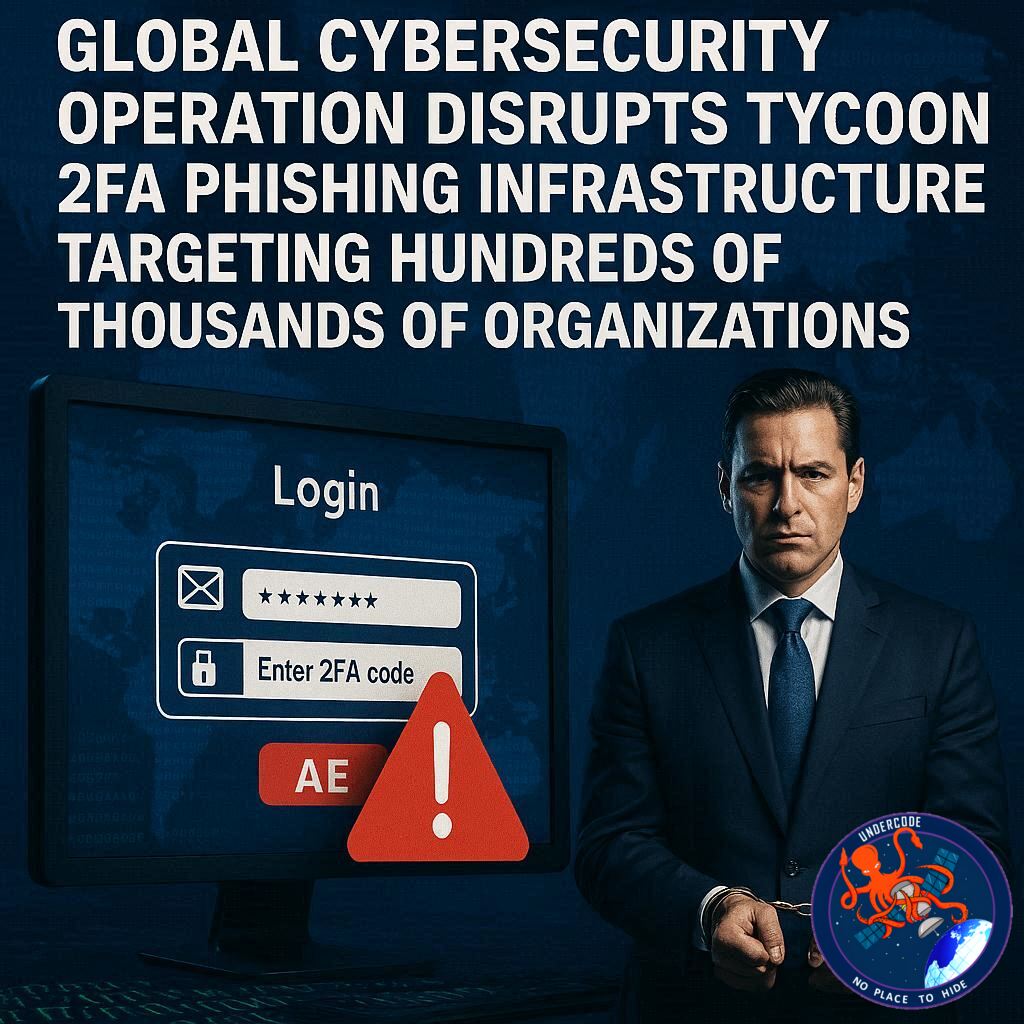
Phishing has evolved from scattered scam emails into a sophisticated cybercrime industry powered by automation, subscription services, and advanced evasion techniques. Among the most dangerous developments is phishing-as-a-service, a criminal business model that allows even inexperienced attackers to launch highly convincing phishing campaigns. One of the most notorious platforms operating under this model was Tycoon 2FA, a toolkit designed to bypass two-factor authentication and hijack accounts at massive scale. A coordinated global operation led by Microsoft, in collaboration with Europol and cybersecurity partners, has now dismantled key infrastructure used by this platform. The disruption represents one of the most significant recent victories against organized phishing operations that targeted hundreds of thousands of companies worldwide.
the Tycoon 2FA Operation and Global Impact
Tycoon 2FA operated as a large-scale phishing-as-a-service ecosystem that allowed cybercriminals to impersonate legitimate users and steal authentication credentials from popular online services. According to cybersecurity investigations, the platform was responsible for sending tens of millions of phishing emails every month, reaching more than 500,000 organizations globally. The scale of the operation was staggering. By mid-2025, security systems at Microsoft reported that Tycoon 2FA accounted for approximately 62 percent of all phishing attempts detected and blocked across its services. In one month alone, more than 30 million malicious emails linked to this infrastructure were identified and stopped.
Researchers from Resecurity managed to infiltrate and analyze the Tycoon 2FA ecosystem. Their findings revealed that thousands of cybercriminals were actively using the toolkit to compromise accounts tied to services such as Microsoft 365, Outlook, and Gmail. Once access was obtained, attackers could steal sensitive information, conduct financial fraud, or launch further attacks from compromised accounts. The platform used several advanced evasion techniques to maintain its operations and avoid detection. One notable method involved rotating phishing URLs through open redirect vulnerabilities found on legitimate third-party websites. This allowed attackers to constantly change malicious links while still appearing trustworthy to victims and automated security systems.
Another layer of protection came from the misuse of cloud infrastructure, particularly services provided by Cloudflare. By exploiting Cloudflare Workers and related technologies, Tycoon 2FA operators were able to shield malicious pages behind trusted network infrastructure, making it far more difficult for defenders to block phishing campaigns effectively.
The toolkit itself was actively maintained and continuously updated by its developer, who regularly released new versions to improve functionality and evade detection. Unlike traditional phishing kits that rely only on simple fake login pages, Tycoon 2FA combined multiple distribution techniques to maximize reach. Attack campaigns included PDF attachments containing malicious links, QR codes designed to redirect victims to credential-stealing pages, and automated infrastructure capable of launching phishing waves at industrial scale.
Despite extensive defensive measures implemented by technology companies and security providers, the platform still managed to compromise a large number of users. Investigations estimate that around 96,000 victims worldwide were affected by Tycoon 2FA campaigns since 2023. Among them were more than 55,000 customers connected to Microsoft services. These victims ranged from individual users to corporate employees whose compromised credentials could potentially expose entire organizations.
The coordinated takedown effort targeted the infrastructure that powered this ecosystem, including domains, hosting systems, and supporting services used to distribute phishing pages. By dismantling these components, investigators effectively shut down one of the most active pipelines for account takeover operations. The disruption is expected to significantly reduce phishing activity connected to the Tycoon 2FA network and prevent follow-on attacks such as data theft, ransomware infections, business email compromise schemes, and large-scale financial fraud operations.
What Undercode Say: The Industrial Business Model Behind Modern Phishing
The Transformation of Phishing into a Subscription Economy
The collapse of Tycoon 2FA highlights a fundamental shift in cybercrime economics. Phishing is no longer an activity conducted by individual hackers writing crude scripts. It has become a service industry where toolkits are rented, infrastructure is shared, and criminal developers continuously update their products. Platforms like Tycoon 2FA operate similarly to legitimate SaaS companies. They provide dashboards, automated campaign tools, customer support within criminal forums, and subscription pricing structures that allow attackers to scale operations quickly.
Why Two-Factor Authentication Became the Primary Target
For years, two-factor authentication was promoted as the strongest defense against stolen passwords. However, attackers have increasingly adapted to this security layer. Tycoon 2FA specialized in real-time credential interception techniques that capture both login credentials and authentication tokens during the login process. Once the attacker obtains these tokens, they can bypass authentication checks and enter the victim’s account as if they were the legitimate user. This method turns a powerful security control into a temporary barrier rather than a permanent protection mechanism.
Cloud Infrastructure as a Shield for Cybercrime
One of the most disturbing trends revealed by this case is the way legitimate cloud services are exploited to hide malicious activity. Infrastructure from companies like Cloudflare offers performance optimization, security protection, and global distribution networks. When cybercriminals route phishing traffic through these services, their malicious content becomes harder to trace and block. Security teams must distinguish between legitimate traffic and disguised attack traffic moving through trusted infrastructure.
Automation and Scale in Modern Phishing Campaigns
Traditional phishing attacks were limited by manual effort. Modern phishing platforms remove those limitations through automation. Attackers can generate thousands of phishing pages instantly, rotate links across multiple domains, and send millions of emails in a short period of time. The Tycoon 2FA infrastructure demonstrated how automation enables cybercriminals to operate on a scale comparable to legitimate marketing campaigns.
The Hidden Damage Beyond Stolen Credentials
The true impact of phishing rarely ends with a single compromised account. Once attackers gain access to email systems such as Outlook or Gmail, they often use those accounts to launch further attacks. Business email compromise scams, internal fraud attempts, and data exfiltration campaigns often originate from previously compromised mailboxes. This chain reaction means that one successful phishing attack can eventually compromise entire corporate networks.
Why Takedowns Only Provide Temporary Relief
Although dismantling the Tycoon 2FA infrastructure is a major victory, the broader phishing ecosystem remains highly resilient. Criminal developers frequently rebuild infrastructure using new domains, hosting providers, and encryption techniques. The code behind these platforms often circulates in underground communities, enabling new variants to appear quickly. For defenders, the challenge is not only to shut down current operations but also to disrupt the economic incentives that make phishing profitable.
The Growing Role of Global Cooperation in Cyber Defense
The operation led by Microsoft and Europol demonstrates the importance of international collaboration. Cybercrime networks operate across borders, making it difficult for any single organization or government to dismantle them alone. By combining threat intelligence, legal authority, and technical capabilities, joint operations can disrupt criminal infrastructure more effectively than isolated efforts.
Fact Checker Results
Tycoon 2FA was responsible for a massive portion of global phishing traffic detected by Microsoft. ✅
The platform used advanced evasion methods including URL rotation and cloud infrastructure abuse involving Cloudflare. ✅
Nearly 100,000 victims were linked to campaigns associated with the toolkit since 2023. ✅
Prediction
The takedown of Tycoon 2FA will temporarily reduce large-scale phishing campaigns, but new phishing-as-a-service platforms are likely to emerge quickly. 🔮
Future phishing kits will increasingly integrate AI-generated messages and automated infrastructure to improve realism and scalability. ⚠️
Global cybersecurity alliances between technology companies and law enforcement will become the primary strategy for dismantling organized phishing networks. 📊
🕵️📝✔️Let’s dive deep and fact‑check.
References:
Reported By: securityaffairs.com
Extra Source Hub (Possible Sources for article):
https://www.quora.com/topic/Technology
Wikipedia
OpenAi & Undercode AI
Image Source:
Unsplash
Undercode AI DI v2
Bing
🔐JOIN OUR CYBER WORLD [ CVE News • HackMonitor • UndercodeNews ]
📢 Follow UndercodeNews & Stay Tuned:
𝕏 formerly Twitter 🐦 | @ Threads | 🔗 Linkedin | 🦋BlueSky | 🐘Mastodon


