
Listen to this Post
🎯 Introduction: A Silent Storm in the Tech Market
The global PC hardware market is entering a turbulent phase, one that many consumers may not fully notice until it directly impacts their wallets. Behind the scenes, supply chain signals, manufacturer decisions, and regional pricing shifts are converging into a clear trend: rising costs across critical components. Solid-state drives, once steadily becoming more affordable, are now reversing course. At the same time, processors, the backbone of computing performance, are showing alarming price jumps in certain regions. What initially looks like isolated adjustments may actually point toward a broader industry reset.
🧩 SSD Price Surge Driven by Supply Chain Pressure
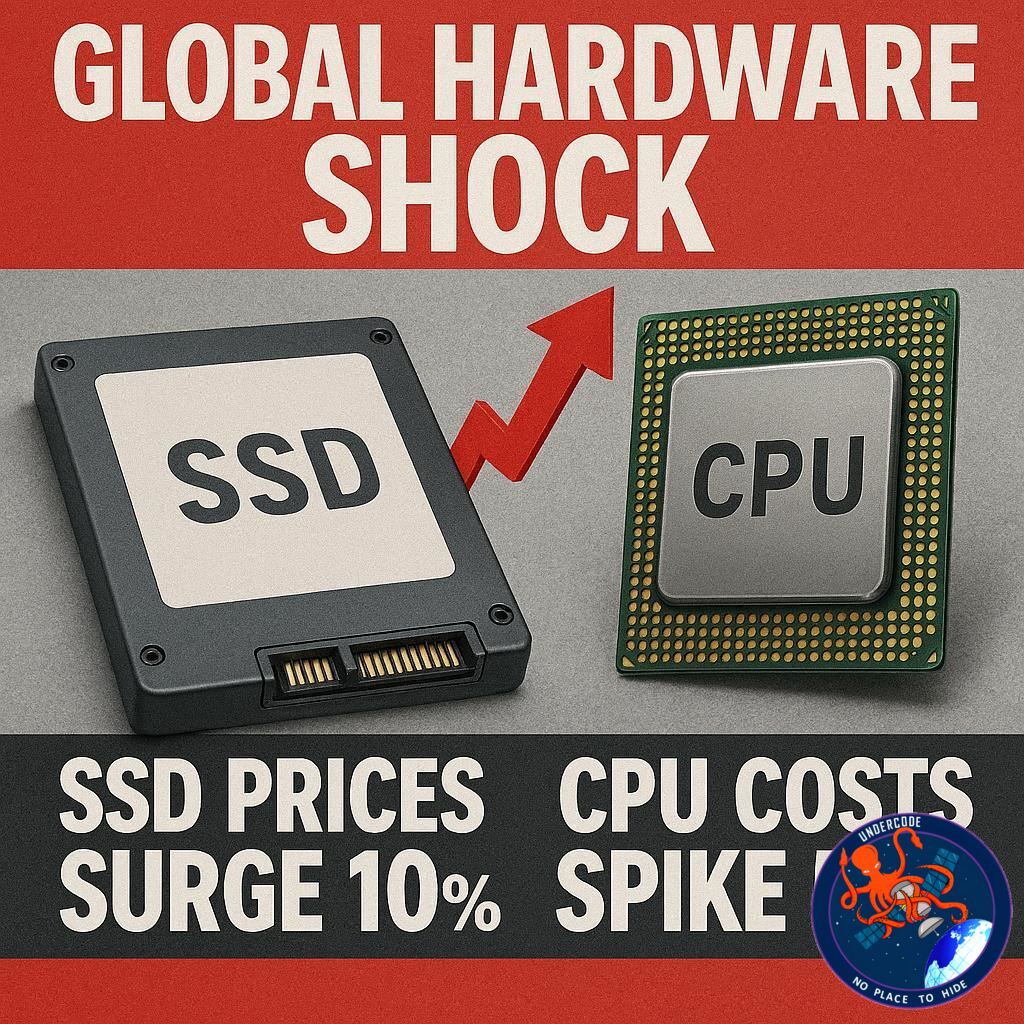
Recent reports indicate that major manufacturers like Samsung and Kingston have begun notifying distributors about an impending price increase of at least 10% for SSDs. These adjustments are not speculative rumors floating in retail markets, but rather signals originating directly from the supply chain. This makes them significantly more credible and impactful. The price changes are reportedly already taking effect, suggesting that consumers could start seeing higher retail prices almost immediately.
🧩 Stealth Price Hikes Already Impacting Premium SSDs
Even before this latest announcement, high-end SSD models from major brands had already experienced stealth price increases. In some cases, the cost of larger-capacity drives has effectively doubled. These changes were subtle, often not publicly announced, but clearly visible in retail pricing trends. This pattern reveals a gradual shift where manufacturers test the market’s tolerance before implementing broader increases.
🧩 CPU Prices Skyrocket in Japan’s Market
Alongside storage concerns, processor pricing is showing even more dramatic changes, particularly in Japan. AMD’s latest Ryzen processors, especially those based on the Zen 5 architecture, have experienced price hikes ranging from 40% to 50%. Some models stand out with even sharper increases. The Ryzen 7 9700X has surged by 57%, while the Ryzen 9 9900X has climbed by 37%.
🧩 Popular Gaming CPUs Not Spared from Inflation
The impact extends beyond flagship processors. Popular gaming CPUs such as the Ryzen 7 9800X3D have seen price increases of around 22%. These chips are widely used in high-performance gaming builds, meaning the effects are not limited to niche enthusiasts but extend to mainstream users. Even previous-generation CPUs like the Ryzen 7000 series are affected, with the 7800X3D experiencing a 41% increase.
🧩 A Broader Industry Trend Emerging
While these CPU price hikes are currently concentrated in Japan, they raise concerns about potential global ripple effects. Historically, regional price changes in tech hardware often spread due to shared supply chains and manufacturing dependencies. What begins as a localized adjustment can evolve into a worldwide pricing trend, especially when driven by underlying production costs.
🧩 NAND Flash Market Driving SSD Inflation
The rising cost of SSDs is closely tied to the NAND flash market. Analysts predict that NAND prices could increase by as much as 75% on a quarter-to-quarter basis. This is a substantial jump, reflecting supply constraints and strategic production cuts by manufacturers aiming to stabilize profits. Since NAND is the core component of SSDs, any fluctuation directly impacts final product pricing.
🧩 RAM Prices Following the Same Path
The situation is not isolated to SSDs alone. Memory markets are also under pressure, with projections suggesting RAM prices could rise by approximately 60%. This reinforces the idea that the entire memory ecosystem is undergoing a significant shift, likely driven by synchronized production strategies among major suppliers.
🧩 Consumers Face Increasing Upgrade Costs
For consumers, these changes translate into higher costs for upgrading or building PCs. Storage and processors are foundational components, meaning any increase in their prices has a cascading effect on total system costs. What was once considered an affordable upgrade cycle may now require more careful budgeting.
🧠 What Undercode Say:
The current wave of hardware price increases is not random, nor is it purely the result of temporary supply disruptions. It reflects a deeper recalibration within the semiconductor industry. For years, aggressive competition and oversupply pushed prices downward, benefiting consumers but squeezing manufacturer margins. Now, the balance is shifting back.
One critical factor is controlled production. Major memory manufacturers have learned from past cycles where overproduction led to severe price crashes. By limiting output, they can maintain higher price levels and avoid market saturation. This strategy is clearly visible in the NAND flash sector, where reduced supply is directly influencing SSD pricing.
Another layer involves geopolitical and economic pressures. Semiconductor production is heavily dependent on global logistics, raw materials, and stable trade relations. Any disruption, whether from policy changes or regional instability, can ripple through the supply chain. These pressures often manifest as gradual price increases rather than sudden spikes, making them harder for consumers to anticipate.
The CPU market adds a different dimension. Unlike memory, processor pricing is influenced not only by manufacturing costs but also by competitive positioning. When a company releases a new architecture, it often tests pricing elasticity. The steep increases seen in Japan could be an early experiment to gauge consumer tolerance, especially in a market known for early adoption and high demand for cutting-edge technology.
There is also a psychological aspect at play. Once consumers begin to expect rising prices, they may accelerate purchasing decisions, which in turn sustains higher demand and justifies further increases. This feedback loop can stabilize elevated price levels over longer periods.
Another overlooked factor is the shift toward high-performance computing. As applications demand more power, both SSDs and CPUs are becoming more advanced, and therefore more expensive to produce. Features like higher NAND layer counts or advanced CPU architectures significantly increase production complexity. These innovations are not cheap, and manufacturers are increasingly passing those costs onto consumers.
Retail dynamics also contribute to the situation. Distributors and retailers often adjust prices based on anticipated supply constraints rather than actual shortages. This creates a speculative pricing environment where costs rise preemptively. Once higher prices are established, they rarely return to previous levels quickly.
Furthermore, the gaming and content creation industries continue to drive demand for high-end hardware. This sustained demand provides manufacturers with confidence that the market can absorb higher prices without significant drops in sales volume.
From a strategic standpoint, this period may mark the end of ultra-cheap storage and relatively stable CPU pricing. Instead, the industry could enter a phase where prices fluctuate more aggressively based on supply control and technological transitions.
The most concerning aspect is the synchronization across multiple components. When SSDs, RAM, and CPUs all increase in price simultaneously, it creates a compounded effect that significantly raises the barrier to entry for new PC builds. This could slow down upgrade cycles and impact the broader PC market.
However, history suggests that such cycles are temporary. The semiconductor industry is highly cyclical, and periods of high pricing are often followed by corrections once supply catches up or demand stabilizes. The key question is not whether prices will fall again, but how long this elevated phase will last.
🔍 Fact Checker Results
✅ SSD manufacturers have reportedly confirmed at least a 10% price increase through supply chain sources.
✅ CPU price hikes of up to 57% have been observed in Japan, particularly for newer Ryzen models.
❌ No global confirmation yet that these CPU increases will spread worldwide at the same scale.
📊 Prediction
📈 Hardware prices will continue rising through the next two quarters as supply constraints persist.
⚠️ Consumers may delay upgrades, leading to a temporary slowdown in PC sales.
🔄 A market correction is likely within 12–18 months as production stabilizes and competition intensifies.
🕵️📝✔️Let’s dive deep and fact‑check.
References:
Reported By: www.techradar.com
Extra Source Hub (Possible Sources for article):
https://www.reddit.com/r/AskReddit
Wikipedia
OpenAi & Undercode AI
Image Source:
Unsplash
Undercode AI DI v2
Bing
🔐JOIN OUR CYBER WORLD [ CVE News • HackMonitor • UndercodeNews ]
📢 Follow UndercodeNews & Stay Tuned:
𝕏 formerly Twitter 🐦 | @ Threads | 🔗 Linkedin | 🦋BlueSky | 🐘Mastodon


