
Listen to this Post
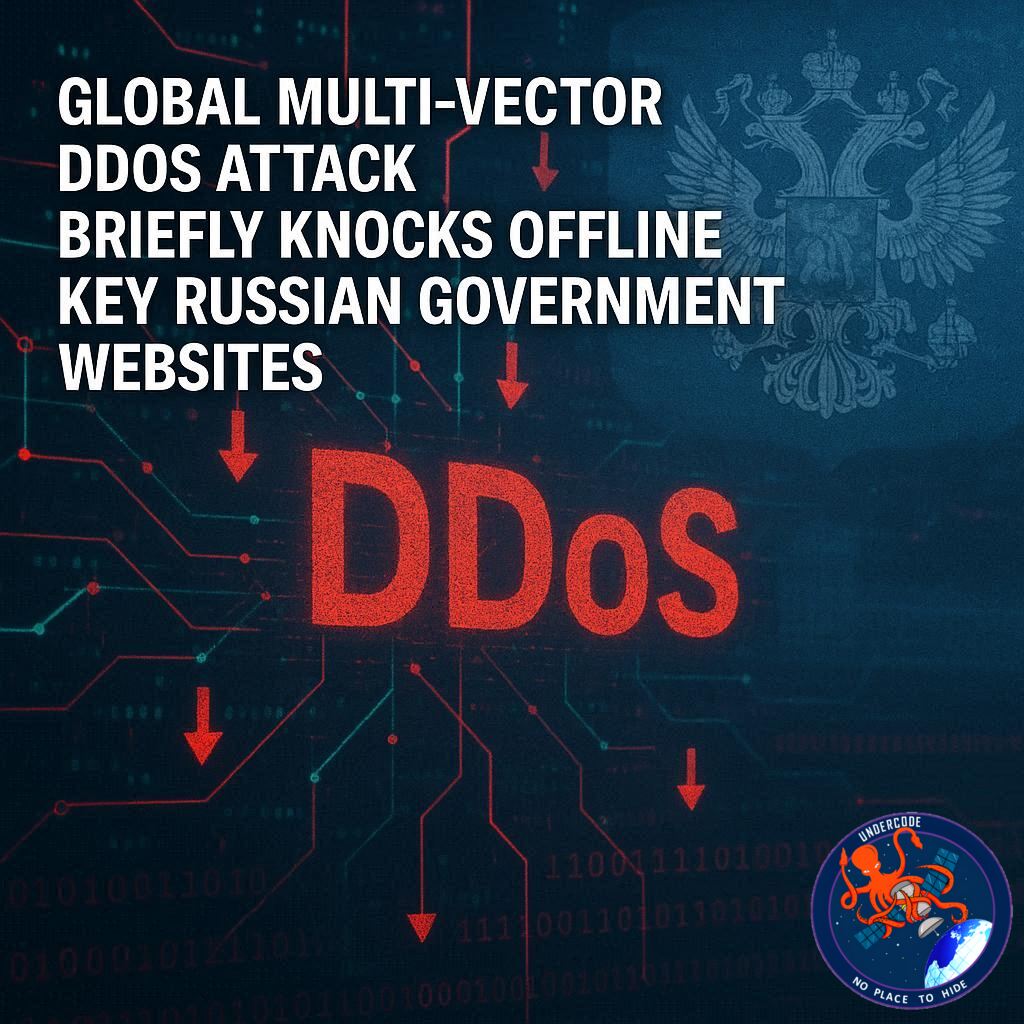
Introduction: A Short Disruption With Long Shadows
A sudden and coordinated cyberattack briefly disrupted several high-profile Russian government websites, reminding the world how fragile even state-level digital infrastructure can be. While the outage lasted only a short time, the technical details behind the incident—and the silence around responsibility—have fueled intense discussion across the cybersecurity community.
the Original Report
A post shared by the account Cybersecurity News Everyday reported a multi-vector Distributed Denial-of-Service (DDoS) attack that temporarily disrupted the websites of Roskomnadzor, Russia’s Defense Ministry of Russia, and GRFC.
According to the report, the attack leveraged infrastructure spread across multiple countries, including Russia, the United States, China, the United Kingdom, and the Netherlands. This geographically distributed setup suggests a deliberately complex operation designed to overwhelm defenses through multiple traffic vectors simultaneously.
At the time of reporting, no hacking group or actor had claimed responsibility, leaving attribution unclear. The disruption was described as brief, and services were reportedly restored without any official confirmation of data loss or internal system compromise.
The information was sourced from hendryadrian.com and circulated on X (formerly Twitter) on March 2, 2026, gaining attention within cybersecurity monitoring circles but limited public visibility.
Overall, the original report focused on three key points:
The targets—high-level Russian regulatory and defense bodies.
The method—a multi-vector DDoS attack using globally distributed servers.
The unknown attribution—no public claim or official explanation beyond service disruption.
What Undercode Say:
The significance of this incident lies less in the downtime and more in what it reveals about modern cyber conflict. A multi-vector DDoS attack is not a casual act; it requires coordination, resources, and testing. This alone suggests either a well-organized hacktivist collective or a state-adjacent actor probing defenses without crossing into overt cyberwarfare.
The choice of targets is also telling. Roskomnadzor controls media, censorship, and internet regulation in Russia—symbolically powerful but not militarily critical. Pairing it with the Defense Ministry and GRFC creates a layered message: disrupt governance, military visibility, and communications oversight simultaneously, even if only briefly.
The global distribution of attacker servers is another key detail. Modern DDoS campaigns frequently rely on botnets or rented infrastructure, but spanning both geopolitical rivals and neutral states complicates attribution and retaliation. It also highlights how national borders mean little in packet-level warfare.
Notably, the lack of a responsibility claim may be intentional. Silence can be strategic—allowing attackers to test response times, mitigation capabilities, and inter-agency coordination without escalating political consequences. In today’s threat landscape, reconnaissance-through-disruption is increasingly common.
This event also reinforces a broader trend: DDoS attacks are no longer just noise-making tools. When executed at scale and against symbolic targets, they function as signals—warnings, probes, or psychological operations aimed at public trust and institutional confidence.
Finally, the restrained public response suggests that Russian authorities either contained the issue quickly or chose not to amplify it. Both scenarios point to a cybersecurity environment where minor incidents are absorbed quietly, while larger confrontations remain unseen until they cross a critical threshold.
Fact Checker Results
✅ The reported organizations did experience temporary service disruptions, consistent with DDoS behavior.
✅ Multi-vector DDoS attacks commonly use globally distributed infrastructure, aligning with the report.
❌ No independent confirmation exists regarding who operated the attacking servers, leaving attribution unverified.
Prediction
Short-term, similar low-duration, high-visibility DDoS attacks are likely to continue against government and regulatory websites, especially during periods of geopolitical tension. Long-term, states will increasingly treat these incidents not as isolated cybercrimes, but as early-warning signals in the evolving landscape of digital confrontation.
🕵️📝✔️Let’s dive deep and fact‑check.
References:
Reported By: x.com
Extra Source Hub (Possible Sources for article):
https://www.linkedin.com
Wikipedia
OpenAi & Undercode AI
Image Source:
Unsplash
Undercode AI DI v2
Bing
🔐JOIN OUR CYBER WORLD [ CVE News • HackMonitor • UndercodeNews ]
📢 Follow UndercodeNews & Stay Tuned:
𝕏 formerly Twitter 🐦 | @ Threads | 🔗 Linkedin | 🦋BlueSky | 🐘Mastodon


