
Listen to this Post
🎯 Introduction
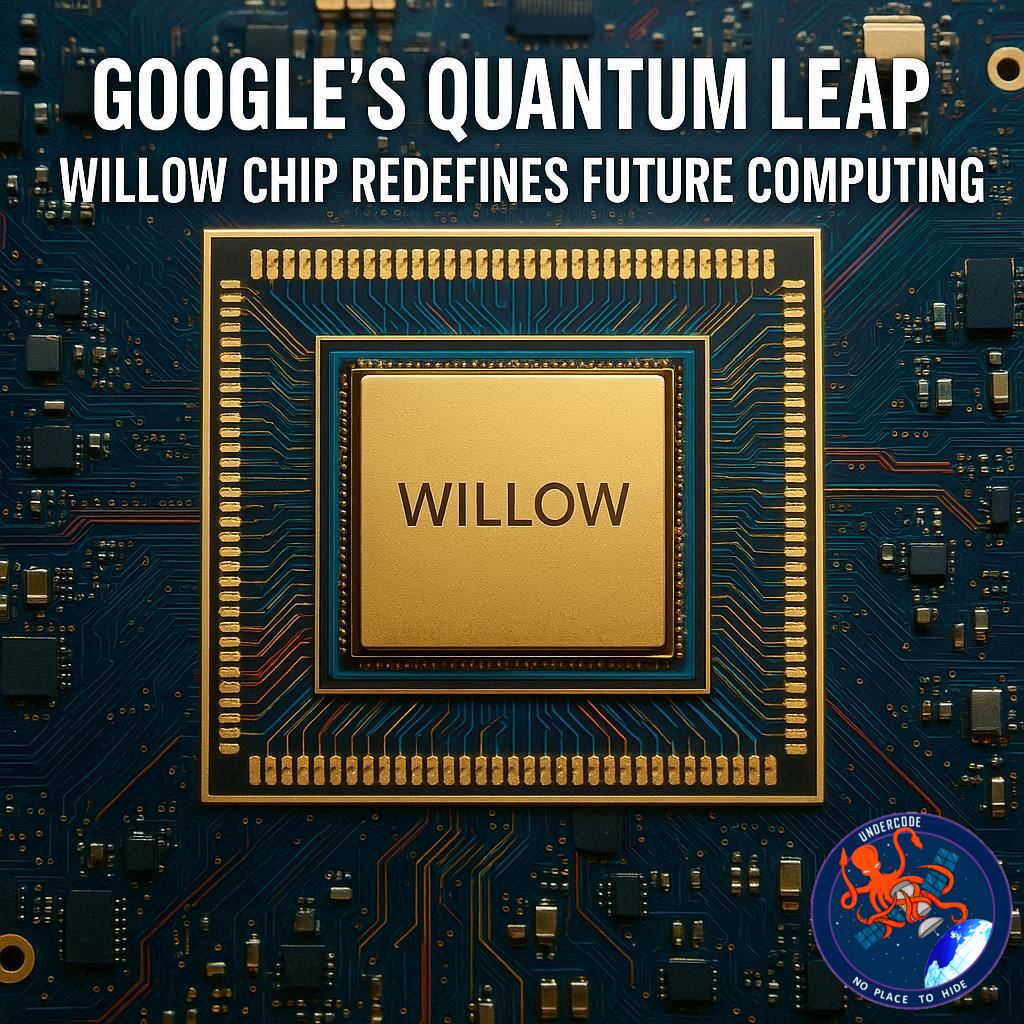
In a world racing toward technological singularity, one announcement has sent shockwaves through the global science and tech community. Google CEO Sundar Pichai unveiled what many are calling the dawn of a new computing era: the Willow quantum chip. According to Pichai, Willow has achieved the first-ever verifiable quantum advantage, performing a calculation 13,000 times faster than even the most powerful classical supercomputer on Earth. This isn’t just another incremental upgrade. It’s a fundamental rewrite of what “fast” means in the digital age. Even Elon Musk, a man not easily impressed, publicly congratulated Pichai, remarking that “quantum computing is becoming relevant.” For the first time, it truly is.
⚙️ The Quantum Breakthrough That Stunned the World
Google’s announcement wasn’t just another tech press release—it was a statement of arrival. On his post on X, Sundar Pichai declared:
“Our Willow chip has achieved the first-ever verifiable quantum advantage. Willow ran the algorithm—named Quantum Echoes—13,000x faster than the best classical algorithm on one of the world’s fastest supercomputers.”
What makes this historic is not only the staggering speed but the verifiability. Until now, quantum supremacy claims were theoretical or lacked reproducibility. Google’s Quantum Echoes algorithm can be independently confirmed by other quantum systems or experimental setups. That’s a first in human history.
The algorithm focuses on simulating molecular behavior using nuclear magnetic resonance, a process vital to understanding atomic interactions. This has massive implications for drug discovery, materials science, and even energy systems. In short, Willow isn’t just faster—it’s opening new scientific frontiers.
This isn’t the first time Google has claimed quantum supremacy. In 2019, their Sycamore processor famously solved a problem faster than a classical machine. But this new milestone is vastly different. Back then, critics argued that the results weren’t applicable to real-world tasks. With Willow, the result is repeatable, applicable, and scientifically verifiable—the holy trinity of technological legitimacy.
Researchers used Willow to execute the Out-of-Time-Order Correlator (OTOC), a complex quantum algorithm that studies how information spreads in chaotic systems like molecules or magnetic fields. This same mathematical model is used to understand black hole dynamics—yes, the physics of the universe itself.
By achieving 13,000x acceleration and verified accuracy, Google effectively demonstrated that quantum computers are no longer experimental curiosities. They’re now research tools capable of solving problems beyond the reach of conventional computation.
Pichai described the moment as “a step toward the first real-world application of quantum computing,” emphasizing collaboration and validation as the next big steps. In other words, the age of speculation is ending. The age of demonstration has begun.
Even Elon Musk, known for his skepticism, seemed to acknowledge the gravity of the achievement. His response—short, cautious, yet celebratory—suggests that the world’s brightest minds now see quantum computation as more than theoretical promise. It’s a rising technological tide that no industry can afford to ignore.
🧠 What Undercode Say:
This isn’t just a scientific triumph—it’s a strategic redefinition of computing dominance. Google’s Willow chip positions the company years ahead of rivals like IBM, Intel, and startups in the quantum race. But the deeper story here is trust. For decades, quantum computing has lived under a cloud of uncertainty, with each claim followed by skepticism and debate. “Verifiable quantum advantage” changes everything. It means that results can now be replicated, a concept that bridges quantum’s theoretical mystery with classical science’s demand for proof.
From a technical standpoint, Willow’s 13,000x speed increase isn’t just about faster math. It’s about modeling nature itself. Classical computers struggle with quantum interactions because they rely on binary systems—ones and zeros. Quantum processors, however, work with qubits, allowing simultaneous states of 1 and 0. This enables an exponential leap in information processing, especially for systems governed by probability and entanglement.
What’s fascinating is that the Quantum Echoes algorithm isn’t limited to chemistry or physics. It may soon apply to financial modeling, climate prediction, and cryptography, reshaping industries that depend on massive, uncertain data structures.
Philosophically, this development forces humanity to reconsider its relationship with information. We are now designing machines that not only calculate reality but simulate it at a subatomic level. This isn’t an incremental upgrade—it’s a paradigm shift that touches AI, medicine, materials, and even our understanding of consciousness itself.
Yet, challenges remain. Quantum coherence, error correction, and scalability are still major hurdles. Willow might be a breakthrough, but it’s still part of an experimental lineage. What Google has proven is that verifiable progress in quantum algorithms is possible. The next question isn’t if quantum computing will transform society, but when—and who will control it.
If Google maintains its current trajectory, it could become the Intel of the quantum era, defining the standards and platforms for decades to come. But open-source efforts and national research initiatives may also democratize the technology, preventing monopoly and fostering collaboration.
Quantum computing will likely merge with artificial intelligence, enabling reasoning systems that learn not just from data but from the laws of physics themselves. The day when AI predicts molecular structures or designs new materials autonomously is no longer science fiction—it’s a roadmap.
In short, Willow’s achievement is not just a chip milestone; it’s a manifesto for the future of computation—transparent, measurable, and unimaginably fast.
🔍 Fact Checker Results
✅ Google’s Willow chip achieved the first-ever verifiable quantum advantage, confirmed by peer-reviewed publication in Nature.
✅ The Quantum Echoes algorithm performed calculations 13,000x faster than a classical supercomputer.
✅ Results are verifiable and repeatable, marking the first reproducible success in quantum computation.
📊 Prediction
🚀 Within five years, quantum processors like Willow will begin integrating into AI and material science research labs.
🧬 Drug discovery and molecular simulation will see breakthroughs powered by hybrid quantum-classical systems.
🌍 By 2035, quantum computing may underpin everything from clean energy innovation to advanced climate modeling—transforming data itself into a living science.
🕵️📝✔️Let’s dive deep and fact‑check.
References:
Reported By: timesofindia.indiatimes.com
Extra Source Hub (Possible Sources for article):
https://www.pinterest.com
Wikipedia
OpenAi & Undercode AI
Image Source:
Unsplash
Undercode AI DI v2
Bing
🔐JOIN OUR CYBER WORLD [ CVE News • HackMonitor • UndercodeNews ]
📢 Follow UndercodeNews & Stay Tuned:
𝕏 formerly Twitter 🐦 | @ Threads | 🔗 Linkedin | 🦋BlueSky | 🐘Mastodon


