
Listen to this Post
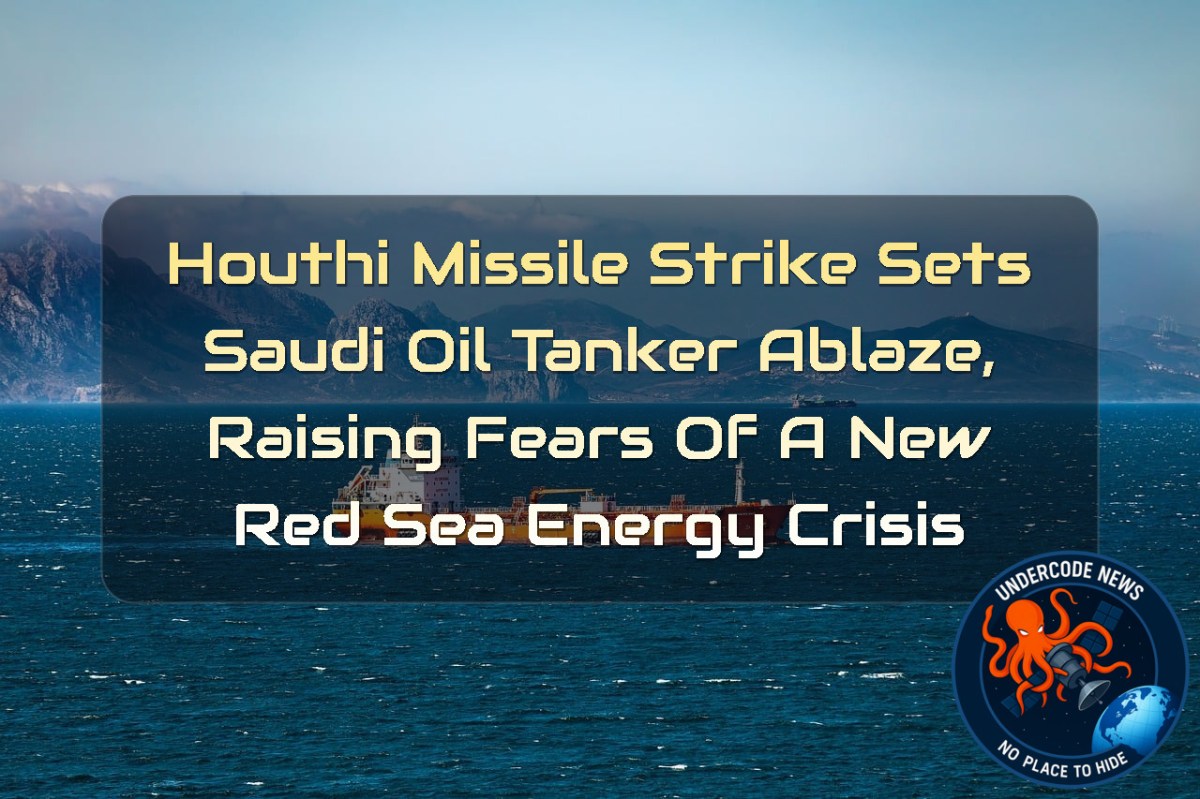 A Burning Tanker and a Dangerous Message Across the Red Sea
A tanker burning in the Red Sea is more than a maritime incident. It is a warning that the conflict surrounding Yemen, Saudi Arabia and Iran may be entering a far more dangerous phase.
According to the information provided, a missile struck a tanker approximately 63 nautical miles west of Yanbu, Saudi Arabia, causing a fire aboard the vessel. The incident comes as Yemen’s Houthi movement, also known as Ansar Allah, intensifies its campaign against Saudi maritime activity and attempts to enforce what it describes as a blockade against the kingdom.
The attack carries consequences far beyond the damaged vessel. Saudi Arabia remains one of the world’s most important oil exporters, and the Red Sea is a major route connecting Middle Eastern energy supplies with global markets. Any sustained campaign against tankers could threaten shipping routes, raise insurance costs, disrupt crude exports and deepen an already volatile regional conflict.
The fire may eventually be extinguished. The strategic consequences, however, could continue spreading.
The Missile Strike Near Yanbu
The Houthi movement said its forces launched a ballistic missile that struck a Saudi oil tanker in the Red Sea. According to the group’s statement, the strike was direct and accurate, resulting in a fire aboard the vessel.
The group also claimed that other ships in the surrounding area moved away after the attack, illustrating the psychological impact that missile and drone threats can have on commercial shipping even when only one vessel is physically damaged.
British maritime authorities separately reported that a tanker had been struck by an unidentified projectile, causing a fire on its main deck. The crew was reported safe and accounted for, while no immediate environmental impact was reported.
The reported location, roughly 63 nautical miles west of Yanbu, is strategically significant. Yanbu is one of Saudi Arabia’s most important industrial and energy hubs on the Red Sea coast. It supports major petroleum infrastructure and provides Saudi Arabia with an export route that does not depend entirely on the Persian Gulf.
An attack in these waters therefore sends a message that the conflict is capable of reaching deeper into Saudi Arabia’s western maritime environment.
A Blockade That Threatens More Than One Country
The Houthis said the attack formed part of their decision to prohibit maritime navigation connected to Saudi Arabia.
A blockade at sea does not need to physically stop every ship to cause serious economic damage. Commercial shipping depends heavily on predictability. When ship operators believe that a route carries an increased risk of missiles, drones or maritime attacks, they may alter their routes, delay voyages or demand significantly higher insurance coverage.
This creates what can be described as an economic pressure campaign.
Even a limited number of successful attacks can affect hundreds of vessels because every shipping company must evaluate whether the next vessel could become the next target.
For Saudi Arabia, the danger is particularly serious because its economy remains deeply connected to energy exports. The kingdom has invested heavily in infrastructure designed to move crude oil toward international markets. A sustained threat against tankers or export facilities could create pressure not only on Saudi operations but also on global oil markets.
The battlefield, in other words, is expanding into the supply chain.
Bab el-Mandeb Remains One of the
The Bab el-Mandeb strait connects the southern Red Sea with the Gulf of Aden and the wider Indian Ocean. It is one of the world’s most strategically important maritime chokepoints.
Large volumes of commercial goods, energy products and container traffic pass through the region. Any major disruption can force ships to consider longer alternative routes around Africa’s Cape of Good Hope.
That diversion can add significant time, fuel consumption and operational costs.
The Houthis previously demonstrated that attacks on commercial shipping could create disruption far beyond Yemen. Their campaign against vessels they associated with Israel-linked interests transformed the Red Sea into a high-risk environment and forced major shipping companies to reassess their routes.
The current confrontation with Saudi Arabia could create a new version of that crisis.
Instead of focusing primarily on ships connected to Israel, the threat now has the potential to directly target Saudi maritime interests and the infrastructure supporting one of the world’s largest oil-exporting economies.
Saudi
Saudi Arabia produces and exports millions of barrels of crude oil, making uninterrupted transportation critically important.
The
This matters because the Middle East depends on several narrow maritime passages.
The Strait of Hormuz is a critical gateway for energy exports from the Persian Gulf.
Bab el-Mandeb connects the Red Sea with the Gulf of Aden.
The Suez Canal provides a further link toward European and Mediterranean markets.
Pressure on one chokepoint can create problems. Pressure on several chokepoints at the same time can create a much larger global economic challenge.
The reported attack near Yanbu therefore represents more than an isolated military event. It highlights the vulnerability of maritime energy infrastructure during a period of escalating regional tensions.
The Conflict Between the Houthis and Saudi Arabia Is Heating Up Again
The latest confrontation follows a broader deterioration in relations between the Houthis and Saudi Arabia.
According to the original report, hostilities intensified after an Iranian aircraft was welcomed in Sana’a, Yemen’s capital, leading to a new cycle of attacks and retaliation.
The Houthis subsequently targeted Saudi-linked maritime assets and continued attacks against forces aligned with Yemen’s internationally recognised government.
Saudi Arabia responded with air strikes against Houthi military positions and infrastructure, including targets in Hodeidah, Yemen’s major Red Sea port.
This cycle is dangerous because both sides possess the ability to increase pressure.
The Houthis have repeatedly demonstrated their ability to launch missiles and drones over significant distances.
Saudi Arabia possesses advanced air power and can conduct strikes against military and logistical infrastructure.
Neither side needs to defeat the other outright to create serious instability.
The conflict can continue through repeated attacks designed to impose economic, military and political costs.
Why Yanbu Matters Strategically
Yanbu is not simply another Saudi coastal city.
It plays an important role in Saudi
From a strategic perspective, infrastructure on Saudi
That flexibility becomes increasingly important whenever the Persian Gulf or the Strait of Hormuz faces military threats.
If attacks begin threatening Red Sea export routes as well, Saudi Arabia could face pressure on multiple sides of its energy transportation network.
This is one reason the reported tanker strike deserves close attention.
A successful attack does not need to destroy an entire export terminal to create disruption. Repeated strikes can cause companies to change procedures, insurers to raise premiums and authorities to allocate more military resources to maritime protection.
The cost of insecurity can become an objective in itself.
The Maritime Battlefield Is Becoming a Strategic Economic Weapon
Modern maritime conflict is increasingly focused on economics.
A missile striking a vessel creates immediate physical damage, but the larger consequences can involve insurance, logistics, energy prices, trade schedules and military deployments.
For the Houthis, targeting maritime traffic provides a way to project influence beyond Yemen’s borders.
A relatively inexpensive missile or drone can force expensive naval deployments and create uncertainty across international shipping networks.
This is a form of asymmetric pressure.
The attacking force does not necessarily need a large conventional navy.
Instead, it can combine ballistic missiles, cruise missiles, drones, intelligence and geographic positioning to threaten ships operating hundreds of kilometres away.
The Red Sea has become one of the clearest examples of this changing model of warfare.
The Risk of Environmental Damage Cannot Be Ignored
Although the crew was reported safe and no immediate environmental impact was identified, an attack involving an oil tanker always creates the possibility of a wider environmental emergency.
A major fire aboard a tanker can spread rapidly.
Damage to cargo systems can create the risk of leaks.
Fuel, chemicals and debris can threaten surrounding waters.
The Red Sea is also an environmentally sensitive region with important marine ecosystems.
A large spill would transform a military confrontation into a long-term ecological crisis.
This means maritime security operations must focus not only on preventing attacks but also on preparing emergency response capabilities.
Protecting a tanker after it has been struck can become as important as preventing the strike itself.
Saudi Arabia Responds With a Multinational Maritime Strategy
Saudi Arabia has attempted to strengthen collective maritime protection through a new multinational defence initiative.
According to the original report, Riyadh announced a maritime defence coalition involving 14 countries, including Pakistan, Turkey and Egypt.
The objective is clear.
No single country can easily monitor and defend every shipping lane across the Red Sea and surrounding waters.
A multinational coalition can potentially combine naval vessels, surveillance systems, intelligence sharing and emergency response capabilities.
However, coalition building does not automatically eliminate the threat.
Missiles and drones can be launched quickly.
Commercial vessels remain spread across large maritime areas.
Attackers can adapt their tactics.
The real test for any coalition will be whether it can establish a security system capable of detecting threats early enough to protect civilian and commercial shipping.
Yemen’s Long War Continues to Shape Regional Security
Yemen has already suffered through more than a decade of devastating conflict.
The Houthis seized
Years of fighting followed.
The conflict drew in regional powers and transformed Yemen into one of the most complicated battlefields in the Middle East.
A truce reached in 2022 temporarily reduced large-scale fighting.
However, the renewed escalation described in the original report demonstrates how fragile such arrangements can be.
The Yemen conflict cannot be viewed only as an internal political struggle.
Its geographic location gives events inside Yemen direct relevance to global trade and regional security.
The
Iran’s Regional Network Adds Another Layer of Complexity
The Houthis are widely associated with
This network has been described as the Axis of Resistance and includes organisations and militias operating across several countries.
The relationship between Tehran and these groups is strategically important because regional conflicts can become interconnected.
An escalation in one country can affect military calculations somewhere else.
Maritime threats in the Red Sea can influence energy markets.
Tensions around Hormuz can affect oil exports.
Conflict involving Israel, Lebanon, Iraq or Gaza can create additional pressure across the region.
This interconnected environment makes de-escalation more difficult.
Every military response must consider the possibility that another actor could react.
The danger is not always a single massive war beginning overnight.
Sometimes escalation develops through dozens of smaller incidents until the entire region is operating under permanent crisis conditions.
What Undercode Say:
The Tanker Strike Shows How Cheap Weapons Can Threaten Expensive Global Systems
The reported missile strike demonstrates the strategic imbalance between the cost of an attack and the cost of defending global shipping.
A missile can be dramatically cheaper than the naval assets deployed to detect and intercept it.
A single successful strike can influence the decisions of dozens of shipping companies.
The attacker does not need to sink every vessel.
Creating uncertainty may be enough.
Commercial shipping is highly dependent on risk calculations.
When risk increases, insurance prices increase.
When insurance increases, transportation costs increase.
Those costs can eventually reach consumers.
This makes maritime attacks a form of economic warfare.
The Red Sea is especially vulnerable because ships must travel through predictable geographic corridors.
Predictability helps trade.
But it can also help attackers identify where targets are likely to travel.
The attack near Yanbu also highlights Saudi
The kingdom cannot rely on a single maritime direction forever.
Its eastern energy routes face the strategic importance of Hormuz.
Its western routes now face increasing pressure in the Red Sea.
If both regions remain unstable, Saudi Arabia must invest heavily in protection, redundancy and rapid response capabilities.
The Houthi strategy appears designed to create pressure disproportionate to the size of the attacking force.
That strategy has already changed how international shipping companies evaluate the Red Sea.
The next stage could involve attempts to create similar pressure specifically against Saudi energy transportation.
This would raise the stakes significantly.
Oil markets react strongly to perceived threats against supply routes.
Actual production does not always need to stop for prices to become volatile.
The possibility of disruption can itself influence markets.
Another important issue is coalition coordination.
A 14-country maritime initiative may provide additional capabilities.
However, multinational security operations require constant intelligence sharing.
A threat detected by one country must be communicated rapidly.
Delays of minutes can matter during a missile attack.
The coalition will also need to distinguish commercial traffic from potential military threats.
False alarms can disrupt shipping.
Missed threats can result in disaster.
The technological side of the conflict will become increasingly important.
Satellite intelligence, radar, drones and electronic surveillance can help detect launch activity.
Missile defence systems may provide another layer of protection.
But attackers can adapt.
They can change launch locations.
They can combine drones with missiles.
They can attempt saturation attacks.
They can exploit gaps in radar coverage.
This means there is no permanent technical solution.
Security will require constant adaptation.
The most important question is whether the conflict remains limited to maritime pressure.
If oil terminals, pipelines or major industrial facilities become regular targets, the regional economic consequences could become significantly more severe.
The Yanbu incident should therefore be treated as a strategic warning.
The Red Sea is no longer only a shipping route.
It is becoming an active military environment where energy security, global trade and regional geopolitics increasingly intersect.
The Psychological Impact May Be as Important as the Physical Damage
The visible fire aboard a tanker creates an image that can influence markets and political decision-making.
Shipping executives do not need to wait for dozens of vessels to be destroyed before changing their routes.
A single incident can trigger emergency reviews.
Crew members may become reluctant to enter high-risk waters.
Insurance providers may reassess premiums.
Governments may deploy additional military forces.
The strategic value of an attack can therefore extend far beyond the vessel itself.
This is why protecting shipping lanes requires more than intercepting missiles.
Governments must also restore confidence.
If commercial operators believe that protection is unreliable, traffic may continue avoiding the region even after the immediate military threat decreases.
Confidence, once lost, can take months or years to rebuild.
Deep Analysis
Monitoring Maritime and Security Data Can Help Detect Escalation Patterns
Security researchers and analysts monitoring regional escalation can use publicly available maritime, network and news data to identify changes in shipping behaviour.
For example, Linux tools can help collect, filter and organise relevant information:
curl -I https://example.com
The command above can be used to inspect HTTP response headers from a legitimate public information source.
dig example.com
This command can be used to examine DNS information when investigating the infrastructure of publicly accessible maritime or security services.
whois example.com
WHOIS queries can provide registration information when analysts are examining publicly documented infrastructure.
grep -i "Red Sea" maritime_reports.txt
This command can filter collected text reports for references to the Red Sea.
grep -Ei "missile|tanker|Yanbu|Bab el-Mandeb" maritime_reports.txt
This can help analysts identify repeated references to important events and locations.
sort maritime_events.txt | uniq -c
This command can identify recurring entries inside a locally collected dataset.
awk '{print $1, $2, $3}' maritime_events.txt
This can extract selected fields from structured event logs.
journalctl --since "24 hours ago"
Security teams can use this command on authorised systems to review recent system logs.
The technical lesson is that geopolitical analysis increasingly depends on data collection and correlation.
However, analysts should avoid relying on a single social media account, anonymous channel or unverified claim.
Cross-checking maritime agencies, government statements, satellite information and credible reporting is essential.
In a conflict environment, misinformation can spread as quickly as a missile alert.
The strongest analysis is therefore based on corroboration.
✅ The provided report consistently identifies a tanker fire near Yanbu and states that the crew was safe, while the exact projectile attribution should be distinguished between official reporting and the Houthi statement.
✅ Bab el-Mandeb is a strategically important maritime chokepoint, and disruption in the region can affect international shipping, energy transportation and insurance costs.
❌ Some broader geopolitical claims in fast-moving conflict reporting require independent verification before being treated as established facts, especially claims about new blockades, negotiations, coalition membership and direct operational coordination between different armed groups.
Prediction
(-1) The most likely negative scenario is continued pressure on Red Sea shipping if missile attacks and retaliatory strikes continue.
Commercial vessels could face higher insurance costs and longer routes around high-risk waters.
Saudi Arabia may increase naval protection and expand intelligence cooperation with international partners.
Further attacks against energy-related targets could create greater volatility in global oil and shipping markets.
A positive outcome remains possible if stronger maritime coordination, diplomatic pressure and renewed negotiations reduce the incentive for continued escalation.
Improved early-warning systems and coordinated naval surveillance could reduce the probability of successful attacks against commercial vessels.
Any durable de-escalation in Yemen could also reduce pressure on one of the world’s most strategically important maritime corridors.
▶️ Related Video (74% Match):
🕵️📝Let’s dive deep and fact‑check.
🎓 Live Courses & Certifications:
Join Undercode Academy for Verified Certifications
🚀 Request a Custom Project:
Secure, high-velocity infrastructure and disruptive technological engineering. Contact our engineering team for high-tier development and proprietary systems:
[email protected]
💎 Smart Architecture | 🛡️ Secure by Design | ⭐ Trusted by Thousands
References:
Reported By: www.euronews.com
Extra Source Hub (Possible Sources for article):
https://www.reddit.com
Wikipedia
OpenAi & Undercode AI
Image Source:
Unsplash
Undercode AI DI v2
🔐JOIN OUR CYBER WORLD [ CVE News • HackMonitor • UndercodeNews ]
📢 Follow UndercodeNews & Stay Tuned:
𝕏 formerly Twitter 🐦 | @ Threads | 🔗 Linkedin | 🦋BlueSky | 🐘Mastodon | 📺Youtube


