
Listen to this Post
Introduction: The Shift Toward Localized AI Power
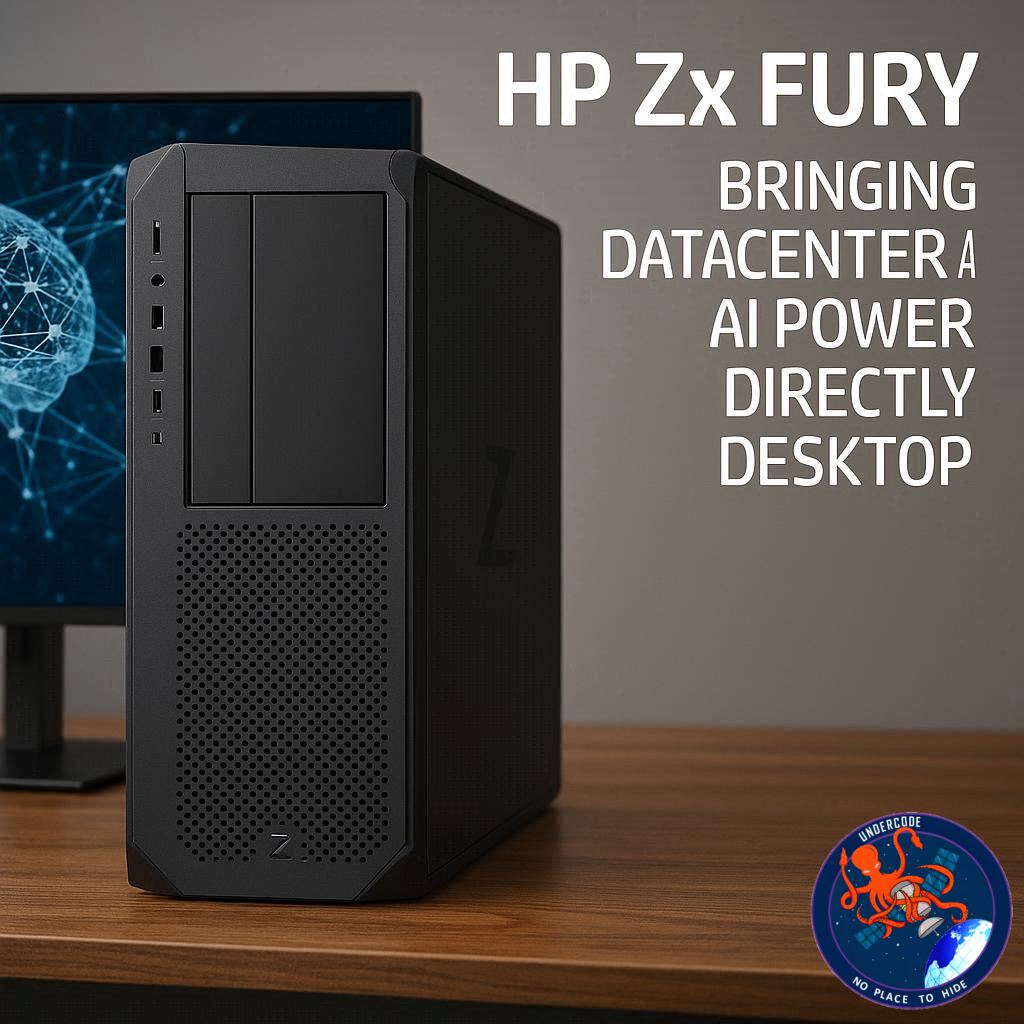
Artificial intelligence is no longer confined to massive cloud infrastructures or hyperscale data centers. As businesses accelerate AI adoption, a new challenge emerges: how to balance performance, cost, privacy, and latency without over-relying on cloud environments. The growing demand for real-time inference, coupled with the explosion of agent-driven AI systems, is pushing organizations to rethink where and how AI workloads should run. HP’s latest innovation, the ZGX Fury, enters this evolving landscape as a bold attempt to redefine AI computing by delivering data-center-level performance directly to a deskside machine.
Summary: HP ZGX Fury and the Evolution of On-Prem AI Infrastructure
HP introduces the ZGX Fury as a powerful solution designed to meet the rising demand for localized AI computation. As AI inference increasingly shifts closer to where data is generated, driven by latency sensitivity, privacy concerns, and cost efficiency, organizations are facing limitations with traditional cloud-based workflows. While cloud infrastructure remains critical for scaling operations, the surge in token usage driven by agentic AI systems has created unpredictable cost structures and performance bottlenecks.
The ZGX Fury addresses this challenge by offering a system capable of delivering production-grade AI performance without requiring a full-scale data center. Powered by the NVIDIA GB300 Grace Blackwell Ultra Desktop Superchip, the system features an impressive 748GB of unified memory, enabling it to handle inference workloads involving trillion-parameter models. This level of capability allows teams to fine-tune models exceeding 100 billion parameters directly on a local machine, eliminating the need for complex infrastructure or specialized cooling systems.
One of the most significant advantages of the ZGX Fury is its ability to unify development and production workflows. Teams can build, test, and deploy AI models on the same system, avoiding costly transitions between local environments and cloud platforms. This results in lower latency, more predictable operational costs, and improved control over sensitive data.
Customer feedback highlights several key industry needs that the ZGX Fury aims to fulfill. Enterprises are moving beyond experimental AI projects and require reliable on-prem inference solutions that comply with strict governance and security standards. Many organizations seek data-center-level performance without the operational burden of maintaining large-scale infrastructure. Additionally, there is a growing demand for data sovereignty, as companies aim to avoid vendor lock-in and maintain full ownership of their data pipelines.
The ZGX Fury also addresses IT management concerns by offering a more sustainable upgrade path, reducing the need for frequent and disruptive hardware refresh cycles. Its design allows organizations to equip high-performance users with cutting-edge AI capabilities while maintaining operational stability.
From a technical perspective, the system enables simultaneous inference workloads for large teams, depending on model size, while maintaining low latency. The integration of NVIDIA’s GB300 architecture ensures that even the most demanding AI models can run locally. Complementing the hardware is the HP ZGX Toolkit, an open-source software suite that simplifies deployment and removes licensing barriers, enabling rapid setup and flexibility.
Security and privacy are further enhanced through hardware-level protections and isolated data pipelines, allowing organizations to maintain strict compliance standards. The system also integrates with NVIDIA OpenShell, an open-source runtime that governs how autonomous agents operate. This ensures that AI agents run within secure, sandboxed environments, providing developers with greater control and safety.
HP is also collaborating on NVIDIA NemoClaw, an open-source framework designed to simplify the deployment of always-on AI assistants. This integration reflects a broader shift toward agentic AI systems that can operate continuously and autonomously, further increasing the demand for efficient and scalable local inference solutions.
The ZGX Fury represents a convergence of advanced hardware and intelligent software, delivering a complete on-prem AI platform. HP positions this system as a future-ready solution, with plans to support upcoming GPU technologies that have not yet been released. This forward-compatible approach allows organizations to extend the lifespan of their systems and adapt to future advancements without major infrastructure overhauls.
What Undercode Say: The Strategic Importance of Desktop-Scale AI Infrastructure
The release of the ZGX Fury signals a deeper transformation in how AI infrastructure is conceptualized and deployed. For years, the industry narrative has centered around cloud dominance, promoting scalability and accessibility as the ultimate solution. However, the reality on the ground is far more complex. Latency-sensitive applications, regulatory constraints, and escalating operational costs are exposing the limitations of cloud-first strategies.
What HP is effectively doing here is challenging the assumption that high-performance AI must live in remote data centers. By compressing data-center capabilities into a deskside system, HP is enabling a decentralized model of AI computation. This is not just a hardware innovation, it is a shift in architectural philosophy.
The inclusion of 748GB of coherent memory is particularly notable. Memory bandwidth and capacity have become critical bottlenecks in modern AI workloads, especially for large language models and agent-based systems. By addressing this constraint directly, the ZGX Fury positions itself as more than just a powerful workstation, it becomes a platform for sustained AI operations.
Another key insight lies in the growing importance of agentic AI. These systems are not static models; they are dynamic, continuously running entities that consume vast amounts of tokens. Even as token pricing declines, total consumption is increasing at a rate that offsets cost reductions. This creates a paradox where AI becomes cheaper per unit but more expensive overall. Local inference, therefore, becomes a strategic necessity rather than a convenience.
The emphasis on software freedom and open-source tooling also reflects a broader industry push against vendor lock-in. Organizations are becoming increasingly cautious about dependencies that limit flexibility or inflate long-term costs. By offering an open ecosystem, HP is aligning itself with enterprise demands for transparency and control.
From an operational standpoint, the ability to unify development and production on a single machine could significantly streamline workflows. Traditionally, AI teams face friction when transitioning models from local experimentation to cloud deployment. This fragmentation introduces inefficiencies, delays, and potential inconsistencies. Eliminating this gap could accelerate innovation cycles and reduce operational complexity.
However, the ZGX Fury also raises important questions. While it reduces reliance on cloud infrastructure, it does not eliminate the need for it entirely. Hybrid models will likely dominate, where organizations balance local and cloud resources based on workload requirements. The challenge will be determining the optimal distribution of tasks between these environments.
Another consideration is accessibility. Systems with such advanced capabilities may come at a premium cost, potentially limiting adoption to larger enterprises or specialized teams. The long-term success of this approach will depend on how effectively HP can scale and democratize access to this level of performance.
Ultimately, the ZGX Fury represents a strategic bet on the future of AI infrastructure. It acknowledges that the next phase of AI growth will not be driven solely by larger models, but by smarter deployment strategies. Bringing compute closer to data, reducing latency, and ensuring data sovereignty are no longer optional, they are becoming foundational requirements.
Fact Checker Results
✅ The ZGX Fury is designed to deliver data-center-level AI performance at the desktop level.
✅ NVIDIA GB300 architecture supports extremely large AI models, including trillion-parameter inference.
❌ Local AI systems cannot fully replace cloud infrastructure in all large-scale scenarios.
Prediction
📊 Hybrid AI infrastructure will become the dominant model, blending local and cloud compute for efficiency.
📊 Demand for on-prem AI systems will surge as enterprises prioritize data control and cost predictability.
📊 Agentic AI growth will significantly increase the need for high-performance local inference systems.
▶️ Related Video (84% Match):
🕵️📝✔️Let’s dive deep and fact‑check.
References:
Reported By: www.hp.com
Extra Source Hub (Possible Sources for article):
https://www.reddit.com/r/AskReddit
Wikipedia
OpenAi & Undercode AI
Image Source:
Unsplash
Undercode AI DI v2
Bing
🔐JOIN OUR CYBER WORLD [ CVE News • HackMonitor • UndercodeNews ]
📢 Follow UndercodeNews & Stay Tuned:
𝕏 formerly Twitter 🐦 | @ Threads | 🔗 Linkedin | 🦋BlueSky | 🐘Mastodon


