
Listen to this Post
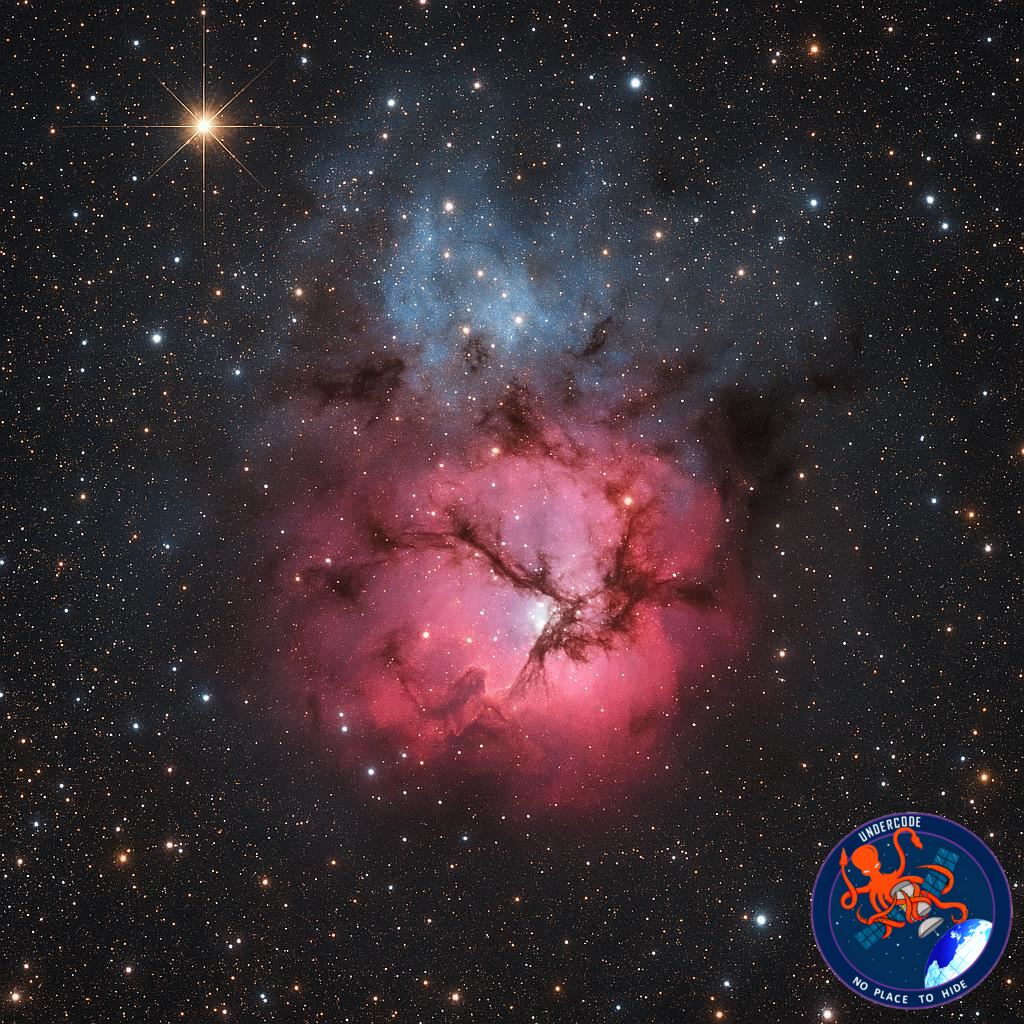
Introduction: A Cosmic Scene That Feels Alive
There are moments in astronomy when an image does more than inform. It captivates. The latest close-up of the Trifid Nebula, captured by NASA’s Hubble Space Telescope, is one of those rare glimpses into the universe that feels almost alive. With swirling colors resembling ocean sediments and shapes that mimic marine creatures, this star-forming region reminds us that space is not silent or static. It evolves, shifts, and tells stories over time.
This new observation, released to celebrate Hubble’s 36th anniversary, is not just visually stunning. It is scientifically powerful. It reveals how stars are born, how they interact with their surroundings, and how even vast cosmic structures can change within a human lifetime.
Summary of the Original
The Trifid Nebula, located about 5,000 light-years from Earth, is a well-known region of active star formation. In this recent observation, Hubble zooms into a specific area shaped by the influence of massive stars over hundreds of thousands of years. Although these stars are not directly visible in the image, their powerful stellar winds have carved out a massive bubble in the surrounding gas and dust. This process compresses material and triggers new waves of star formation.
Hubble had previously observed this nebula in 1997, and by comparing past and present data, scientists can now detect changes over time. This is particularly important because it allows researchers to study cosmic evolution on timescales that humans can actually observe. The telescope’s upgraded instruments, especially those installed during Servicing Mission 4, provide enhanced sensitivity and a wider field of view, making these comparisons more detailed than ever before.
A central feature in this image is a structure nicknamed the “Cosmic Sea Lemon” due to its resemblance to a sea slug. This formation consists of dense gas and dust, with a “head” and flowing “body.” Within it, a young protostar is actively ejecting jets of plasma, known as Herbig-Haro 399. These jets extend outward over time, and by tracking their movement, scientists can measure their speed and energy output.
Additional features include a counter-jet visible as jagged streaks and another young star embedded in a darker horn-shaped region. Evidence suggests that intense ultraviolet radiation from nearby massive stars is eroding material around these protostars, influencing their formation process.
Elsewhere in the image, a small pillar of gas and dust remains partially intact despite being stripped away by stellar winds. Bright streaks and shifting lines indicate further activity from other forming stars hidden within the nebula.
Color variations across the image reveal different physical processes. Blue regions indicate ionized gas caused by ultraviolet radiation, while darker areas mark dense dust clouds where new stars are still forming. Bright orange points represent fully formed stars that have cleared their surroundings.
The article also highlights Hubble’s remarkable longevity and scientific contributions. Over its 36-year lifetime, the telescope has conducted more than 1.7 million observations and contributed to tens of thousands of scientific publications. Its data continues to be widely used and publicly accessible.
Looking ahead, astronomers are combining Hubble’s observations with those from newer telescopes like the James Webb Space Telescope. Future missions, such as the Nancy Grace Roman Space Telescope and the proposed Habitable Worlds Observatory, promise even greater discoveries, including the search for Earth-like planets and signs of life beyond our solar system.
What Undercode Say: The Real Meaning Behind This Observation
A Rare Look at Change in Real Time
What makes this observation truly fascinating is not just its beauty, but its timing. Astronomy often deals with events that unfold over millions or billions of years. Yet here, we are witnessing measurable changes within just a few decades. That is incredibly rare. It suggests that certain regions of space are far more dynamic than we once believed.
Stellar Feedback Is More Violent Than It Appears
The shaping of the nebula by unseen massive stars highlights a key concept in astrophysics called stellar feedback. These stars are not passive light sources. They actively reshape their environment through radiation and stellar winds. The compression of gas that leads to new star formation is essentially a cosmic chain reaction, where one generation of stars gives birth to another.
The “Sea Lemon” Is More Than a Visual Metaphor
The so-called Cosmic Sea Lemon is not just a poetic description. It reflects how human perception helps us interpret complex structures. By comparing it to a familiar marine creature, scientists and communicators make the data more relatable. But beneath that imagery lies a turbulent region filled with jets, radiation, and collapsing material.
Protostars Reveal the Mechanics of Star Birth
The jets observed in Herbig-Haro objects are critical clues. They show how young stars regulate their growth. Instead of simply accumulating mass, protostars eject part of their material back into space. This process prevents them from growing too quickly and helps stabilize their formation. It is a delicate balance between gravity and energy release.
Radiation Is Both Creator and Destroyer
One of the most striking insights is how ultraviolet radiation plays a dual role. It destroys gas and dust by stripping electrons, yet it also contributes to shaping new star-forming regions. This paradox is common in space. The same forces that tear structures apart can also trigger their creation.
The Importance of Long-Term Observation
Hubble’s ability to revisit the same region after nearly three decades is a reminder of the importance of long-term missions. Many discoveries in astronomy do not come from a single observation, but from comparing data across time. Without this continuity, we would miss subtle but crucial changes.
Collaboration Between Telescopes Is the Future
The combination of Hubble with newer instruments like the James Webb Space Telescope signals a shift in how astronomy operates. Instead of relying on a single flagship observatory, scientists now integrate data from multiple sources. Each telescope observes different wavelengths, providing a more complete picture of the universe.
The Next Generation Will Go Even Further
Future missions such as the Nancy Grace Roman Space Telescope and the Habitable Worlds Observatory will expand our capabilities dramatically. The ability to capture wider fields and higher resolution images will not only deepen our understanding of nebulae but also bring us closer to answering one of humanity’s biggest questions: Are we alone?
Data Accessibility Is Driving Discovery
Another understated but powerful aspect is the public availability of Hubble’s data. Thousands of astronomers worldwide can analyze this information, leading to discoveries that the original mission team may never have anticipated. This democratization of science accelerates progress in ways that were not possible decades ago.
Fact Checker Results
✅ The Trifid Nebula is approximately 5,000 light-years away and is an active star-forming region.
✅ Hubble has been operational for over 36 years with more than 1.7 million observations recorded.
✅ Combining Hubble and newer telescopes like James Webb is an active and ongoing scientific strategy.
Prediction
🔭 Future observations will reveal even faster changes in star-forming regions as imaging technology improves.
🌌 Multi-telescope collaboration will become the standard approach in astrophysics research.
🪐 The next generation of space telescopes will likely identify strong candidates for habitable Earth-like planets.
🕵️📝✔️Let’s dive deep and fact‑check.
References:
Reported By: science.nasa.gov
Extra Source Hub (Possible Sources for article):
https://www.quora.com/topic/Technology
Wikipedia
OpenAi & Undercode AI
Image Source:
Unsplash
Undercode AI DI v2
Bing
🔐JOIN OUR CYBER WORLD [ CVE News • HackMonitor • UndercodeNews ]
📢 Follow UndercodeNews & Stay Tuned:
𝕏 formerly Twitter 🐦 | @ Threads | 🔗 Linkedin | 🦋BlueSky | 🐘Mastodon


