
Listen to this Post
 A Coordinated Cybercrime Offensive Signals a New Era in African Digital Enforcement
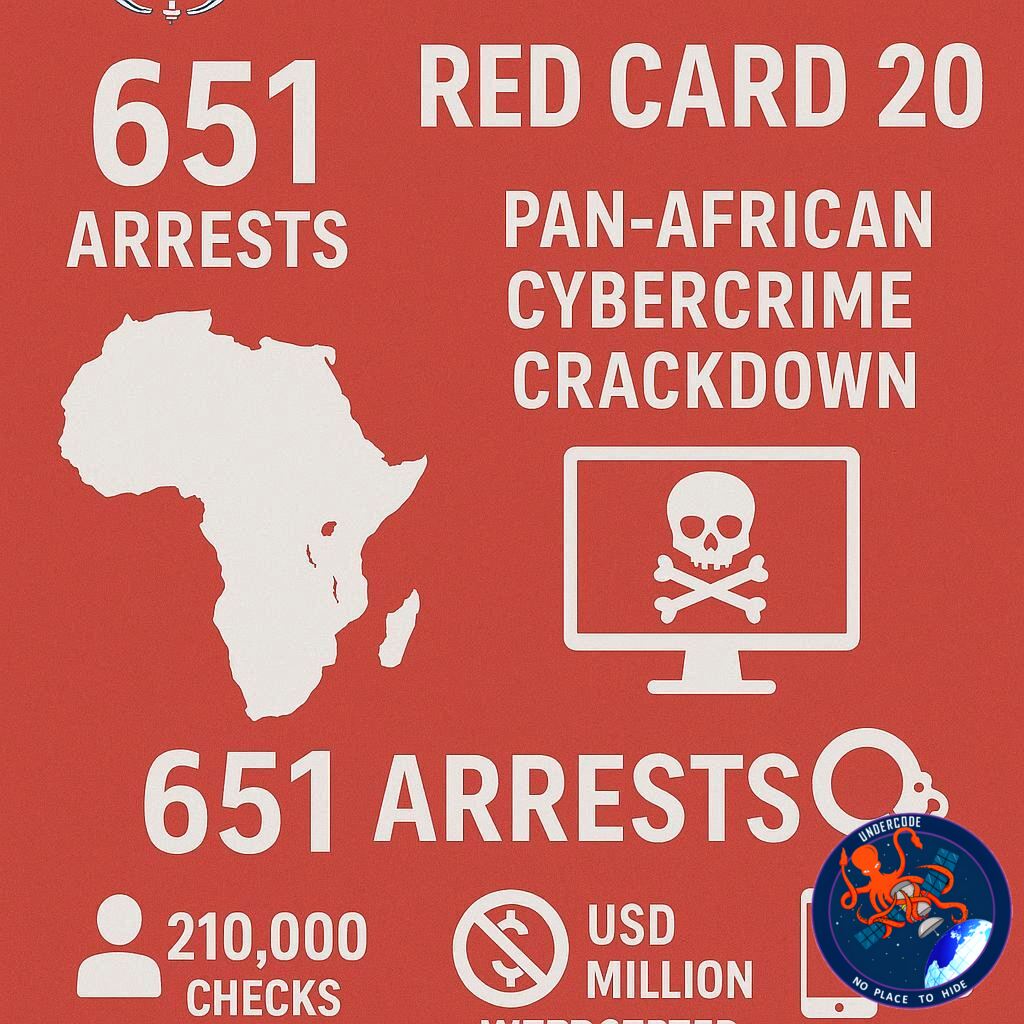
Cybercrime has evolved into a borderless industry, exploiting regulatory gaps, digital illiteracy, and economic vulnerability. In response to this growing threat, the International Criminal Police Organization, known globally as INTERPOL, launched Operation Red Card 2.0, a sweeping multinational enforcement action that has sent a clear message to online scam syndicates operating across Africa and beyond. Conducted between 8 December 2025 and 30 January 2026, the operation united law enforcement agencies from 16 African nations under a shared objective: dismantle the infrastructure powering high-yield investment scams, mobile money fraud, and predatory loan applications. The results were substantial, 651 arrests, over 4.3 million USD in illicit funds seized, and a sprawling digital scam ecosystem disrupted at scale.
Multinational Cyber Enforcement Under AFJOC Framework
Operation Red Card 2.0 was executed under the African Joint Operation against Cybercrime, a regional enforcement framework funded by the United Kingdom’s Foreign, Commonwealth and Development Office. Additional strategic support came from the EU–Council of Europe’s GLACY-e initiative, strengthening investigative capacity and digital forensics capabilities. This institutional backing transformed what could have been fragmented national investigations into a synchronized strike against transnational cybercriminal enterprises.
The operation did not merely target low-level actors. It focused on dismantling the infrastructure that sustains digital fraud economies, including servers, malicious domains, phishing networks, and communication channels used to lure victims worldwide.
651 Arrests and Millions Recovered from Scam Networks
Authorities confirmed that 651 individuals were arrested in connection with organized online scam networks. Investigators uncovered criminal schemes responsible for more than 45 million USD in global losses, affecting at least 1,247 victims across multiple continents. In addition to arrests, law enforcement seized 2,341 digital devices and dismantled 1,442 malicious IP addresses, domains, and servers that formed the operational backbone of these networks.
The 4.3 million USD recovered represents only a fraction of total losses, yet it demonstrates the increasing ability of coordinated law enforcement to trace digital money flows, freeze accounts, and disrupt laundering channels. For victims, this recovery signals hope. For scammers, it marks rising operational risk.
Nigeria’s Investment Fraud Ring and Telecom Breach
In Nigeria, authorities dismantled a large-scale investment fraud ring that relied heavily on phishing campaigns and fabricated cryptocurrency platforms. The syndicate maintained more than 1,000 fraudulent social media accounts to lure investors with promises of extraordinary returns. Law enforcement raided the group’s operational hub, seizing equipment and shutting down its digital footprint.
In a separate investigation, Nigerian authorities arrested six hackers who breached a telecommunications provider. These individuals exploited system vulnerabilities to steal and resell airtime, effectively monetizing digital infrastructure weaknesses. The arrests highlight how cybercrime in the region extends beyond consumer fraud into direct attacks on critical service providers.
Kenya’s Messaging App Investment Scam Crackdown
Kenyan authorities arrested 27 suspects tied to fraudulent investment schemes promoted through messaging platforms. These scams used social engineering tactics, fake testimonials, and manipulated financial dashboards to build credibility. Victims were persuaded to transfer funds under the illusion of guaranteed profits, only to see communication channels disappear once payments were made.
This case illustrates how messaging applications have become a primary vector for financial deception, offering anonymity and encrypted channels that complicate investigations.
Côte d’Ivoire Targets Abusive Mobile Loan Apps
In Côte d’Ivoire, 58 individuals were detained for operating abusive mobile loan applications. These apps often targeted financially vulnerable individuals, offering small, rapid loans while harvesting personal data. When repayment deadlines passed, operators resorted to harassment, public shaming, and data misuse to extort additional funds.
Such schemes blur the line between fintech innovation and digital exploitation, underscoring the regulatory vacuum that scammers exploit in emerging financial markets.
Infrastructure Seizures Disrupt Global Scam Operations
Beyond arrests, Operation Red Card 2.0 struck at the digital infrastructure enabling these crimes. The dismantling of 1,442 malicious IPs, domains, and servers significantly disrupted communication channels and financial pipelines used by scam networks. With INTERPOL providing forensic intelligence and coordination across borders, authorities were able to map digital footprints that would have otherwise remained fragmented across jurisdictions.
This level of technical cooperation reflects a maturation in global cyber enforcement, shifting from reactive arrest models to proactive infrastructure takedowns.
Psychological and Financial Impact of Organized Cybercrime
Neal Jetton, Director of INTERPOL’s Cybercrime Directorate, emphasized that organized cybercriminal syndicates inflict both financial devastation and psychological trauma. High-yield investment scams often drain life savings. Fraudulent loan apps weaponize personal data. Telecom breaches undermine trust in essential services.
The broader societal cost extends beyond monetary losses. It erodes digital confidence, discourages fintech adoption, and damages the credibility of legitimate online platforms operating in emerging markets.
The Strategic Importance of International Collaboration
Operation Red Card 2.0 reinforces a crucial reality: cybercrime is transnational, and enforcement must be equally borderless. No single country can dismantle scam ecosystems that span servers in one jurisdiction, victims in another, and financial flows routed through offshore intermediaries.
The operation demonstrates how intelligence sharing, forensic support, and synchronized enforcement actions can compress the operational space for cybercriminal groups. It also reflects increasing political will across African nations to address digital fraud as a serious economic threat rather than a peripheral issue.
What Undercode Say:
A Structural Shift in African Cyber Policing
Operation Red Card 2.0 represents more than a tactical sweep. It signals a structural shift in how African nations approach cybercrime enforcement. Historically, cyber fraud in parts of the continent has been treated as a localized issue, often sensationalized but insufficiently coordinated. This operation breaks that pattern by embedding regional cooperation within a global intelligence framework.
The arrest of 651 suspects is operationally impressive, yet the real significance lies in the infrastructure disruption. By targeting 1,442 malicious IPs and servers, authorities attacked scalability. Scam networks thrive on digital redundancy. When infrastructure collapses, rebuilding requires time, resources, and risk exposure.
Economic Pressure as a Deterrence Mechanism
Recovering 4.3 million USD may seem modest compared to the 45 million USD in estimated losses. Still, financial seizures create friction in cybercriminal supply chains. Scammers depend on liquidity for recruitment, advertising, bot networks, and money laundering. Asset freezing undermines that cycle.
Moreover, publicized seizures alter risk calculations. Cybercrime often flourishes where enforcement visibility is low. High-profile operations change perception. They signal that digital anonymity no longer guarantees impunity.
Investment Scams Reflect Global Economic Anxiety
The prominence of high-yield investment scams in this operation reflects broader macroeconomic conditions. In periods of economic uncertainty, individuals search aggressively for alternative income streams. Fraudsters exploit this vulnerability by offering unrealistic returns tied to cryptocurrency narratives or algorithmic trading myths.
The Nigerian case involving over 1,000 fake social media accounts illustrates how psychological manipulation and algorithmic amplification intersect. Fraud today is not random spam. It is targeted digital marketing engineered for deception.
Telecom Breaches Highlight Critical Infrastructure Risks
The arrest of hackers who breached a telecom provider is strategically important. Telecommunications networks underpin digital banking, mobile money, and authentication systems. When cybercriminals penetrate such infrastructure, the threat shifts from consumer fraud to systemic risk.
This case suggests that future operations may increasingly prioritize infrastructure resilience, not just financial scam rings.
Mobile Loan Abuse and Data Exploitation
The Côte d’Ivoire arrests reveal another evolving threat vector: exploitative fintech models. Fraudulent loan apps harvest contact lists, photos, and personal identifiers. They weaponize this data for intimidation and extortion.
This trend demonstrates that cybercrime in Africa is not merely about phishing emails. It is about data extraction economies operating through seemingly legitimate mobile applications.
Global Partnerships Define Future Cyber Enforcement
The involvement of the UK Foreign Office and the EU–Council of Europe GLACY-e initiative reflects geopolitical recognition that cybercrime in Africa has global consequences. Victims are worldwide. Financial systems are interconnected. Digital threats ripple across borders.
Future operations will likely depend on even deeper integration of private cybersecurity firms, telecom providers, fintech companies, and regulatory bodies.
Long-Term Impact on Digital Trust
If sustained, operations like Red Card 2.0 could rebuild digital trust in emerging markets. Trust is the currency of digital transformation. Without it, fintech growth slows, foreign investment hesitates, and innovation stagnates.
The success of this operation therefore extends beyond arrests. It influences investor confidence, regulatory reform, and cross-border digital cooperation.
Fact Checker Results
✅ 651 arrests and 4.3 million USD in recovered funds were officially reported by INTERPOL.
✅ The operation ran from 8 December 2025 to 30 January 2026 under the AFJOC framework.
❌ The 4.3 million USD recovered does not represent total scam losses, which exceeded 45 million USD globally.
Prediction
📊 Increased multinational cyber operations across Africa are likely in 2026 as governments invest in digital forensics and cross-border intelligence sharing.
📊 Scam networks may shift toward decentralized infrastructure and encrypted communication platforms to evade similar crackdowns.
📊 Regulatory tightening around mobile loan apps and crypto investment promotions is expected to accelerate in response to the exposed fraud models.
▶️ Related Video (84% Match):
🕵️📝✔️Let’s dive deep and fact‑check.
References:
Reported By: securityaffairs.com
Extra Source Hub (Possible Sources for article):
https://www.digitaltrends.com
Wikipedia
OpenAi & Undercode AI
Image Source:
Unsplash
Undercode AI DI v2
Bing
🔐JOIN OUR CYBER WORLD [ CVE News • HackMonitor • UndercodeNews ]
📢 Follow UndercodeNews & Stay Tuned:
𝕏 formerly Twitter 🐦 | @ Threads | 🔗 Linkedin | 🦋BlueSky | 🐘Mastodon


