
Listen to this Post
Introduction
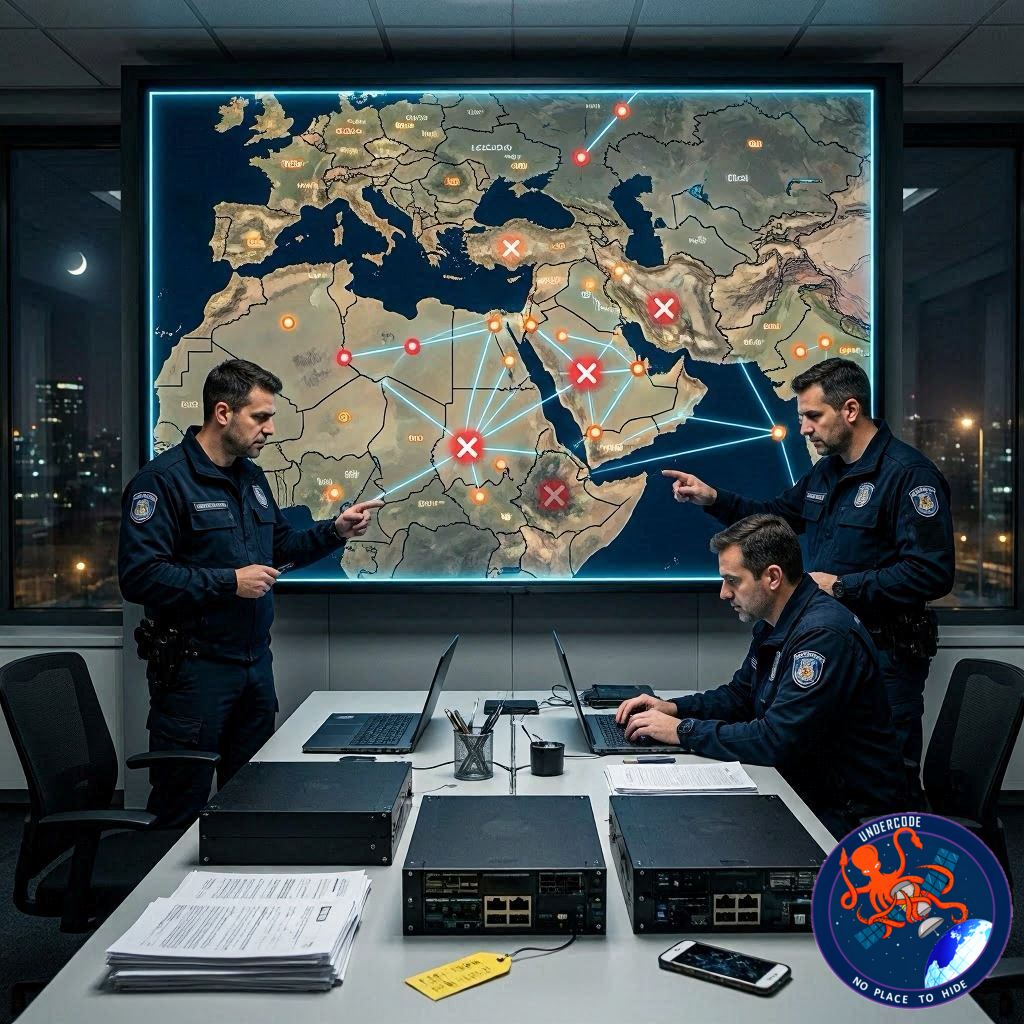
Cybercrime operations are becoming increasingly global, organized, and financially devastating. From phishing scams and malware distribution to fake investment platforms and online fraud syndicates, cybercriminals continue targeting both governments and ordinary citizens at an alarming scale. In response to this growing threat, INTERPOL launched a large-scale international crackdown known as “Operation Ramz,” targeting cybercrime networks operating across the Middle East and North Africa.
The operation turned into one of the region’s biggest coordinated cybercrime enforcement actions in recent years. Authorities arrested hundreds of suspects, dismantled malicious infrastructure, and uncovered massive phishing and malware operations affecting thousands of victims. The campaign also highlighted how modern cybercrime increasingly depends on international cooperation between law enforcement agencies and private cybersecurity firms.
Operation Ramz Leads to More Than 200 Arrests
During Operation Ramz, law enforcement agencies arrested more than 200 individuals connected to cybercrime activities throughout the Middle East and North Africa region. Authorities also identified an additional 382 suspects who are currently under investigation across 13 participating countries.
The countries involved in the operation included Algeria, Bahrain, Egypt, Iraq, Jordan, Lebanon, Libya, Morocco, Oman, Palestine, Qatar, Tunisia, and the United Arab Emirates. The multinational cooperation demonstrated how cybercrime now crosses borders effortlessly, requiring governments to coordinate intelligence sharing and rapid response efforts.
Investigators seized 53 servers that were actively being used for phishing campaigns, malware distribution, and online fraud operations. These malicious systems were connected to at least 3,867 confirmed victims, though the actual number may be significantly higher as investigations continue.
Authorities obtained nearly 8,000 intelligence packages from confiscated equipment during the operation. Those intelligence datasets helped investigators map cybercriminal infrastructure, identify suspects, and uncover additional fraud networks operating throughout the region.
According to INTERPOL, the operation primarily focused on neutralizing phishing threats, malware campaigns, and cyber scams that caused severe financial and operational damage to individuals and organizations.
Cybersecurity Companies Played a Critical Role
One of the most important aspects of Operation Ramz was the collaboration between law enforcement agencies and private cybersecurity organizations. INTERPOL worked alongside major cybersecurity firms including Kaspersky, Group-IB, The Shadowserver Foundation, Team Cymru, and TrendAI.
These companies assisted investigators in tracking malicious servers, analyzing malware infrastructure, identifying phishing campaigns, and mapping threat actor activity. The collaboration demonstrates how cyber defense has become increasingly dependent on partnerships between governments and private security researchers.
Modern cybercrime investigations often require highly specialized technical expertise, particularly when dealing with encrypted communications, distributed infrastructure, cryptocurrency payments, and rapidly changing attack methods. Private cybersecurity firms frequently possess threat intelligence capabilities that can dramatically accelerate investigations.
Major Successes During the Operation
Operation Ramz produced several important tactical victories against cybercriminal infrastructure operating in the region.
In Qatar, investigators secured compromised devices that had unknowingly been turned into malware distribution systems. Many cybercriminal groups exploit poorly protected devices to silently spread malicious software without the owners realizing their systems have been hijacked.
In Jordan, authorities dismantled a major investment scam operation involving human trafficking victims. Investigators discovered that 15 workers from Asia had allegedly been forced to operate online fraud schemes against their will. Two organizers connected to the operation were arrested. This case exposed the growing overlap between cybercrime and organized human trafficking networks.
Meanwhile, authorities in Oman disabled a malware-infected server containing sensitive data. Such servers are often used as command-and-control systems that coordinate malware infections and stolen information across multiple countries.
In Algeria, investigators shut down a phishing-as-a-service platform and arrested one suspect. Phishing-as-a-service operations have become increasingly popular within cybercriminal ecosystems because they allow less technically skilled criminals to launch attacks using ready-made phishing kits and infrastructure rented online.
Moroccan authorities also seized devices and banking information linked to phishing operations. Several suspects connected to those activities are now facing judicial investigations.
INTERPOL’s Expanding Global Cybercrime Campaign
Operation Ramz is only one part of a much broader international campaign against cybercrime organized by INTERPOL during 2026.
Earlier this year, INTERPOL announced the results of “Operation Synergia III,” a massive cybercrime crackdown conducted across 72 countries. That operation led to the sinkholing of 45,000 malicious IP addresses, the seizure of 212 servers and devices, and the arrest of 94 individuals linked to phishing, hacking, malware distribution, and fraud campaigns.
In February, authorities also concluded “Operation Red Card 2.0,” which targeted mobile money scams, investment fraud, and fake loan applications across Africa. The operation resulted in the arrest of 651 suspects across 16 African nations and uncovered cybercrime activities associated with more than $45 million in financial losses.
These operations collectively show that international law enforcement agencies are beginning to scale their response to cybercrime in a more aggressive and coordinated way than ever before.
The Growing Cost of Cybercrime
The success of Operation Ramz also reveals how severe the cybercrime problem has become globally. Cybercriminal networks no longer operate as isolated hackers working alone. Many now function like structured businesses with customer support systems, subscription services, malware developers, financial operators, and recruitment channels.
Phishing campaigns continue to evolve rapidly because they remain one of the most effective attack methods. Criminals exploit social engineering techniques to steal credentials, financial information, and sensitive corporate data. Once attackers gain access, stolen credentials are often sold on underground marketplaces or used in ransomware attacks.
The rise of phishing-as-a-service platforms has dramatically lowered the barrier to entry for cybercrime. Individuals with limited technical knowledge can now purchase ready-made phishing kits, fake login pages, malware loaders, and automated fraud tools.
At the same time, cybercriminals increasingly exploit geopolitical instability, economic pressure, and weak cybersecurity infrastructure in developing regions to expand their operations.
What Undercode Say:
Operation Ramz reflects a major shift in how international cybercrime enforcement is evolving. For years, cybercriminal organizations benefited from fragmented legal systems and poor international coordination. Attackers could launch phishing campaigns from one country, host malicious servers in another, steal money from victims in multiple regions, and cash out through cryptocurrency services elsewhere. Law enforcement agencies struggled to keep pace because cybercrime infrastructure was decentralized by design.
What makes Operation Ramz significant is not only the arrest count, but the intelligence-driven methodology behind the operation. Nearly 8,000 intelligence packages were analyzed from seized infrastructure. That volume of data suggests investigators are no longer focusing solely on individual arrests but are instead targeting entire cyber ecosystems.
The partnership between INTERPOL and private cybersecurity firms also signals a growing dependence on commercial threat intelligence. Companies like Kaspersky and Group-IB already monitor global malware activity daily, often detecting campaigns long before governments become aware of them. Integrating that intelligence directly into law enforcement operations dramatically improves response speed and operational reach.
Another important aspect is the connection between cybercrime and human trafficking revealed in Jordan. This case highlights how online fraud operations are increasingly tied to forced labor networks. Similar scam compounds have already been uncovered in Southeast Asia, where trafficked workers are coerced into running cryptocurrency fraud and romance scams. The Jordan investigation suggests this criminal model may now be spreading into additional regions.
The shutdown of phishing-as-a-service infrastructure in Algeria is equally important because these services industrialize cybercrime. Instead of requiring advanced technical expertise, cybercrime now operates on a subscription economy. Criminals can rent phishing pages, malware kits, credential stealers, and attack infrastructure almost like legitimate cloud services.
However, despite the success of these operations, the long-term challenge remains enormous. Cybercriminal organizations adapt quickly. Arrests and server seizures may temporarily disrupt operations, but many groups rebuild infrastructure within weeks. The underground economy surrounding phishing, ransomware, and fraud remains highly profitable.
Another critical issue is the imbalance between offensive and defensive scalability. A single cybercriminal group can target millions of users globally with automated phishing campaigns, while defenders must secure every endpoint, user account, and server continuously.
The operation also demonstrates that malware infrastructure increasingly relies on compromised consumer devices. Many infected systems in these campaigns belong to ordinary individuals or small businesses that have no idea their devices are being used in cyberattacks. This creates a massive hidden botnet ecosystem worldwide.
Cloud adoption and remote work environments have also expanded the attack surface dramatically. Misconfigured cloud environments, weak password practices, and insufficient employee training continue providing opportunities for attackers.
Artificial intelligence may further complicate the situation. AI-generated phishing emails, deepfake impersonations, automated scam calls, and adaptive malware could significantly increase attack sophistication over the next several years. Cybercriminal groups are already experimenting with generative AI tools to improve social engineering attacks.
Financially motivated cybercrime is also evolving into a geopolitical concern. Some ransomware groups operate with indirect state tolerance or protection, making international prosecution difficult. In some cases, cybercriminals essentially function as proxy actors within broader geopolitical conflicts.
The continued expansion of INTERPOL-led operations suggests governments understand the urgency of the threat. But enforcement alone will not solve the problem. Stronger cybersecurity awareness, faster threat sharing, mandatory security standards, and improved global cooperation will all be required to slow the growth of organized cybercrime.
The future of cybersecurity may increasingly depend on predictive intelligence rather than reactive response. Instead of waiting for attacks to occur, organizations will need to identify malicious infrastructure and behavioral patterns before campaigns reach victims.
Operation Ramz proves that coordinated action can produce meaningful disruption. Yet it also reveals the scale and professionalism of the cybercriminal economy now operating worldwide.
Fact Checker Results
✅ INTERPOL confirmed that Operation Ramz resulted in more than 200 arrests across the Middle East and North Africa region.
✅ Authorities seized 53 servers linked to phishing, malware, and online fraud operations affecting thousands of victims.
❌ There is currently no evidence suggesting Operation Ramz permanently dismantled all cybercrime groups involved, as many networks can rapidly rebuild infrastructure.
Prediction
🔮 International cybercrime operations will become larger and more intelligence-driven over the next few years as governments strengthen cooperation with private cybersecurity firms.
🔮 Phishing-as-a-service and AI-assisted scams are likely to become one of the fastest-growing threats globally due to their low cost and scalability.
🔮 Future INTERPOL operations may increasingly target cryptocurrency laundering services and underground cybercrime marketplaces rather than only arresting individual attackers.
🕵️📝Let’s dive deep and fact‑check.
References:
Reported By: www.bleepingcomputer.com
Extra Source Hub (Possible Sources for article):
https://www.twitter.com
Wikipedia
OpenAi & Undercode AI
Image Source:
Unsplash
Undercode AI DI v2
Bing
🔐JOIN OUR CYBER WORLD [ CVE News • HackMonitor • UndercodeNews ]
📢 Follow UndercodeNews & Stay Tuned:
𝕏 formerly Twitter 🐦 | @ Threads | 🔗 Linkedin | 🦋BlueSky | 🐘Mastodon


