
Listen to this Post
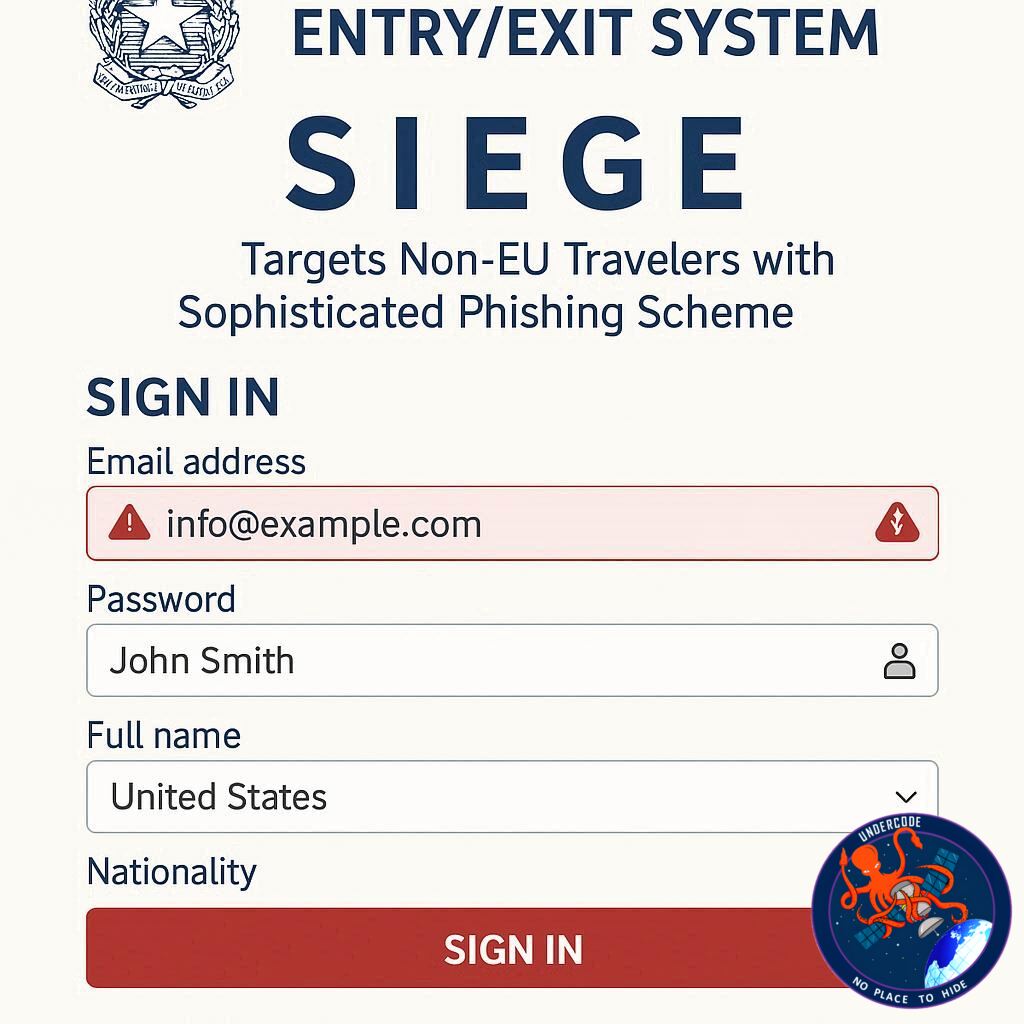
In a digital era where every border checkpoint increasingly relies on data, Italy’s Entry/Exit System (EES) — a platform meant to track travelers entering and leaving the Schengen area — has become the latest target of cyber deception. A fraudulent website has surfaced, mirroring the official EES platform and designed to collect sensitive personal information from non-EU travelers.
The alarming discovery came from CERT-AGID (Italy’s Computer Emergency Response Team), which identified the phishing site posing as the official EES portal. According to investigators, the site currently does not transmit or misuse the captured data — but experts warn that this could be an early stage of a broader cyber fraud operation.
The phishing portal, almost indistinguishable from the legitimate system, invites travelers to input passport numbers, personal details, and even travel itineraries under the guise of “EES registration.” While the Entry/Exit System is designed to streamline border management and improve security, this cloned version weaponizes that trust, turning technology into a tool of deceit.
CERT-AGID noted that the fraudulent domain mimics the appearance, tone, and structure of Italy’s real EES website — down to the official logos, wording, and interface. This level of sophistication suggests a well-organized campaign, potentially orchestrated by cybercriminals with experience in large-scale identity theft operations. The absence of current data transmission is not a relief but a red flag: it implies the attackers are either testing the infrastructure or waiting for the right moment to activate the data exfiltration mechanism.
For now, the phishing page appears dormant — collecting, but not yet sending data. This kind of “sleeping” behavior is often used to evade detection and build a large pool of stolen information before deployment. Once activated, such databases can be sold on dark web markets or used in social engineering campaigns that impersonate government agencies or immigration authorities.
Cybersecurity experts warn travelers not to underestimate the long-term dangers. Even if no immediate theft occurs, having sensitive travel data stored in an unauthorized system creates future vulnerabilities — from identity fraud to targeted scams. With increasing reliance on digital immigration systems across Europe, the trust placed in government portals makes them ideal targets for exploitation.
The Italian government has not reported any confirmed data breaches within the official EES system, but CERT-AGID has moved swiftly to block and take down the fake site. Travelers are advised to verify the authenticity of URLs and avoid entering any personal data on unofficial domains. The official EES platform can only be accessed through secure government channels ending with “.gov.it.”
Cybercriminals have long understood that fear and bureaucracy make potent tools. In this case, the illusion of official procedure — combined with the confusion surrounding post-pandemic travel regulations — creates the perfect lure for unsuspecting tourists and business travelers. The sophistication of this phishing campaign highlights a broader trend: cyberattacks are evolving from brute-force data theft to psychological manipulation, exploiting human trust rather than system vulnerabilities.
Italy’s incident serves as a warning not only for travelers but for digital border security across Europe. As the EU’s new biometric-based Entry/Exit System prepares to become fully operational, hackers are clearly testing public perception, readiness, and the weakest link — user awareness.
What Undercode Say:
This phishing case reveals an unsettling evolution in cybercrime strategy. Rather than breaking into networks, attackers are building replicas of trust — fake sites that perfectly imitate legitimate government systems. It’s no longer about hacking firewalls; it’s about hacking psychology.
The Italian EES incident is a textbook example of “trust-based intrusion.” By copying the visual and linguistic identity of a national platform, cybercriminals exploit one of the most powerful security blind spots: human assumption. Most users believe that a site with official logos, familiar colors, and government-style text must be real. That’s where social engineering becomes the most effective weapon in a hacker’s arsenal.
Interestingly, CERT-AGID’s observation that the fake site doesn’t yet transmit data is crucial. It suggests an early reconnaissance phase — the attackers are likely testing traffic patterns, collecting user interaction data, or measuring response rates before activating full-scale data theft. This cautious, patient approach reflects a professional operation, not a random amateur phishing attempt.
Moreover, targeting non-EU travelers isn’t random. This demographic is less familiar with European digital services and thus more vulnerable to such scams. A visitor from Asia, Africa, or South America might not know what the “EES” portal should look like, making them easy targets for deception. This demographic precision implies the attackers have a strategic, data-driven understanding of human behavior.
From a broader perspective, this attack raises questions about digital sovereignty and the psychological resilience of public infrastructure. If citizens can’t distinguish fake from real, even the most secure system loses credibility. Governments must invest not only in technical defenses but in public awareness campaigns that train people to verify sources, recognize phishing patterns, and report suspicious URLs immediately.
The Italy case also hints at the future battlefield of cybersecurity: identity simulation. In an age where artificial intelligence can generate realistic voices, websites, and even video messages, the next generation of cybercrime will rely on synthetic authenticity. The fake EES site could easily evolve into a full-scale scam involving AI-generated immigration officers or chatbot-based fraudsters.
What we’re witnessing is a shift from attacks on code to attacks on cognition. And that’s far more dangerous — because while software can be patched, human trust cannot.
Fact Checker Results:
✅ CERT-AGID confirmed the existence of the phishing site mimicking the EES portal.
✅ The fake site currently collects but does not transmit user data.
❌ No evidence of compromise within Italy’s official EES infrastructure.
Prediction: 🧭
Expect more phishing campaigns impersonating government systems as Europe rolls out biometric border controls. Attackers will likely target other EU countries next, using AI to generate even more convincing interfaces and communication. As digital trust becomes the new currency of security, the real battle won’t just be fought in servers — it will be fought in minds.
🕵️📝✔️Let’s dive deep and fact‑check.
References:
Reported By: x.com
Extra Source Hub (Possible Sources for article):
https://www.reddit.com
Wikipedia
OpenAi & Undercode AI
Image Source:
Unsplash
Undercode AI DI v2
Bing
🔐JOIN OUR CYBER WORLD [ CVE News • HackMonitor • UndercodeNews ]
📢 Follow UndercodeNews & Stay Tuned:
𝕏 formerly Twitter 🐦 | @ Threads | 🔗 Linkedin | 🦋BlueSky | 🐘Mastodon


