
Listen to this Post
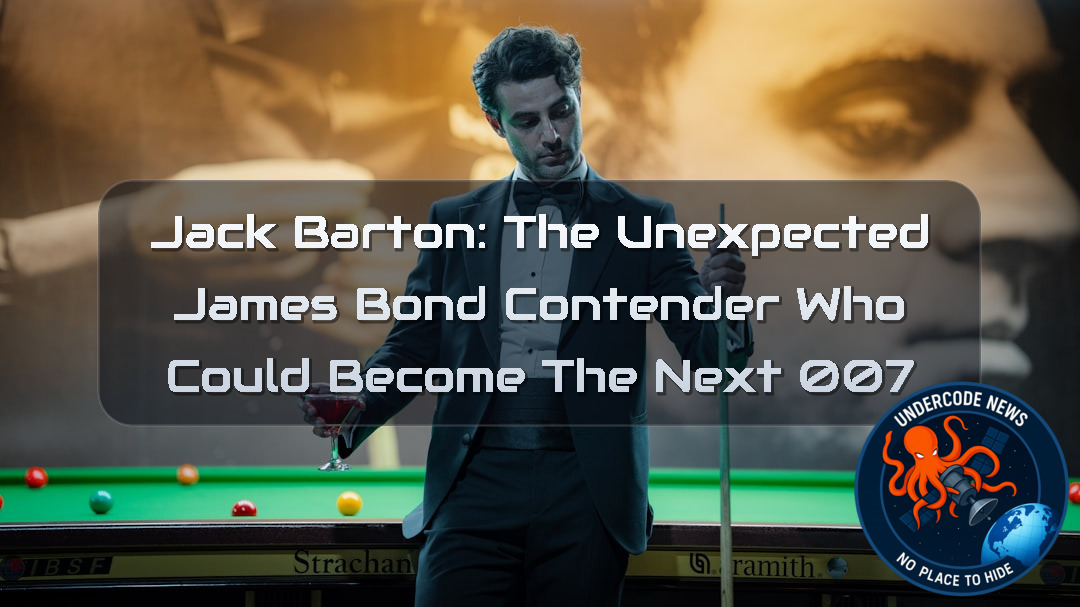 A New Name Suddenly Shakes the Bond Race
For years, the question of who will inherit the tuxedo, the Aston Martin, and cinema’s most famous licence to kill has kept James Bond fans guessing. Now, as the search for the next 007 reportedly enters a more serious stage, an unexpected name has begun attracting attention: Jack Barton.
He may not yet have the international recognition of Jacob Elordi, Paul Mescal, Callum Turner, or other frequently discussed candidates, but that could be exactly what makes him interesting. At 31, British, classically trained, and still relatively unfamiliar to mainstream audiences, Barton appears to fit a pattern that has shaped the Bond franchise for decades.
The original report suggests that Barton has emerged as a surprise contender ahead of further screen testing expected in September. If the reports prove accurate, the race for one of the most important roles in modern cinema may be entering a far more unpredictable phase.
And perhaps that is exactly what James Bond needs.
The Original Report in Summary
The search for the next James Bond is reportedly narrowing, with several recognizable actors believed to be under consideration. Names such as Jack Lowden, Jacob Elordi, Callum Turner, Paul Mescal, Jack O’Connell, and Harris Dickinson have all appeared in speculation surrounding the future of the franchise.
However, the biggest surprise may be Jack Barton, a 31-year-old British actor who remains relatively unknown to global audiences. Barton trained at the Oxford School of Drama and has appeared in productions including Netflix’s Heartstopper, Yorgos Lanthimos’ Poor Things, and the second season of SAS: Rogue Heroes.
His appearance in SAS: Rogue Heroes is particularly interesting because the series was created by Steven Knight, who is also attached as the writer of the next Bond film. That connection does not necessarily mean Barton has an advantage, but it has naturally added another layer to the speculation.
Barton also represents something that has historically worked extremely well for the Bond franchise: a fresh face. James Bond has repeatedly transformed relatively unfamiliar actors into global stars, allowing audiences to discover the character and performer at almost the same time.
The upcoming film, often referred to as Bond 26, is expected to be directed by Denis Villeneuve and written by Steven Knight. Amy Pascal has indicated that an announcement about the new actor could arrive toward the end of the year. Production is expected to begin in 2027, with a possible release planned for 2028.
The Mystery Behind Jack Barton
There is something almost perfectly ironic about the possibility of Jack Barton becoming James Bond.
His name is Jack. His surname is Barton. And until recently, he was not a name dominating the endless online debates about who should become cinema’s next 007.
That may be changing.
In an era where casting rumours can spread across the internet within minutes, Barton represents the kind of candidate that can suddenly move from obscurity into the center of one of Hollywood’s biggest conversations. He does not arrive with the overwhelming public image of an established blockbuster star. Instead, he arrives with something potentially more valuable for a character like Bond: mystery.
James Bond is not supposed to feel completely familiar.
The audience needs to believe that there are parts of him they cannot see. His past should feel complicated. His emotions should remain partially hidden. Even when he enters a room wearing an immaculate tuxedo, there should be the sense that something dangerous exists beneath the surface.
Casting an actor whose personality and career have already been endlessly documented can make that illusion more difficult to create.
The Oxford School of Drama Connection
Barton trained at the Oxford School of Drama, giving him a professional acting background that could prove important for a role as demanding as James Bond.
Bond is often remembered for explosions, car chases, casinos, gadgets, and spectacular locations. But the character also requires control.
A Bond actor must communicate confidence without appearing arrogant. He must be physically convincing without turning the character into a superhero. He must be charming enough to enter the world’s most exclusive rooms while still looking capable of surviving the moment everything goes wrong.
That combination is difficult.
The most successful Bond performances have generally depended on restraint. Sean Connery could make Bond dangerous with a glance. Roger Moore used charm and wit to create a lighter interpretation. Timothy Dalton brought intensity and emotional seriousness. Pierce Brosnan combined elegance with blockbuster spectacle. Daniel Craig transformed the character into a more vulnerable, physical, and psychologically damaged figure.
The next actor will need to find another balance.
Barton, if he is genuinely under consideration, would need to demonstrate that he can carry this enormous legacy while creating something that feels entirely his own.
From Heartstopper to the World of 007
Barton is known to some audiences for playing David, the on-screen brother of Kit Connor’s character Nick Nelson, in Netflix’s Heartstopper.
It is a very different world from James Bond.
That contrast could actually work in his favour. Actors often benefit from roles that allow casting directors to see unexpected sides of their abilities. A performer should not necessarily be judged only by the size or style of their previous projects.
The question is not whether Barton has already played a spy.
The question is whether he can become one.
Bond has always required transformation. The actor disappears into a character who has existed for generations while simultaneously redefining him. Every Bond must feel connected to the past, but no new Bond can simply imitate the previous actor.
If Barton has impressed during screen testing, the ability to surprise may be one of his strongest weapons.
A Small Role in Poor Things, But a Valuable Credit
One of
It may not sound like the kind of role that immediately leads to a licence to kill.
But acting careers rarely follow a perfectly predictable route.
Many performers spend years appearing in supporting roles, theatre productions, television series, and smaller films before suddenly finding the role that changes everything. Bond itself has historically been one of the greatest examples of this phenomenon.
The right actor does not always need a long list of blockbuster leading roles.
Sometimes, the role creates the star.
SAS: Rogue Heroes Could Be an Interesting Connection
Barton also appeared in the second season of SAS: Rogue Heroes, a project created by Steven Knight.
Knight’s involvement in the next Bond film naturally makes this connection interesting. He has already demonstrated an ability to create charismatic, dangerous, emotionally complicated British characters.
Of course, appearing in one of his productions does not automatically mean an actor is destined to become James Bond.
Casting decisions for a franchise of this scale involve producers, directors, studios, screen tests, long-term contracts, and extensive discussions about the future of the character.
Still, familiarity can matter.
If Steven Knight has already seen Barton working within a high-pressure production environment, that experience may give decision-makers a better understanding of what the actor can bring to the screen.
Whether that becomes an advantage remains unknown.
But in a race filled with speculation, every possible connection is being examined.
Why an Unknown Actor Could Be the Smartest Choice
One of the strongest arguments in favour of Barton is not necessarily his previous work.
It is the fact that many people still do not know him.
The Bond franchise has repeatedly demonstrated that audiences are willing to accept a new face when the actor is right for the role.
Sean Connery was not the global superstar he would later become before stepping into the world of 007. George Lazenby came from modelling and had almost no traditional acting career. Timothy Dalton was highly respected but not a mainstream Hollywood action icon. Pierce Brosnan had television fame but Bond transformed his international profile.
Daniel Craig was arguably the most established actor of the modern Bond era before taking the role. Even then, Casino Royale elevated him into a completely different level of global stardom.
This history creates an important lesson.
James Bond does not necessarily need a famous actor.
James Bond can make one famous.
The Danger of Casting a Superstar
A major celebrity can bring immediate attention to a franchise, but that attention can also create a problem.
When audiences see an actor who has already become strongly associated with other famous characters, they may spend the entire film thinking about the actor rather than Bond.
That is particularly dangerous for 007.
The character needs to feel like a complete identity.
If the audience walks into the cinema and immediately sees the actor’s previous roles, celebrity relationships, social media personality, or highly public personal life, the illusion can become more difficult to maintain.
A relatively unknown performer gives filmmakers the opportunity to build a new cinematic identity almost from the ground up.
The actor becomes associated with Bond.
Bond becomes associated with the actor.
And for several years, those two identities can grow together.
The Importance of Remaining an Enigma
Former Bond casting director Debbie McWilliams has previously argued that mystery remains an essential quality for the actor playing 007.
That philosophy makes sense.
James Bond is a spy.
The audience should feel that there are parts of him that remain inaccessible. We can understand his pain without knowing every detail of his life. We can witness his relationships without feeling as though we know everything about him.
A celebrity whose entire life has been heavily documented can struggle to create that distance.
This is why a performer like Barton could fit the traditional Bond formula.
Audiences may not arrive with years of expectations.
They may simply see the character.
A Five-Film Future Could Shape the Casting Decision
Another important factor is longevity.
Reports surrounding the casting process have suggested that the next Bond could be chosen with a long-term commitment in mind, potentially carrying the franchise through multiple films.
That changes the calculation.
The studio is not simply casting an actor for one movie. It may be choosing a performer who will become the public face of the franchise for more than a decade.
Daniel Craig played Bond for approximately fifteen years, from Casino Royale through No Time to Die. That kind of commitment requires enormous physical endurance, scheduling flexibility, and a willingness to repeatedly return to the same character.
A younger and less established actor could potentially offer the franchise more flexibility.
The studio would also avoid some of the financial complications associated with hiring an actor who is already commanding massive salaries across multiple competing franchises.
For a company thinking strategically about the future of Bond, a fresh face could therefore be both an artistic and business decision.
Denis Villeneuve and the Possibility of a New Bond Era
The next Bond film is expected to be directed by Denis Villeneuve, a filmmaker associated with ambitious and visually distinctive productions.
His involvement immediately raises questions about the tone of the next era.
Will Bond remain grounded and psychologically intense after Daniel Craig’s final chapter?
Will the franchise move toward a more stylized interpretation?
Could Villeneuve create a version of Bond that feels both classic and completely new?
The choice of actor will be central to answering those questions.
Villeneuve’s cinematic style often depends heavily on atmosphere, visual presence, silence, and tension. A Bond actor capable of communicating emotion without constantly explaining it could therefore become particularly valuable.
The next 007 may need to speak less with dialogue and more with expression.
A look.
A pause.
A decision.
A silence before violence.
Steven Knight Could Bring a Different Voice to Bond
Steven
Knight has built a reputation for writing characters who are ambitious, violent, intelligent, emotionally damaged, and frequently trapped between loyalty and survival.
Those qualities are not foreign to James Bond.
However, the challenge will be avoiding repetition.
Bond cannot simply become another version of a previous Steven Knight protagonist.
The character has his own mythology, rhythm, humour, and cultural history.
The most successful new era would likely take elements of Knight’s storytelling strengths while preserving what makes Bond unique.
A new actor, particularly someone without an overwhelming public image, could give Knight and Villeneuve greater freedom to rebuild the character.
The Competition Is Still Formidable
Barton may be receiving attention, but the reported competition remains significant.
Several actors have been repeatedly linked to the role, and each represents a different possible direction for the franchise.
Some candidates offer established dramatic credibility. Others bring international recognition. Some may fit the physical expectations of a modern action franchise, while others could potentially deliver a more traditional British interpretation.
That diversity demonstrates how uncertain the final choice remains.
The next Bond could be familiar.
Or he could be someone audiences barely know today.
That uncertainty is part of what makes the casting process so fascinating.
Why September Could Become an Important Moment
Further screen testing reportedly expected in September could become an important stage in determining who remains under serious consideration.
Screen tests are not simply auditions.
For a role like Bond, filmmakers may examine how an actor moves, speaks, reacts, handles action, wears formal clothing, delivers humour, and creates chemistry with other performers.
They may test the actor with scenes from different emotional environments.
Can he appear dangerous?
Can he appear vulnerable?
Can he command a room?
Can he look believable in a quiet conversation and then convincing during an intense action sequence?
James Bond requires all of those qualities.
The final decision could therefore depend on something that is impossible to predict from a photograph or online fan poll.
It may come down to who walks into a room and suddenly feels like 007.
Amy Pascal Hints at a Future Announcement
Producer Amy Pascal has suggested that the end of the year could be a realistic period for announcing the new actor.
The careful approach is understandable.
Replacing Daniel Craig is not simply a casting decision.
It is a cultural event.
Craig’s Bond era created one of the most commercially successful and critically discussed periods in the history of the franchise. His interpretation redefined the character for a generation that had become accustomed to darker, more emotionally complex blockbuster heroes.
The next actor cannot simply recreate
That would make the new era feel unnecessary.
Instead, the producers must find someone capable of honouring what came before while opening a new chapter.
That is a difficult task.
It may also explain why the casting process appears to be so methodical.
Bond 26 Needs More Than a New Face
The next Bond film will not succeed simply because the producers find a handsome actor capable of wearing a tuxedo.
The franchise needs a clear reason to continue.
After decades of films and multiple interpretations of the same character, audiences will expect something fresh.
That does not necessarily mean changing everything.
The famous music, espionage, luxury, danger, humour, travel, and spectacle remain part of Bond’s DNA.
But the emotional world surrounding those elements may need to evolve.
Modern audiences understand surveillance, cyberwarfare, artificial intelligence, geopolitical instability, and digital espionage in ways previous generations could barely imagine.
The next Bond could explore a world where secrecy itself is becoming increasingly difficult.
What happens to a spy when everyone is being watched?
What does anonymity mean in a society built around data?
Can a man whose profession depends on secrecy survive in a world that records everything?
Those questions could give the next era a powerful foundation.
Jack Barton Could Represent the
If Barton truly remains under serious consideration, his biggest advantage may be the simplest one.
He does not arrive carrying decades of audience expectations.
The producers could introduce him to the world as Bond.
For a character whose identity is built around mystery, reinvention, and transformation, that could be incredibly powerful.
Audiences would not necessarily compare every movement to another famous role.
Instead, they would discover what Barton can do as the world’s most famous spy.
That possibility alone makes him one of the more interesting names in the current conversation.
What Undercode Say:
The possible rise of Jack Barton shows that the Bond casting process may be moving away from internet popularity contests.
The biggest name is not always the best strategic choice.
Bond is a franchise where the character is bigger than the actor.
That creates an unusual advantage for relatively unknown performers.
A new face can make the audience believe they are meeting a new Bond rather than watching a celebrity play dress-up.
The mystery surrounding Barton could therefore become an asset.
His limited mainstream exposure allows producers to shape his public image around the franchise.
That was far easier during earlier generations of Bond.
Today, social media creates a permanent archive of actors’ lives, interviews, relationships, opinions, and previous performances.
Finding someone who still feels unknown is becoming increasingly difficult.
That may explain why Barton has suddenly become such an interesting possibility.
However, being unknown is not enough.
The next Bond must have screen presence powerful enough to survive global attention.
The actor will be compared with Connery, Moore, Dalton, Brosnan, and Craig almost immediately.
Every interview will be examined.
Every trailer will be analyzed frame by frame.
Every action scene will be compared with the previous era.
That pressure can destroy an inexperienced performer.
Or it can create a global star.
The decision will also reveal what kind of Bond Amazon wants for the future.
A famous actor would suggest an attempt to launch the franchise with immediate recognition.
A lesser-known actor would suggest a longer-term investment.
The second option may be more consistent with Bond’s history.
The franchise traditionally builds its stars.
It does not always borrow them.
Denis
His films often depend on performers capable of creating tension without excessive dialogue.
A Bond actor with subtle physical control could therefore become more valuable than someone known primarily for charisma or social media popularity.
Steven Knight adds another interesting dimension.
His writing style could bring a rougher, more psychologically complicated edge to the franchise.
But the next Bond must avoid becoming a copy of Daniel Craig’s damaged and emotionally exposed version.
The new era needs contrast.
It needs its own identity.
Barton could represent that reset because audiences have fewer expectations about what his Bond would look like.
That creative freedom could become a major advantage.
The biggest question is whether he can command the screen.
Bond is not a role that can hide behind visual effects.
Even inside the largest action sequence, the actor remains the center of the frame.
One look must communicate intelligence, danger, confidence, and calculation.
That is why screen testing will matter far more than online speculation.
The final choice may ultimately surprise everyone.
And history suggests that surprise would not be unusual for James Bond.
Deep Analysis
The Bond casting process can be understood like a long-term compatibility test.
Producers are effectively evaluating an actor across multiple variables rather than simply asking whether he looks convincing in a tuxedo.
A simplified way to visualize the evaluation process is through weighted criteria:
Create a simple conceptual Bond candidate evaluation
candidate="Jack Barton"
acting_score=9
screen_presence=9
physicality=8
longevity=9
public_familiarity=9
global_marketability=7
total=$((acting_score + screen_presence + physicality + longevity + public_familiarity + global_marketability))
echo "$candidate Bond Potential Score: $total"
A more advanced conceptual model could store candidate information and compare multiple factors:
cat > bond_candidates.txt << 'EOF'
Jack Barton:unknown:31:long_term
Candidate A:established:35:medium_term
Candidate B:international_star:33:limited_availability
EOF
grep "unknown" bond_candidates.txt
From a strategic perspective, studios may also consider contract duration:
films=5
years=15
echo "Potential franchise commitment: $films films across approximately $years years"
These examples are simplified, but they demonstrate the real challenge.
The next Bond is not merely an acting hire.
It is a long-term investment.
The studio must evaluate talent, public perception, age, physical capability, scheduling, international appeal, contract flexibility, chemistry with future co-stars, and the ability to evolve with the franchise.
That complexity is why an apparently unexpected candidate can suddenly become the strongest option.
The best Bond may not be the actor with the largest fan base today.
He may be the actor whose career changes completely the moment the gun barrel appears on screen.
✅ Jack Barton has acting credits including Heartstopper, Poor Things, and SAS: Rogue Heroes, supporting the description of him as a British actor with a comparatively limited mainstream profile.
✅ The idea that Bond has often elevated less globally established actors is broadly supported by the franchise’s history, although each actor entered the role with different levels of previous fame.
❌ Jack Barton becoming the next James Bond should not be treated as confirmed until an official announcement is made by the filmmakers or rights holders, because casting speculation and reported screen tests do not equal a final contract.
Prediction
(+1) A relatively unknown British actor has a strong strategic chance of being selected because the Bond franchise benefits from mystery, long-term availability, and the opportunity to build a new global star.
If Barton continues to impress during the reported casting process, his lack of overwhelming celebrity recognition could become one of his biggest advantages.
The eventual announcement is likely to trigger intense debate, regardless of who wins the role, because replacing Daniel Craig will be one of the most closely scrutinized casting decisions in modern cinema.
If the production decides that immediate international recognition is more important than long-term mystery, an already established star could ultimately overtake a newcomer such as Barton.
The Countdown to the Next 007
For now, Jack Barton’s name remains one of the most intriguing developments in the search for the next James Bond.
He may ultimately become 007.
Or he may become another fascinating name in the long history of actors who came close to inheriting one of cinema’s most famous roles.
But the fact that a relatively unknown performer can reportedly enter the conversation so late is a reminder that the final decision may not follow public expectations.
The next Bond could be standing quietly outside the spotlight today.
Then, with one official announcement, everything could change.
If production begins in 2027 and the next film arrives around 2028 as currently expected, the franchise is approaching the beginning of an entirely new era.
A new face.
A new interpretation.
A new mission.
And somewhere inside the casting process, perhaps, a 31-year-old British actor named Jack Barton may be waiting for the words that could change his life forever.
The name’s Barton. Jack Barton.
Whether that introduction ever becomes reality remains one of the biggest unanswered questions in cinema.
▶️ Related Video (82% Match):
🕵️📝Let’s dive deep and fact‑check.
🎓 Live Courses & Certifications:
Join Undercode Academy for Verified Certifications
🚀 Request a Custom Project:
Secure, high-velocity infrastructure and disruptive technological engineering. Contact our engineering team for high-tier development and proprietary systems:
[email protected]
💎 Smart Architecture | 🛡️ Secure by Design | ⭐ Trusted by Thousands
References:
Reported By: www.euronews.com
Extra Source Hub (Possible Sources for article):
https://www.instagram.com
Wikipedia
OpenAi & Undercode AI
Image Source:
Unsplash
Undercode AI DI v2
🔐JOIN OUR CYBER WORLD [ CVE News • HackMonitor • UndercodeNews ]
📢 Follow UndercodeNews & Stay Tuned:
𝕏 formerly Twitter 🐦 | @ Threads | 🔗 Linkedin | 🦋BlueSky | 🐘Mastodon | 📺Youtube


