
Listen to this Post
Introduction
A major cybersecurity incident has shaken the trusted software community after the official website of JDownloader was compromised to distribute malicious Windows and Linux installers. The attack, which occurred between May 6 and May 7, 2026, turned one of the internet’s most popular download managers into an unexpected malware delivery platform. Millions of users have relied on JDownloader for years to automate downloads from hosting platforms, streaming services, and premium file-sharing sites, making this breach especially dangerous due to the software’s massive global user base.
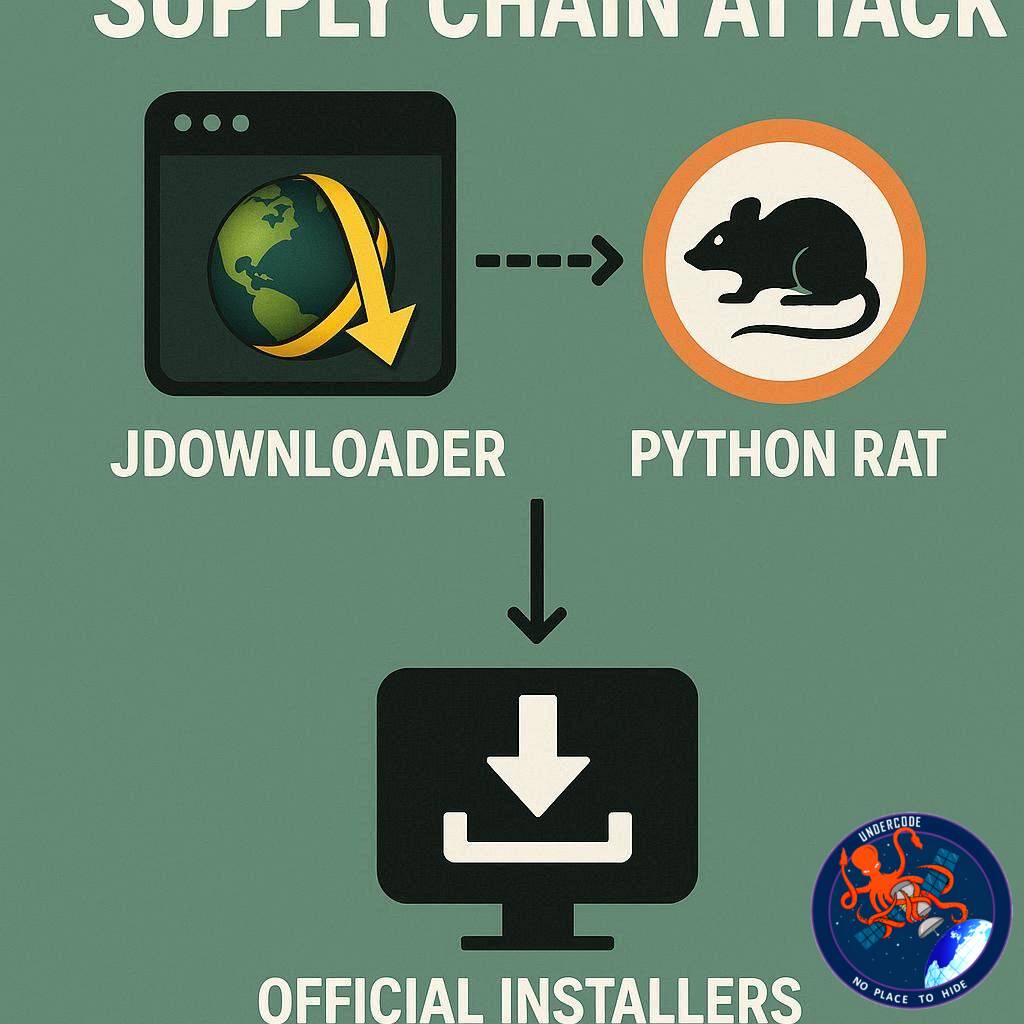
The incident highlights how attackers are increasingly shifting toward software supply chain compromises instead of directly targeting victims. Rather than tricking users through phishing emails or fake advertisements, hackers manipulated legitimate download links on the official website itself. Users believed they were downloading authentic software updates, but instead received trojanized installers capable of deploying advanced remote access malware.
Security researchers investigating the attack discovered that the malicious Windows installer deployed a heavily obfuscated Python-based remote access trojan (RAT), while the Linux installer dropped stealthy ELF payloads with persistence mechanisms capable of surviving reboots. The compromise has raised serious concerns about website security, software distribution trust models, and the growing sophistication of cybercriminal operations targeting widely used applications.
Official Website Was Quietly Weaponized
The compromise was first noticed by a Reddit user named “PrinceOfNightSky,” who reported that freshly downloaded Windows installers from the official JDownloader website were being flagged by Microsoft Defender. The user noticed suspicious publisher names such as “Zipline LLC” and “The Water Team” instead of the expected AppWork GmbH certificate associated with legitimate JDownloader releases.
This immediately raised alarms within the cybersecurity community because JDownloader has maintained a long-standing reputation as a trusted and widely used application. The developers later confirmed that attackers had indeed compromised the website and manipulated specific download links to redirect users toward malicious payloads hosted on third-party infrastructure.
According to the official incident report, the attackers exploited an unpatched vulnerability within the site’s content management system. This vulnerability allowed unauthorized modifications to website content and access control lists without authentication. Fortunately, the attackers reportedly did not gain full operating system access to the underlying servers, limiting the compromise to CMS-managed content rather than complete infrastructure takeover.
The developers clarified that only certain installers were affected. Specifically, the Windows “Alternative Installer” download links and the Linux shell installer were maliciously modified. Other distribution methods, including in-app updates, macOS downloads, Flatpak packages, Winget releases, Snap packages, and the primary JAR package, remained untouched during the incident.
Windows Malware Delivered a Python-Based RAT
Cybersecurity researcher Thomas Klemenc performed an analysis of the malicious Windows executable and uncovered a sophisticated loader designed to deploy an obfuscated Python-based RAT framework.
The malware was not a simple infostealer or downloader. Instead, it acted as a modular remote access platform capable of executing arbitrary Python code delivered remotely from attacker-controlled command-and-control infrastructure. This design gives threat actors tremendous flexibility because they can dynamically deploy new malicious modules without needing to redistribute the malware itself.
The malware reportedly connected to the following command-and-control servers:
parkspringshotel[.]com/m/Lu6aeloo.php
auraguest[.]lk/m/douV2quu.php
The use of Python for malware development has become increasingly popular among threat actors due to the language’s portability, extensive libraries, and ease of obfuscation. By leveraging Python, attackers can rapidly update payload capabilities, automate credential theft, establish persistence, deploy ransomware, or even pivot deeper into victim networks.
Researchers noted that the payload was heavily obfuscated, making reverse engineering significantly more difficult. This level of sophistication indicates the attackers likely invested substantial effort into ensuring long-term stealth and adaptability.
Linux Users Were Also Targeted
The Linux shell installer contained malicious code that downloaded an archive disguised as an SVG image file from a suspicious external domain called checkinnhotels[.]com. Once executed, the installer extracted two ELF binaries named pkg and systemd-exec.
The malware then escalated persistence by installing systemd-exec as a SUID-root binary inside /usr/bin/, effectively granting elevated privileges. It also copied the primary payload into /root/.local/share/.pkg, created a persistence script within /etc/profile.d/systemd.sh, and launched the malware while disguising itself as /usr/libexec/upowerd.
The payload named pkg was additionally protected with Pyarmor obfuscation, preventing researchers from immediately determining its exact functionality. However, the persistence mechanisms strongly suggest that attackers intended to maintain long-term access to infected systems while remaining hidden from users and administrators.
This Linux-focused component is especially notable because Linux malware distribution campaigns remain less common than Windows attacks. The inclusion of both Windows and Linux payloads demonstrates that attackers deliberately designed this operation to maximize reach across multiple operating systems.
Developers Warn Users to Reinstall Operating Systems
The JDownloader development team warned that users are only affected if they downloaded and executed the malicious installers during the compromise window between May 6 and May 7, 2026.
To help users verify authenticity, the developers instructed people to inspect installer digital signatures. Legitimate installers should display a valid signature from “AppWork GmbH.” Files lacking signatures or displaying different publisher names should be considered malicious and immediately deleted.
Because the malware may have executed arbitrary code on compromised devices, the developers strongly advised affected users to completely reinstall their operating systems rather than attempting partial cleanup. Security experts also warned that credentials stored on infected systems could have been stolen, making password resets essential after remediation.
The incident serves as another reminder that once malware executes with user privileges, especially installers running with elevated permissions, attackers can achieve deep system compromise that is difficult to fully reverse without a clean OS reinstall.
Supply Chain Attacks Are Becoming the New Normal
The JDownloader compromise is not an isolated case. Cybercriminal groups are increasingly targeting trusted software vendors and download portals because compromising a legitimate distribution channel provides instant credibility and massive victim reach.
Earlier this year, attackers compromised the websites for popular hardware monitoring tools like CPU-Z and HWMonitor by modifying official download links to distribute malicious executables. More recently, threat actors also targeted the DAEMON Tools website with trojanized installers carrying backdoor malware.
These attacks are effective because users naturally trust official software websites. Traditional security awareness training often tells users to “download only from official sources,” but supply chain attacks completely undermine that assumption.
The trend reflects a broader shift in cybercrime strategy. Rather than spending resources convincing users to trust fake websites, attackers compromise real infrastructure and weaponize legitimate software ecosystems themselves.
What Undercode Say:
The JDownloader incident is another clear demonstration that software supply chain attacks are becoming one of the most dangerous cybersecurity threats of the modern internet era. Attackers no longer need sophisticated phishing campaigns when they can compromise trusted platforms directly and silently poison legitimate software distributions.
One of the most alarming aspects of this attack is the attackers’ operational discipline. They did not fully compromise backend servers or destroy infrastructure. Instead, they performed a surgical modification of selected download links within the CMS environment. This approach reduces noise, minimizes detection, and extends the attack window long enough to infect more victims.
The use of Python-based malware is also strategically important. Python gives attackers modularity, portability, and rapid development cycles. Security teams traditionally focused heavily on compiled malware families, but interpreted malware frameworks are becoming increasingly capable and harder to detect through static analysis alone.
Another major concern is the Linux payload sophistication. Many organizations assume Linux endpoints are naturally safer, but this attack proves threat actors are investing more heavily in cross-platform malware ecosystems. Persistence through SUID binaries and disguised system services shows a level of maturity usually associated with advanced threat operations.
The compromise additionally exposes weaknesses in how users validate software authenticity. Most users never inspect digital signatures before running installers. Attackers understand this behavior and exploit it effectively. Even when Microsoft Defender raised alerts, some users might still have bypassed warnings because the software appeared to come from the legitimate website.
The incident also highlights how CMS vulnerabilities continue to represent a major security blind spot. Even if backend infrastructure remains secure, a vulnerable CMS can still provide enough control for attackers to weaponize software delivery mechanisms. Organizations often underestimate the impact of partial website compromises.
Another critical lesson is the importance of defense-in-depth for software distribution. Developers should consider multiple integrity validation layers including reproducible builds, detached signatures, transparency logs, hash verification systems, and geographically separated mirrors with independent validation pipelines.
This attack may also trigger broader discussions around secure software delivery standards. Governments and enterprise customers increasingly demand software bill of materials (SBOM) frameworks and stronger supply chain verification requirements. Incidents like this will likely accelerate adoption of those standards.
From an attacker perspective, supply chain compromises are extremely efficient. A single successful website compromise can produce thousands of infections within hours. Compared to phishing campaigns with low conversion rates, poisoned software installers provide high-value targets that willingly execute malware with elevated privileges.
There is also a psychological component to these attacks. Users who lose trust in official software channels may begin ignoring security recommendations entirely. That erosion of trust damages the broader software ecosystem and creates long-term consequences beyond the immediate infection campaign.
The growing overlap between software engineering and cybersecurity is becoming impossible to ignore. Modern software vendors are now effectively operating as security providers, infrastructure defenders, and trust custodians simultaneously.
The JDownloader compromise will likely become a case study for future supply chain attack analysis because it demonstrates how even partial website control can have devastating downstream consequences for end users worldwide.
Fact Checker Results
✅ The compromise affected JDownloader installers distributed between May 6 and May 7, 2026 through modified official download links.
✅ Researchers confirmed the Windows payload deployed an obfuscated Python-based remote access trojan capable of remote code execution.
❌ There is currently no public evidence suggesting the attackers gained full operating system access to JDownloader’s backend servers.
Prediction
🔮 Supply chain attacks against popular software distribution websites will continue increasing throughout 2026 because they provide high infection rates with minimal user suspicion.
🔮 More malware campaigns will adopt cross-platform payloads targeting both Windows and Linux environments simultaneously.
🔮 Software vendors will face growing pressure to implement stronger download integrity verification systems and transparent security auditing practices.
🕵️📝Let’s dive deep and fact‑check.
References:
Reported By: www.bleepingcomputer.com
Extra Source Hub (Possible Sources for article):
https://www.quora.com/topic/Technology
Wikipedia
OpenAi & Undercode AI
Image Source:
Unsplash
Undercode AI DI v2
Bing
🔐JOIN OUR CYBER WORLD [ CVE News • HackMonitor • UndercodeNews ]
📢 Follow UndercodeNews & Stay Tuned:
𝕏 formerly Twitter 🐦 | @ Threads | 🔗 Linkedin | 🦋BlueSky | 🐘Mastodon


