
Listen to this Post
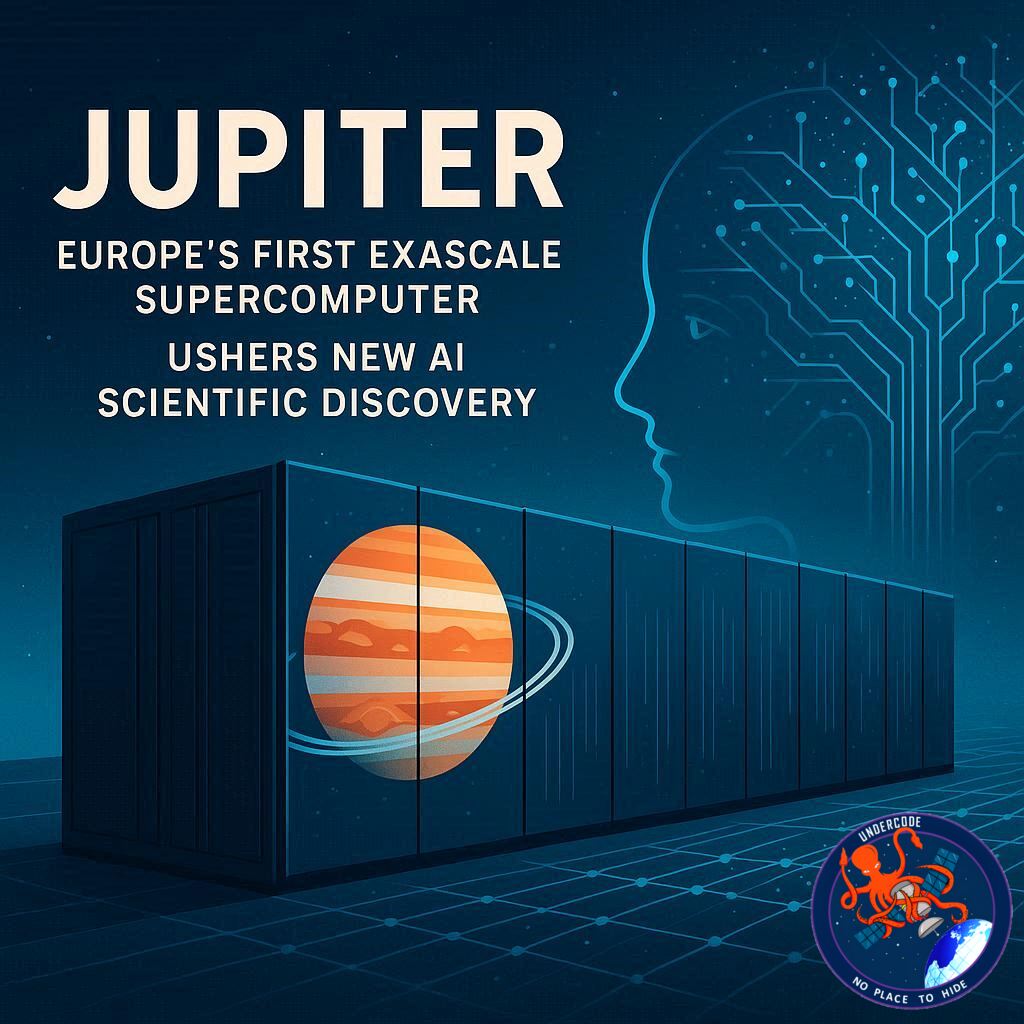
Europe has officially stepped into the exascale computing era with the inauguration of JUPITER, the continent’s first exascale supercomputer, at the Jülich Supercomputing Centre. Designed to accelerate breakthroughs in fields ranging from climate modeling to quantum computing, JUPITER is a technological marvel built to handle tasks that were previously thought impossible. Its unveiling marks a pivotal moment in scientific innovation, positioning Europe as a global leader in high-performance computing (HPC) and artificial intelligence (AI).
A Quantum Leap in Computing Power
JUPITER leverages NVIDIA’s Grace Hopper platform and Eviden’s BullSequana XH3000 liquid-cooled architecture, allowing it to perform an astonishing 1 quintillion FP64 operations per second. For AI workloads, it is expected to reach up to 90 exaflops, more than doubling the performance of Europe’s previous fastest systems. Thomas Lippert, director of the Jülich Supercomputing Centre, emphasizes that this milestone is the result of over a decade of research and development. The supercomputer represents not just speed but versatility, enabling entirely new scientific and industrial possibilities across the continent.
Pioneering AI and HPC Integration
Unlike traditional supercomputers, JUPITER fuses AI and high-performance computing into a single architecture, creating a platform for next-generation research. Jensen Huang, NVIDIA’s founder and CEO, highlights that this system will accelerate progress in climate modeling, renewable energy research, quantum simulations, new material design, and digital twin creation. Its high-speed Quantum-2 InfiniBand connectivity ensures that large-scale data transfer won’t be a bottleneck, making it ideal for multi-disciplinary projects requiring immense computational resources.
Driving European Research Forward
Eighteen teams from Germany and fifteen from across Europe are among the first to access JUPITER. Researchers at the Max Planck Institute for Meteorology are already using the supercomputer to simulate climate predictions at a remarkable 1-kilometer spatial resolution. This level of detail allows for more accurate modeling of extreme weather events, including thunderstorms and heavy rainfall, which could revolutionize disaster preparedness and climate adaptation strategies.
In the realm of AI, the TrustLLM project is leveraging JUPITER to train large language models for multiple European languages. These models promise to improve productivity and automation across numerous sectors by generating humanlike responses and streamlining workflows. Meanwhile, neuroscientist Thorsten Hater is simulating subcellular neuron activity to aid research into neurodegenerative diseases like Alzheimer’s, demonstrating the supercomputer’s potential to impact healthcare directly.
Breaking Records in Quantum Computing
JUPITER is set to redefine the limits of quantum simulation. While a typical laptop can handle around 32 qubits, and the current supercomputer record stands at 48, JUPITER is expected to surpass 50 qubits. Achieving this milestone would position Europe at the forefront of quantum research, opening doors to unprecedented computational experiments that could accelerate the development of quantum technologies worldwide.
Energy Efficiency and Industrial Impact
Designed with optimal energy efficiency, JUPITER is not only Europe’s most powerful AI and HPC system but also one of the most sustainable. Chancellor Friedrich Merz emphasized that the supercomputer is a national asset that will boost industrial innovation and maintain Europe’s competitive edge in scientific research. Its energy-conscious design ensures that scaling up AI and simulation workloads won’t come at the cost of environmental responsibility.
What Undercode Say:
JUPITER represents more than a technological achievement; it is a catalyst for Europe’s scientific renaissance. By combining HPC and AI, the system bridges the gap between traditional simulations and modern machine learning, creating a platform capable of solving problems that were previously unattainable. Its applications span critical global issues:
- Climate Modeling: High-resolution simulations will enable better forecasting of extreme weather events, potentially saving lives and resources.
- AI Advancement: TrustLLM and other AI-driven projects will streamline multilingual processing, enhancing productivity across industries.
- Neuroscience Breakthroughs: Subcellular neuron simulations could fast-track research in neurodegenerative diseases, offering hope for new treatments.
- Quantum Innovation: Surpassing 50 qubits sets a new benchmark in quantum simulation, paving the way for future discoveries in material science and cryptography.
- Industrial Competitiveness: By providing startups and enterprises with unparalleled computing power, JUPITER accelerates product development, research, and innovation.
Energy efficiency also sets a standard for future exascale systems. Many current HPC facilities are criticized for massive power consumption, but JUPITER demonstrates that peak performance and sustainability can coexist. In essence, it is a blueprint for the next generation of global supercomputing infrastructure.
🔍 Fact Checker Results
✅ JUPITER is Europe’s first exascale supercomputer, operational at Jülich.
✅ It utilizes NVIDIA Grace Hopper technology and BullSequana XH3000 architecture.
❌ No evidence suggests JUPITER has already broken global quantum computing records; it is projected to surpass 50 qubits.
📊 Prediction
JUPITER is poised to become the cornerstone of Europe’s scientific leadership. Within the next five years, its capabilities could lead to:
Dramatic improvements in climate prediction and renewable energy optimization.
Breakthroughs in personalized medicine through neuroscience simulations.
Expansion of AI capabilities in multilingual communication and automation.
Establishment of Europe as a global hub for quantum research, influencing international technology policies.
Energy-efficient HPC models becoming the new standard for future supercomputing projects worldwide.
JUPITER is not just a machine; it is Europe’s gateway to a future where AI, HPC, and quantum computing converge to transform research, industry, and everyday life.
🕵️📝✔️Let’s dive deep and fact‑check.
References:
Reported By: blogs.nvidia.com
Extra Source Hub:
https://stackoverflow.com
Wikipedia
OpenAi & Undercode AI
Image Source:
Unsplash
Undercode AI DI v2
🔐JOIN OUR CYBER WORLD [ CVE News • HackMonitor • UndercodeNews ]
📢 Follow UndercodeNews & Stay Tuned:
𝕏 formerly Twitter 🐦 | @ Threads | 🔗 Linkedin | 🦋BlueSky | 🐘Mastodon


