
Listen to this Post
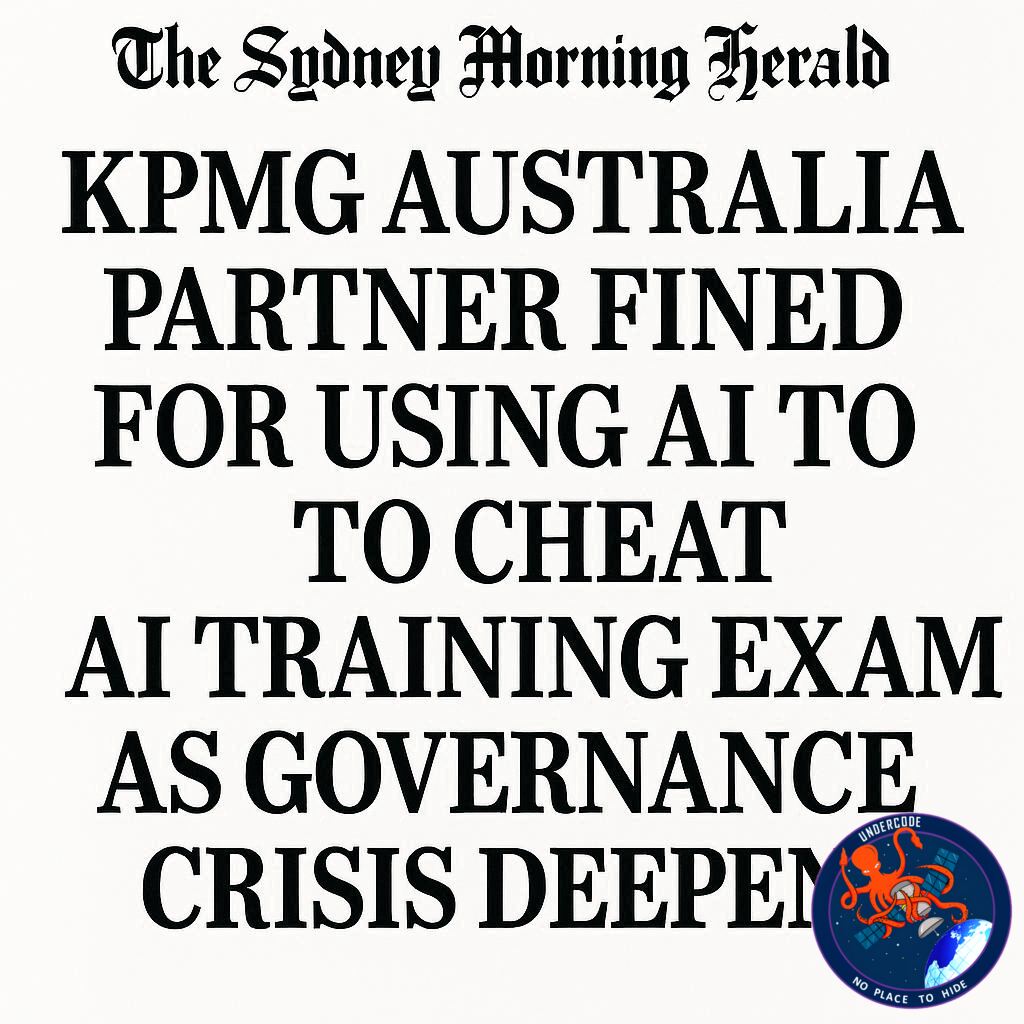
Introduction: When Artificial Intelligence Tests Human Integrity
Artificial intelligence is reshaping corporate life at breathtaking speed. It writes reports, drafts emails, builds models, and increasingly sits at the center of professional training programs. Yet in a twist that borders on irony, a senior partner at KPMG Australia was recently fined for using AI tools to cheat on an internal course about artificial intelligence itself. The episode has triggered renewed scrutiny over ethics, governance, and the fragile line between innovation and misconduct inside major accounting firms.
Internal AI Exam Scandal Sparks Financial Penalty
A partner at KPMG Australia was fined A$10,000, roughly $7,000 USD, after admitting to using an AI platform to generate answers during an internal AI-focused training course. According to reporting by the Financial Times, the unnamed partner uploaded official training materials into an external AI tool and relied on machine-generated responses to complete the assessment. The firm required him to retake the exam in addition to imposing the fine, signaling that the matter was treated as a serious breach of professional standards.
Widespread AI Misuse Among Staff Raises Red Flags
The incident was not isolated. KPMG confirmed that more than two dozen employees within its Australian division have been caught using AI tools to manipulate internal assessments since July of the current financial year. The discovery came after the firm deployed its own AI detection systems to monitor irregularities in exam submissions. In other words, artificial intelligence was used to detect artificial intelligence misuse, a technological paradox that highlights the complexity of modern compliance.
History of Exam Cheating at KPMG Australia
The scandal revives uncomfortable memories for the firm. In 2021, KPMG Australia was fined A$615,000, approximately $430,000 USD, after more than 1,100 partners were found to have shared answers on integrity and skills-based tests. That earlier episode exposed cultural weaknesses in compliance oversight and professional accountability. The current AI-related misconduct suggests that while technology has evolved, the ethical vulnerabilities may not have disappeared.
Senate Inquiry Amplifies Governance Concerns
The matter surfaced during an Australian Senate inquiry into industry governance. Greens senator Barbara Pocock sharply criticized the outcome, calling the fine “extremely disappointing” and warning that the regulatory system lacks sufficient deterrence. Her comments reflected broader political frustration with how major consulting and accounting firms police themselves, especially when ethical breaches involve senior professionals rather than junior staff.
CEO Response Highlights Cultural and Technological Challenges
KPMG Australia CEO Andrew Yates acknowledged the difficulty of managing AI-related misconduct, noting how rapidly society has embraced the technology. He stated that the firm is working to strengthen its internal controls and governance frameworks. His remarks underscore a broader industry reality: companies are racing to integrate AI into workflows while simultaneously trying to prevent it from undermining training, compliance, and trust.
Industry-Wide Struggles with AI-Driven Cheating
The AI cheating problem extends beyond KPMG. The Association of Chartered Certified Accountants, the world’s largest accounting body, eliminated remote examinations after determining that safeguards could not keep pace with AI-assisted dishonesty. Traditional proctoring methods proved inadequate in an era where generative AI can produce polished, context-aware answers in seconds.
Deloitte Australia Faces AI Hallucination Fallout
Meanwhile, Deloitte Australia encountered its own AI controversy after refunding part of its fee for a government report that contained AI-generated fabrications. The document reportedly included invented court quotations and fictitious academic references. The incident illustrated another risk: not only can AI be used to cheat on exams, but it can also infiltrate professional deliverables, threatening accuracy and credibility in public sector work.
KPMG’s Transparency Pledge Signals Damage Control
In response to the mounting criticism, KPMG announced plans to track and publicly report AI misuse figures alongside its annual financial results. By formalizing disclosure, the firm appears to be attempting a transparency-driven reset. Public reporting may serve both as a deterrent and as a signal to regulators that the organization recognizes the reputational stakes.
Corporate Integrity Under Pressure in the AI Era
The broader narrative is not merely about one partner or a single firm. It reflects a systemic tension across professional services: AI increases productivity and competitive advantage, yet it also lowers the barrier to misconduct. When even senior partners turn to automation shortcuts during ethics training, it raises uncomfortable questions about cultural resilience inside high-trust institutions.
What Undercode Say:
AI Exposure Is Outpacing Ethical Adaptation
The KPMG case is less about one individual and more about the speed mismatch between technological adoption and ethical adaptation. Firms rushed to deploy AI across consulting, auditing, and advisory functions because clients demanded efficiency and innovation. Yet internal compliance systems were not redesigned with the same urgency. The result is predictable friction.
Senior-Level Misconduct Signals Cultural Weakness
When a partner cheats on an AI course, the symbolism matters. Partners represent leadership, governance, and tone at the top. If integrity lapses occur at that level, it suggests that cultural reinforcement mechanisms may be weaker than firms publicly claim. Training about AI ethics becomes performative if participants treat it as a box-ticking exercise.
AI Detection Versus AI Exploitation Arms Race
There is now an emerging arms race inside corporations. Employees experiment with generative AI tools to accelerate tasks, while compliance teams deploy detection systems to identify suspicious patterns. This dynamic creates a technological cat-and-mouse environment. Over time, detection systems may become more sophisticated, but so will AI usage tactics.
Regulatory Scrutiny Will Intensify
The involvement of the Australian Senate is not incidental. Political institutions increasingly view large accounting and consulting firms as quasi-public infrastructure due to their influence over government audits and advisory services. Any ethical breach invites stronger oversight. AI misuse could become a focal point for new governance regulations, particularly in sectors handling public funds.
Training Models Must Evolve Beyond Static Exams
Traditional exam-based training may no longer be viable in an AI-saturated environment. If answers can be generated instantly, assessment models must pivot toward scenario-based simulations, oral defenses, or real-time supervised exercises. Firms that fail to modernize evaluation frameworks risk normalizing superficial compliance.
Reputation Risk Is the Real Cost
The A$10,000 fine is modest in financial terms. The deeper cost lies in reputational erosion. Clients expect accounting firms to embody rigor, independence, and ethical clarity. AI cheating stories weaken that narrative. Even if the monetary penalty appears small, public trust can suffer disproportionately.
Transparency Strategy as Preemptive Defense
KPMG’s commitment to publicly disclose AI misuse numbers is a strategic move. Transparency can disarm critics by demonstrating accountability. However, disclosure alone will not restore confidence unless accompanied by measurable cultural reform and governance upgrades.
Industry Transformation Is Inevitable
The cases involving KPMG and Deloitte illustrate that AI governance is no longer optional. It is becoming central to operational credibility. Accounting firms, regulators, and professional bodies must collectively redefine standards that address AI-generated content, exam integrity, and deliverable verification.
Fact Checker Results
Verification of Reported Fine and Misconduct
✅ A partner was fined approximately $7,000 USD for using AI to cheat on internal AI training.
✅ More than two dozen staff were identified for similar AI misuse within the same financial year.
❌ No evidence suggests criminal prosecution; the action remained internal disciplinary enforcement.
Prediction
AI Governance Will Become a Core Compliance Metric
📊 AI misuse disclosures are likely to become standard in annual corporate governance reports.
📊 Professional bodies may permanently shift away from remote unsupervised examinations.
📊 Firms that fail to implement robust AI oversight frameworks risk intensified regulatory intervention.
▶️ Related Video (76% Match):
🕵️📝✔️Let’s dive deep and fact‑check.
References:
Reported By: timesofindia.indiatimes.com
Extra Source Hub (Possible Sources for article):
https://www.medium.com
Wikipedia
OpenAi & Undercode AI
Image Source:
Unsplash
Undercode AI DI v2
Bing
🔐JOIN OUR CYBER WORLD [ CVE News • HackMonitor • UndercodeNews ]
📢 Follow UndercodeNews & Stay Tuned:
𝕏 formerly Twitter 🐦 | @ Threads | 🔗 Linkedin | 🦋BlueSky | 🐘Mastodon


