
Listen to this Post
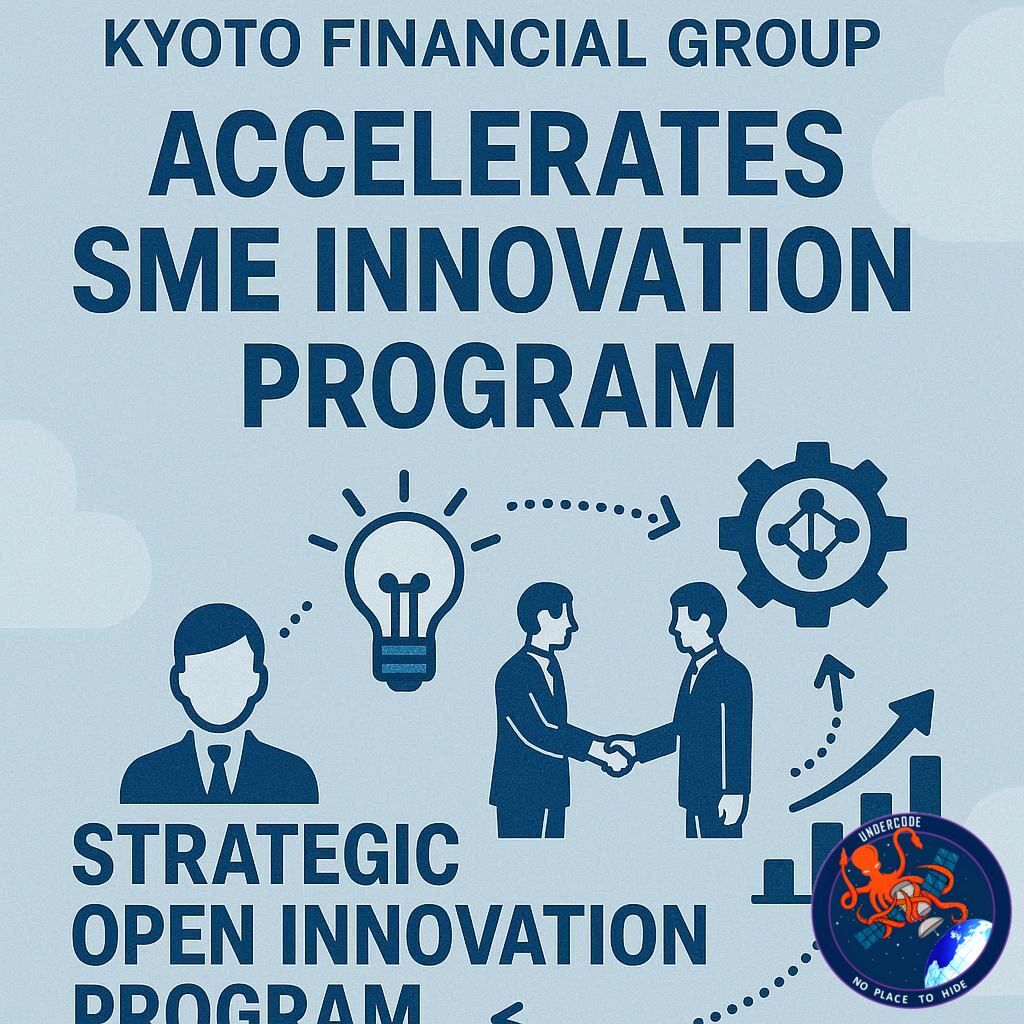
🎯 Introduction: A Regional Financial Powerhouse Steps Beyond Banking
In a bold move to redefine its role in regional economic development, Kyoto Financial Group has taken a proactive stance in nurturing innovation among small and medium-sized enterprises. Rather than remaining a traditional financial intermediary, the group is positioning itself as a catalyst for collaboration, technological adoption, and business creation. Its recently concluded open innovation program marks a significant step toward transforming how local businesses evolve in an increasingly competitive and digital economy.
🔥 Main Summary: How Kyoto FG’s 8-Month Innovation Program Reshaped SME Growth
Kyoto Financial Group announced the results of its open innovation program on the 24th, showcasing a strategic initiative aimed at empowering small and medium-sized enterprises to develop new business opportunities. The program, designed in collaboration with KPMG Japan, ran for eight months and involved four participating companies from the Kyoto region. These companies engaged in weekly sessions with emerging startup partners, focusing on collaboration-driven innovation.
The core objective of the program was to bridge the gap between traditional industries and cutting-edge technologies. Participating firms explored practical applications of artificial intelligence, conducted market research, and developed new business concepts tailored to evolving consumer and industrial demands. By pairing established companies with agile startups, the initiative created a dynamic environment where experience met innovation.
One notable participant, Ikuta Industrial Machinery, a Kyoto-based metal processing equipment manufacturer, leveraged the program to explore advanced AI integration within its manufacturing processes. This reflects a broader trend among traditional manufacturers seeking to modernize operations and remain competitive in global markets.
The weekly collaborative meetings served as the backbone of the program, ensuring consistent progress and iterative development. These sessions allowed companies to refine ideas, test assumptions, and adapt strategies in real time. Unlike conventional consulting models, this hands-on, partnership-driven approach emphasized experimentation and co-creation.
Kyoto Financial Group’s involvement extended beyond funding. The institution actively facilitated connections, provided strategic guidance, and created a structured environment for innovation. Its partnership with KPMG Japan added analytical depth and global expertise, enhancing the program’s credibility and effectiveness.
This initiative comes at a critical time for regional economies in Japan, where population decline and aging demographics pose significant challenges. Local financial institutions are increasingly under pressure to diversify their roles, moving beyond lending to actively supporting business growth and regional revitalization.
The program also highlights a growing trend among regional banks, credit unions, and cooperative financial institutions to strengthen their competitiveness through mergers, new business development, and the cultivation of local enterprises. By fostering innovation ecosystems, these institutions aim to sustain economic vitality in areas facing structural decline.
Ultimately, Kyoto FG’s program demonstrates how financial institutions can act as enablers of transformation. By connecting SMEs with startups and equipping them with tools for innovation, the initiative has laid the groundwork for sustainable business growth and regional economic resilience.
🧩 The Strategic Shift from Financing to Innovation Leadership
Kyoto Financial Group’s initiative signals a deeper transformation within the banking sector, where value creation is no longer limited to capital provision but extends to ecosystem building and strategic facilitation.
🧩 Bridging Traditional Industries with Emerging Technologies
The collaboration between established manufacturers and startups underscores the importance of technological adaptation, particularly in integrating AI and data-driven decision-making into legacy operations.
🧩 Weekly Collaboration as a Catalyst for Real Progress
The structured, recurring meetings ensured accountability and continuous development, preventing stagnation and encouraging agile thinking among participants.
🧩 Regional Revitalization Through Corporate Collaboration
By focusing on local enterprises, the program directly contributes to strengthening Kyoto’s economic fabric, addressing broader challenges such as population decline and market contraction.
🧩 Financial Institutions Redefining Their Core Identity
This initiative reflects a broader industry trend where banks evolve into innovation partners, offering strategic value beyond financial services.
🧩 Startup Partnerships as Engines of Disruption
The involvement of emerging companies introduced fresh perspectives, enabling traditional businesses to rethink processes, products, and market strategies.
🧩 The Role of Global Expertise in Local Innovation
KPMG Japan’s collaboration added analytical rigor and global best practices, ensuring that the program’s outcomes were both practical and scalable.
What Undercode Say:
Kyoto Financial Group’s approach reveals a subtle but powerful shift in how regional economies might survive the next decade. The real story here is not just about SMEs experimenting with AI or conducting market research. It is about redefining the role of trust-based institutions in a time when trust alone is no longer enough.
Banks historically thrived on stability, predictability, and risk aversion. Innovation, on the other hand, thrives on uncertainty, experimentation, and calculated risk. What Kyoto FG has done is attempt to merge these opposing philosophies into a workable model. That is not easy, and it is not guaranteed to succeed, but it is necessary.
The choice to run an eight-month program is also telling. It is long enough to produce meaningful results, yet short enough to maintain urgency. Many innovation programs fail because they either rush outcomes or drag on without direction. This balance suggests careful design rather than symbolic effort.
Another critical insight lies in the weekly collaboration model. Consistency often matters more than intensity in innovation. By forcing regular interaction, the program ensures that ideas evolve instead of fading into inactivity. It creates a rhythm of accountability that traditional corporate environments often lack.
The inclusion of startups is equally strategic. Startups bring speed and adaptability, but they often lack resources and industry depth. SMEs, especially in manufacturing, possess deep expertise but struggle with agility. Combining the two is not just beneficial, it is almost inevitable in modern economies.
However, there is an underlying risk. Not all collaborations lead to scalable business outcomes. Some may result in interesting prototypes that never reach commercialization. The true measure of success will not be the number of ideas generated, but how many evolve into sustainable revenue streams.
Another layer worth examining is the involvement of KPMG Japan. Consulting firms often bring structure and analytical frameworks, but they can also unintentionally standardize innovation, which should ideally remain fluid. The challenge is maintaining creativity while applying discipline.
From a macro perspective, this initiative reflects a survival strategy for regional Japan. With declining populations and shrinking local markets, organic growth is no longer sufficient. Innovation is no longer optional; it is existential.
Financial institutions stepping into this role may also be a response to declining profitability in traditional banking. Low interest rates and reduced lending opportunities push banks to explore new value propositions. Acting as innovation facilitators could become a new revenue and relevance stream.
There is also a reputational dimension. By supporting local businesses, Kyoto FG strengthens its brand as a community-centric institution. This can lead to long-term loyalty, which is increasingly rare in modern financial ecosystems.
Yet, the biggest question remains scalability. Can this model be replicated across other regions, industries, or even countries? Or is it uniquely suited to Kyoto’s industrial and cultural landscape?
The answer likely depends on execution. Programs like this are easy to announce but difficult to sustain. Continuous iteration, measurable outcomes, and genuine commitment will determine whether this becomes a blueprint or just another pilot project.
In the end, Kyoto Financial Group is not just supporting innovation. It is testing a new identity for regional finance. Whether that identity becomes the future standard or a temporary experiment will depend on what happens after the program ends.
🔍 Fact Checker Results
✅ Kyoto Financial Group launched an 8-month open innovation program with SME participation
✅ The program included collaboration with startups and support from KPMG Japan
❌ No confirmed large-scale commercial outcomes from the program have been publicly detailed yet
📊 Prediction
📈 Regional banks will increasingly adopt innovation programs to remain relevant
📉 Traditional lending-only models will continue to decline in influence
⚙️ SME-startup collaborations will become a standard approach for industrial transformation
▶️ Related Video (86% Match):
🕵️📝✔️Let’s dive deep and fact‑check.
References:
Reported By: xtechnikkeicom_71b3581069fc24504b4b2710
Extra Source Hub (Possible Sources for article):
https://www.quora.com/topic/Technology
Wikipedia
OpenAi & Undercode AI
Image Source:
Unsplash
Undercode AI DI v2
Bing
🔐JOIN OUR CYBER WORLD [ CVE News • HackMonitor • UndercodeNews ]
📢 Follow UndercodeNews & Stay Tuned:
𝕏 formerly Twitter 🐦 | @ Threads | 🔗 Linkedin | 🦋BlueSky | 🐘Mastodon


