
Listen to this Post
 Introduction: A New Era of Exploring Worlds Beyond Our Solar System
The exploration of exoplanets has long been limited by imagination, data tables, and static imagery. Now, researchers at Kyoto University are pushing the boundaries of how humanity interacts with the cosmos. By launching an advanced 3D visualization database, they have transformed distant, abstract celestial bodies into immersive, explorable environments. This innovation not only enhances scientific understanding but also opens the door to a more interactive and educational experience for anyone curious about worlds beyond Earth.
the Original Development and Features
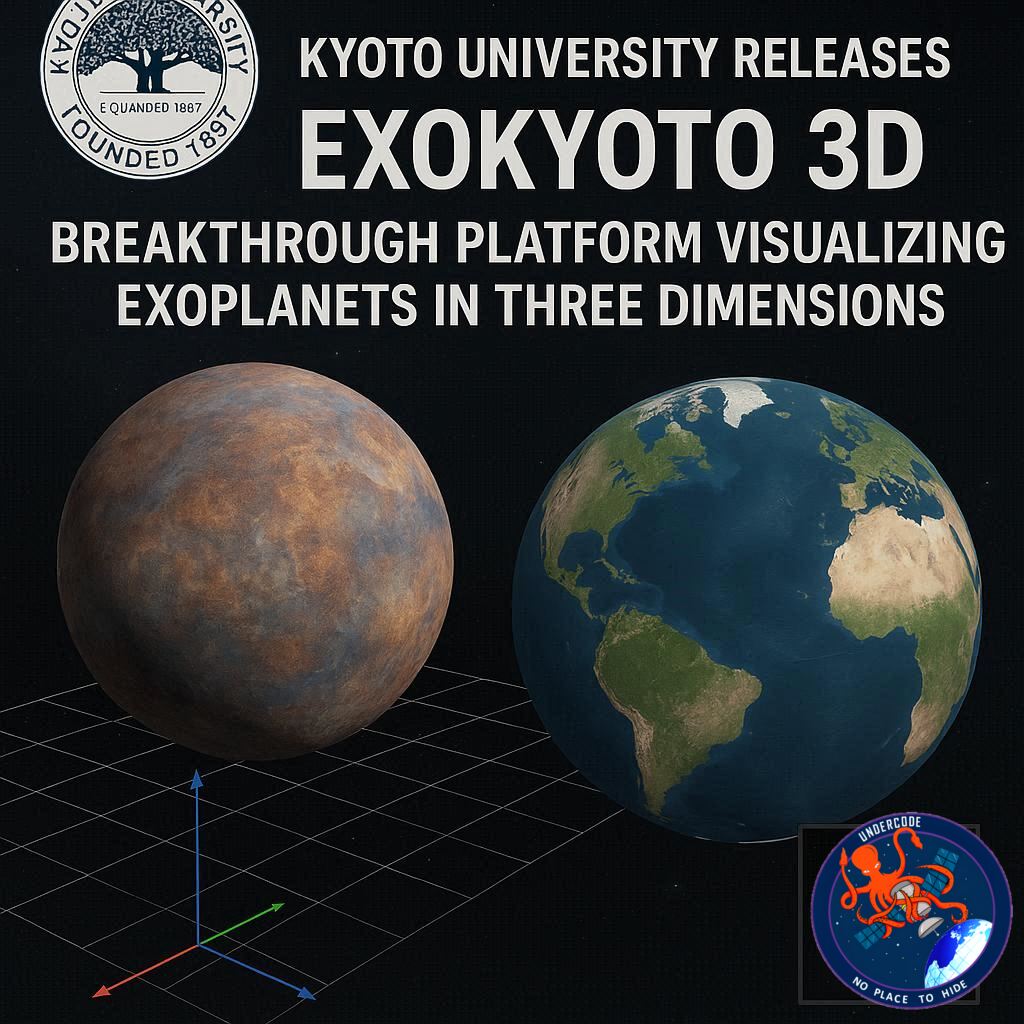
A research team led by Professor Yosuke Yamashiki at Kyoto University has officially released a groundbreaking database software that visualizes exoplanets in three dimensions. The platform, named “ExoKyoto 3D,” allows users to search for planets based on criteria such as name and classification. It provides free access to detailed planetary data, including size, distance from their host stars, and conceptual visual representations.
The project builds upon an earlier 2D version introduced in 2016. This latest iteration significantly enhances performance by incorporating artificial intelligence to optimize processing speed and rendering capabilities. As a result, users can now interact with a database containing approximately 6,000 exoplanets with improved responsiveness and visual fidelity.
One of the most compelling features of ExoKyoto 3D is its interactive interface. By clicking on a star within the system, users can travel through a 3D star map directly to the selected planet. Once there, the software displays environmental details such as surface conditions and estimated temperatures. It also reconstructs the night sky as seen from that planet and visualizes its orbital motion, creating a dynamic and immersive experience.
The project also reflects a collaborative spirit. Some of the conceptual planetary illustrations were developed in partnership with students from Shiga Prefectural Moriyama High School, demonstrating a blend of academic research and educational outreach.
The database aligns with Kyoto
Among the thousands of known exoplanets, those located at an optimal distance from their stars may support liquid water on their surfaces, a key factor in the potential development of life. ExoKyoto 3D is expected to assist scientists and researchers in evaluating the habitability of such planets more effectively.
Beyond research applications, the database is designed as a powerful educational and science communication tool. Professor Yamashiki highlighted that users can virtually experience living on or traveling to various stars across the universe. The development team is currently working on a more advanced version that incorporates the element of time, aiming for a release around July, which would allow users to observe cosmic changes over time.
What Undercode Say: The Strategic Impact of Interactive Space Visualization
The release of ExoKyoto 3D is more than just a technological upgrade, it represents a paradigm shift in how astronomical data is consumed, interpreted, and applied. Traditionally, space research has been confined to specialists working with raw datasets, simulations, and indirect observation methods. This platform disrupts that model by democratizing access to complex cosmic information.
The integration of artificial intelligence into the system is particularly significant. AI does not merely enhance speed, it fundamentally changes how data relationships are discovered. In the context of exoplanet research, this could lead to faster identification of habitable zones, pattern recognition in planetary formation, and even predictive modeling of undiscovered celestial bodies.
Another critical aspect lies in user interaction. Visualization transforms abstract numbers into tangible experiences. When users can “travel” to a planet, observe its environment, and see its orbit, comprehension deepens dramatically. This has profound implications for education, especially in STEM fields, where engagement often determines long-term interest and career direction.
The collaboration with high school students is not just symbolic. It signals a shift toward inclusive scientific development, where younger generations are not passive learners but active contributors. This approach could reshape how future scientific tools are built, blending academic rigor with creative input from diverse age groups.
From a strategic standpoint, ExoKyoto 3D aligns closely with the global race for space exploration and colonization. As private companies and national agencies accelerate missions to Mars and beyond, the need for precise planetary data becomes critical. Tools like this could serve as foundational infrastructure for mission planning, habitat simulation, and risk assessment.
There is also a subtle but powerful cultural dimension. By enabling people to virtually “visit” distant planets, the platform nurtures a collective imagination about life beyond Earth. This is not trivial. Public perception and interest often influence funding, policy decisions, and the overall pace of scientific advancement.
However, challenges remain. The accuracy of simulated environments depends heavily on available data, which is still incomplete for many exoplanets. There is also the risk of oversimplification, where visually appealing models might be mistaken for fully accurate representations. Maintaining scientific integrity while enhancing accessibility will be a delicate balance.
Looking forward, the planned addition of time-based data could elevate the platform to an entirely new level. Observing how planetary systems evolve over time introduces a dynamic layer that could revolutionize both research and education. It moves the experience from static observation to temporal exploration, which is closer to how the universe actually behaves.
In essence, ExoKyoto 3D is not just a database, it is an interface between humanity and the unknown. It compresses vast cosmic distances into a format that can be explored from a screen, making the universe feel less distant and more within reach.
Fact Checker Results
✅ Kyoto University developed and released a 3D exoplanet visualization database called ExoKyoto 3D
✅ The platform includes around 6,000 exoplanets with interactive 3D exploration features
❌ Full environmental accuracy of all planets cannot be guaranteed due to limited observational data
Prediction
📊 The integration of AI-driven visualization tools will accelerate exoplanet discovery and classification
📊 Educational institutions will increasingly adopt immersive space simulations as standard learning tools
📊 Virtual exploration platforms like ExoKyoto 3D may influence future space mission planning and public support
🕵️📝✔️Let’s dive deep and fact‑check.
References:
Reported By: xtechnikkeicom_af38ed8278b30a5dc71b0b49
Extra Source Hub (Possible Sources for article):
https://www.instagram.com
Wikipedia
OpenAi & Undercode AI
Image Source:
Unsplash
Undercode AI DI v2
Bing
🔐JOIN OUR CYBER WORLD [ CVE News • HackMonitor • UndercodeNews ]
📢 Follow UndercodeNews & Stay Tuned:
𝕏 formerly Twitter 🐦 | @ Threads | 🔗 Linkedin | 🦋BlueSky | 🐘Mastodon


