
Listen to this Post
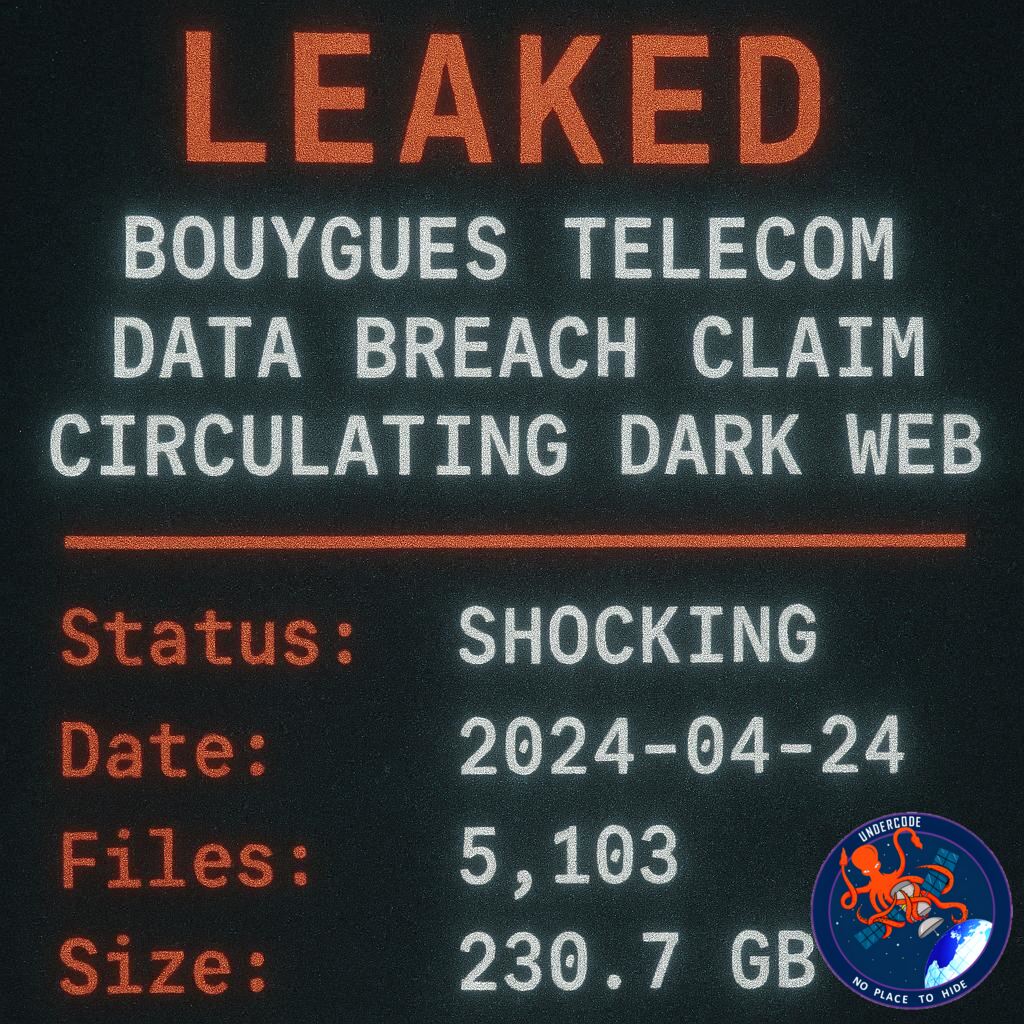
📌 the Original Claim (Bouygues Telecom Dataset Allegation)
A dark web forum post allegedly published by a group calling itself “OverSec” has surfaced, claiming possession of a massive Bouygues Telecom dataset.
The claim suggests a data package of approximately 80.9 GB in JSON format.
The seller reportedly offers proof only through private, controlled sessions rather than public verification.
A limited sample has been shared, but it appears heavily obfuscated and partially unreadable.
No clear technical evidence has been provided to validate the authenticity of the dataset.
There is no confirmed breach vector explaining how the data was allegedly obtained.
No timeline of the incident has been disclosed by the actors involved.
The systems or infrastructure affected remain unspecified in the claim.
The group “OverSec” is not widely recognized in established cybersecurity threat databases.
This raises immediate concerns regarding credibility and motivation behind the leak.
Security analysts note that “private proof sessions” are often used to avoid independent verification.
Such tactics can be used to selectively show data while hiding inconsistencies.
The large file size claim lacks supporting schema or structural breakdown of contents.
Without schema validation, it is impossible to determine if the data is real or synthetic.
Experts suggest the dataset could be repackaged from older leaks or scraped sources.
There is also the possibility of fabricated data designed for resale attention.
Telecom data, if legitimate, would typically include subscriber identifiers and metadata.
Such information could pose high risks for identity theft and SIM swap attacks.
It could also enable targeted phishing campaigns against customers.
Brand impersonation attempts could increase if attackers exploit the Bouygues name.
No third-party cybersecurity firm has confirmed the dataset’s legitimacy.
At present, it remains an unverified claim circulating in underground markets.
The risk level is considered medium to low confidence due to lack of proof.
Monitoring continues for potential public leaks or independent validation.
The telecom sector is advised to watch for abnormal fraud activity.
Social engineering attempts may increase if the claim gains traction.
Customers could be targeted with realistic-looking scams using leaked-style data.
Until verified, the dataset should not be treated as confirmed breach evidence.
The situation remains open and under observation by threat analysts.
Overall, the claim currently stands as unverified with insufficient technical proof.
🧠 What Undercode Say:
⚠️ Narrative Control Tactics in Dark Web Markets
The Bouygues Telecom claim follows a familiar pattern seen in underground forums where sellers avoid public verification. By restricting “proof” to private sessions, threat actors gain control over what is shown and what is hidden. This method is often used to maintain leverage while preventing independent forensic validation. It allows sellers to appear credible without exposing inconsistencies in their datasets. In many cases, this tactic is associated with low-quality or partially fabricated leaks designed to attract buyers or attention.
📊 Dataset Size Claims Without Technical Depth
An 80.9 GB dataset sounds significant, but size alone is not a meaningful indicator of legitimacy. Without schema, table structure, or field definitions, the claim lacks technical grounding. Real telecom breaches typically include detailed metadata descriptions and system-level context. The absence of such indicators suggests either poor-quality data aggregation or intentional inflation of dataset value. This is a common strategy in underground markets to increase perceived worth.
🔍 Ambiguous Group Identity and Credibility Issues
The actor group “OverSec” is not widely documented in established cybersecurity intelligence circles. Unknown or newly formed groups often surface in leak markets to simulate credibility. However, lack of historical activity reduces trust in their operational capability. Established threat actors usually have consistent patterns, past incidents, or recognizable techniques. In contrast, this claim provides no attribution chain or prior evidence of activity.
📡 Potential Data Repurposing or Recycling
One strong possibility is that the dataset originates from previously leaked telecom databases. Cybercriminals frequently repackage old data, restructure it into new formats, and resell it as fresh breaches. JSON formatting alone does not confirm originality. Without timestamps, schema consistency, or system identifiers, reuse cannot be ruled out. This significantly lowers the reliability of the claim.
🎭 Fabrication as a Monetization Strategy
Fabricated leaks are increasingly used as a monetization tactic in underground forums. Sellers generate attention by attaching well-known brand names like Bouygues Telecom to attract buyers. Even if no real breach exists, the perceived association with a major telecom company increases market interest. This tactic relies heavily on fear, uncertainty, and urgency rather than technical truth.
📉 Lack of Breach Vector Weakens Validity
A critical missing component in the claim is the absence of a breach vector. No explanation is provided for how the alleged data was accessed. In legitimate cybersecurity incidents, attack paths such as credential theft, API exploitation, or system intrusion are usually identified. The absence of this detail strongly suggests either incomplete fabrication or deliberate omission.
🧩 Risk Exposure if Data Were Real
If the dataset were authentic, it could pose serious risks including identity theft, SIM swapping, and targeted phishing. Telecom data is highly sensitive because it links personal identity with communication infrastructure. Attackers could exploit such information to bypass authentication systems or impersonate service providers. This makes even unverified claims worth monitoring closely.
🧭 Market Behavior and Attention Exploitation
Dark web markets often thrive on attention-driven pricing. The mere mention of a large telecom dataset can increase engagement, even without proof. Sellers exploit curiosity and fear to create artificial demand. This dynamic means that credibility is often secondary to visibility in underground ecosystems.
🧪 Verification Gaps and Intelligence Limitations
At present, there is no external validation confirming the Bouygues Telecom dataset. No cybersecurity firm, breach tracking service, or independent analyst has verified the claim. This creates a significant intelligence gap. Without corroboration, the dataset remains in a speculative category rather than confirmed breach status.
📊 Overall Threat Assessment Perspective
From a threat intelligence standpoint, the claim currently falls into a low-to-medium confidence category. It should not be ignored entirely due to potential telecom sector impact. However, it also should not be treated as confirmed evidence of compromise. Continuous monitoring remains the most appropriate response strategy.
🔍 Fact Checker Results
❌ No verified proof of Bouygues Telecom breach has been publicly confirmed
❌ “OverSec” group lacks established cybersecurity credibility history
❌ Dataset structure and sample evidence are insufficient for validation
📊 Prediction
The claim is likely to evolve into one of three outcomes:
It may disappear without further evidence if it is purely fabricated.
It may reappear later with recycled or partially modified datasets.
Or it could escalate into a confirmed leak if independent validation emerges in the coming weeks.
🕵️📝Let’s dive deep and fact‑check.
References:
Reported By: x.com
Extra Source Hub (Possible Sources for article):
https://www.reddit.com
Wikipedia
OpenAi & Undercode AI
Image Source:
Unsplash
Undercode AI DI v2
Bing
🔐JOIN OUR CYBER WORLD [ CVE News • HackMonitor • UndercodeNews ]
📢 Follow UndercodeNews & Stay Tuned:
𝕏 formerly Twitter 🐦 | @ Threads | 🔗 Linkedin | 🦋BlueSky | 🐘Mastodon


