
Listen to this Post
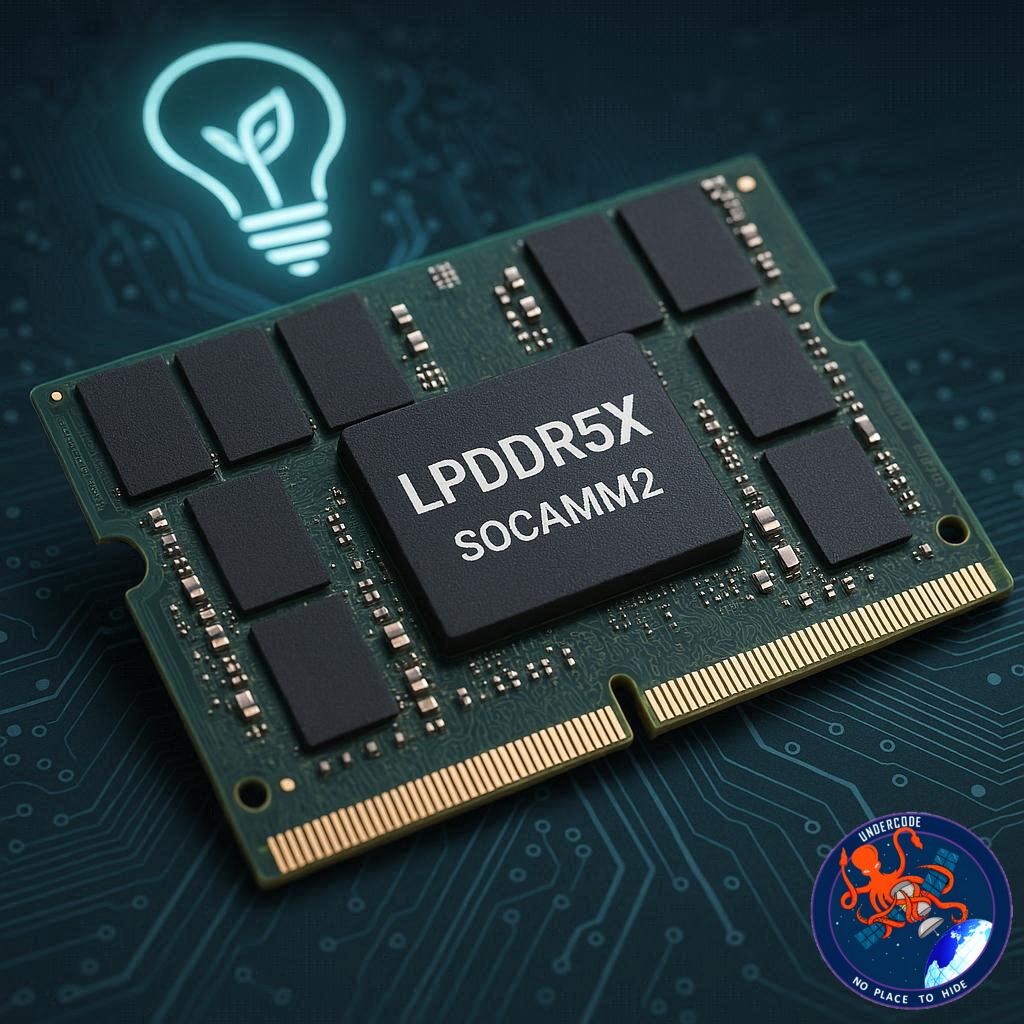
Introduction: A New Era for Data Center Memory
Modern data centers are undergoing a profound transformation. As artificial intelligence, cloud computing, and real-time analytics continue to expand, the demand placed on server infrastructure has reached unprecedented levels. At the heart of this evolution lies memory, no longer just a supporting component, but a decisive factor in performance, scalability, and power efficiency.
Traditional memory technologies like DDR-based RDIMMs have steadily improved over the years. However, the growing pressure to reduce energy consumption while increasing performance has pushed the industry to explore alternative solutions. One of the most promising developments is the emergence of LPDDR5X memory in the SOCAMM2 form factor, a combination that could redefine how servers are designed and optimized for the future.
The Rising Pressure on Server Memory
In today’s data centers, memory plays a central role in determining system performance. Workloads such as AI inference, real-time data processing, and distributed databases require massive bandwidth and increasingly larger memory capacities.
At the same time, power consumption has become a critical limitation. Data centers are no longer constrained only by physical space, but also by how much energy they can consume and dissipate. While CPUs and GPUs are often blamed for high energy usage, memory contributes a significant portion of the total power footprint.
As operators aim to maximize performance per watt, improving memory efficiency has become a strategic priority. This shift is driving the exploration of new memory technologies that can deliver both speed and energy savings.
Understanding LPDDR5X SOCAMM2
LPDDR5X is a low-power memory technology originally developed for mobile devices, where energy efficiency is essential. It operates at lower voltages compared to traditional DDR memory while maintaining high data transfer rates.
However, there has always been a major limitation. LPDDR memory was designed to be soldered directly onto motherboards, making it difficult to upgrade or replace in server environments.
The introduction of SOCAMM2 changes this completely. This JEDEC-standard form factor allows LPDDR5X to be deployed as a modular, replaceable component, similar to traditional server memory. It combines the energy efficiency of mobile memory with the flexibility and serviceability required in data centers.
Why LPDDR5X Matters for Servers
The biggest advantage of LPDDR5X is its energy efficiency. By operating at lower voltages and optimizing power usage during both active and idle states, it significantly reduces overall energy consumption.
In large-scale data centers, even small efficiency gains can lead to substantial cost savings. When each server contains large amounts of memory, reducing power usage per module can dramatically lower electricity and cooling expenses.
Bandwidth is another key benefit. LPDDR5X supports very high data rates, enabling faster communication between processors and memory. This is especially important for workloads like AI, data streaming, and web-scale applications that rely heavily on memory throughput.
Together, these benefits translate into improved performance per watt, a metric that is becoming increasingly important in modern computing.
SOCAMM2 vs RDIMM: A Shift in Design Philosophy
Traditional server memory, such as DDR5 RDIMMs, offers high capacity, mature ecosystem support, and strong reliability features. However, these modules tend to consume more power and occupy more physical space.
SOCAMM2 modules, on the other hand, are designed to be smaller and more energy-efficient. Their horizontal layout allows for better airflow and simpler cooling solutions, which can significantly improve thermal management inside servers.
This compact design enables higher server density within racks. Data centers can fit more compute power into the same physical space while reducing heat generation and cooling complexity.
Despite these advantages, LPDDR5X still faces challenges, particularly in reliability, availability, and serviceability, commonly referred to as RAS.
The RAS Challenge: A Work in Progress
One area where traditional DDR memory still dominates is RAS capabilities. Server-grade DDR modules include advanced error correction and fault tolerance features that are critical for 24/7 operation.
LPDDR5X, originally designed for mobile devices, does not yet match this level of robustness. However, the industry is actively working to close this gap. Enhancements such as additional error correction mechanisms and improved memory controller support are being developed.
For now, LPDDR5X SOCAMM2 may be best suited for environments where software-level resilience can compensate for hardware limitations. Over time, as RAS features improve, its adoption is expected to expand.
Industry Momentum and Ecosystem Support
Major memory manufacturers including Micron, Samsung, and SK hynix are already investing in LPDDR5X SOCAMM2 products. This growing ecosystem is a strong indicator that the technology is gaining traction.
At the same time, companies like AMD are working to integrate this memory into future server platforms. The collaboration between hardware vendors and memory manufacturers is essential to ensure compatibility and optimize performance.
This collective effort highlights the industry’s commitment to improving energy efficiency across the entire computing stack.
What Undercode Say:
A Strategic Shift Toward Efficiency
The transition to LPDDR5X SOCAMM2 is not just a technical upgrade; it represents a broader strategic shift in how data centers are designed. The industry is moving from raw performance metrics to a more balanced approach that prioritizes efficiency, scalability, and sustainability.
Power as the New Bottleneck
For years, computing innovation focused on increasing processing power. Today, energy consumption has become the primary constraint. Data centers are hitting limits not because they lack hardware capacity, but because they cannot supply or cool additional power.
Memory as a Leverage Point
Memory has emerged as a key leverage point for improving system efficiency. Unlike CPUs and GPUs, which are already highly optimized, memory still offers significant room for innovation, especially in reducing power consumption.
The Modular Advantage
SOCAMM2 solves one of the biggest limitations of LPDDR technology by introducing modularity. This is a critical step because data centers require components that can be easily replaced and upgraded without disrupting operations.
Not a Replacement, But a Complement
LPDDR5X is unlikely to replace DDR memory entirely. Instead, it will coexist as a complementary solution tailored for specific workloads that prioritize energy efficiency over maximum reliability.
AI Workloads Driving Change
Artificial intelligence is a major driver behind this shift. AI workloads demand high bandwidth but can often tolerate different reliability trade-offs, making them ideal candidates for LPDDR5X adoption.
Cooling and Density Benefits
Reducing memory power consumption has a ripple effect. Lower heat output simplifies cooling systems, which in turn reduces infrastructure costs and allows for higher server density.
Ecosystem Maturity Will Decide Adoption
The success of LPDDR5X SOCAMM2 will depend heavily on ecosystem maturity. This includes not just hardware, but also software optimization, compatibility, and industry standards.
Gradual Evolution, Not Instant Disruption
The transition will not happen overnight. Just like previous memory generations, LPDDR5X will gradually improve and gain adoption as its limitations are addressed.
AMD’s Strategic Positioning
AMD’s plan to support LPDDR5X SOCAMM2 in its future EPYC processors positions it as a key player in this transition. By offering both traditional and low-power memory options, AMD is giving customers flexibility based on their specific needs.
Fact Checker Results
✅ LPDDR5X provides lower power consumption compared to traditional DDR memory
✅ SOCAMM2 enables modular deployment of LPDDR memory in servers
❌ LPDDR5X currently matches DDR5 RDIMM in RAS capabilities (it still lags behind)
Prediction
The adoption of LPDDR5X SOCAMM2 will accelerate rapidly after 2027 as RAS improvements mature and hyperscalers prioritize energy efficiency. 🚀
Hybrid memory architectures combining DDR and LPDDR will become standard in AI-focused data centers. ⚡
Vendors that optimize for performance per watt rather than raw power will lead the next generation of infrastructure innovation. 🔮
🕵️📝✔️Let’s dive deep and fact‑check.
References:
Reported By: www.amd.com
Extra Source Hub (Possible Sources for article):
https://www.discord.com
Wikipedia
OpenAi & Undercode AI
Image Source:
Unsplash
Undercode AI DI v2
Bing
🔐JOIN OUR CYBER WORLD [ CVE News • HackMonitor • UndercodeNews ]
📢 Follow UndercodeNews & Stay Tuned:
𝕏 formerly Twitter 🐦 | @ Threads | 🔗 Linkedin | 🦋BlueSky | 🐘Mastodon


