
Listen to this Post
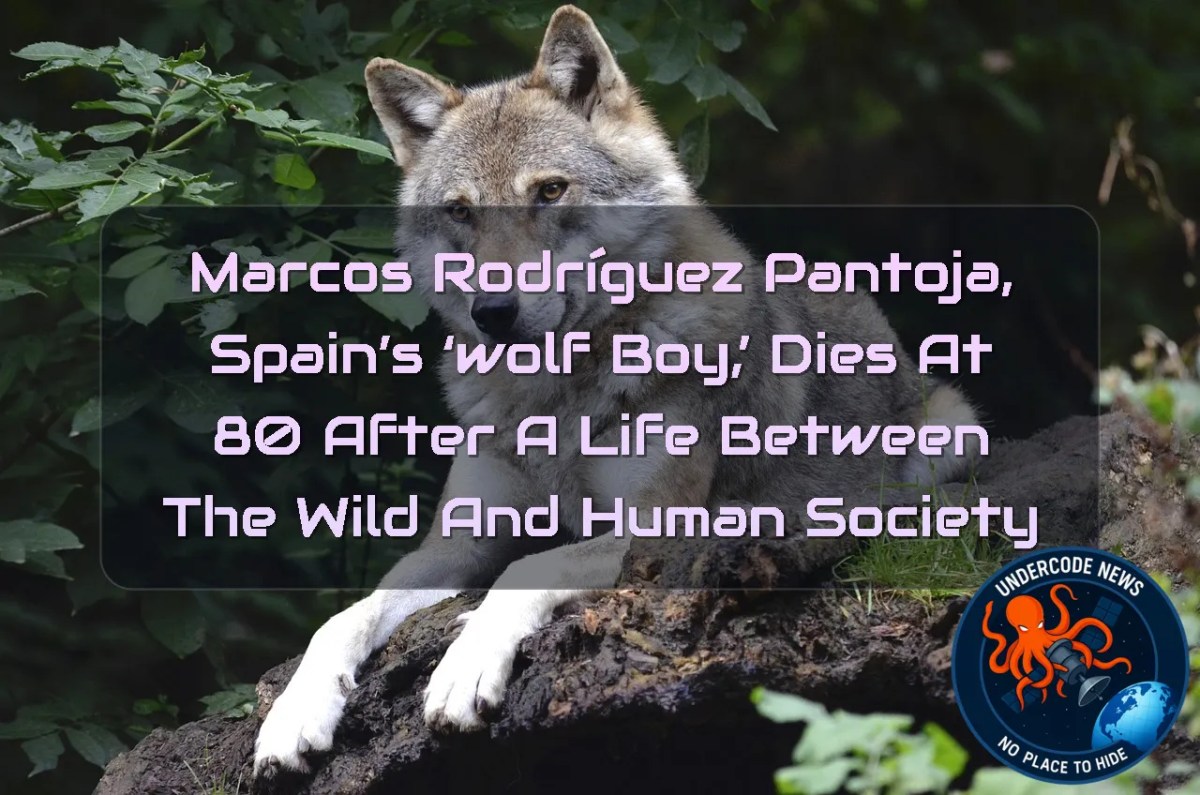 A Life That Sounds Like a Legend but Was Born From Real Hardship
Marcos Rodríguez Pantoja, the Spanish man whose extraordinary childhood among the animals of Sierra Morena turned him into one of the country’s most remarkable modern legends, has died at the age of 80. He passed away on August 15, 2026, in Rante, a small village in the municipality of San Cibrao das Viñas in Ourense, north-western Spain. After decades of instability, exploitation and difficult attempts to adapt to ordinary society, Rante had become the place he finally considered home.
The End of an Extraordinary Journey
His death closes a life story that seems almost impossible to believe: a boy born into poverty, sent away from his family at the age of six, left alone in the mountains after the death of an elderly goatherd, and eventually living for more than a decade in close proximity to wild animals.
But behind the extraordinary nickname of the “wolf boy” was something much more painful. Marcos did not choose isolation because he was looking for adventure. As a child, he was pushed into the wilderness by circumstances that left him with very few alternatives.
A Childhood Defined by Poverty and Abuse
Marcos was born in 1946 in Añora, Córdoba, in Andalusia, during a period when Spain was still struggling with the consequences of the Civil War and severe poverty.
His early years were marked by hunger, family instability and mistreatment. According to accounts of his life, his father eventually sent him to work with a goatherd when he was only six years old. The elderly shepherd became the closest thing Marcos had to a teacher and guardian, introducing him to the practical skills required to survive in the mountains.
The Mountains Became His Only Home
The arrangement changed dramatically when the shepherd died. Marcos was still a child, but suddenly there was no adult left to guide him.
Instead of returning to a stable family environment, he remained in the mountains. Over the years, the wilderness stopped being an unfamiliar and frightening place. It became his home.
He learned how to find food, locate water, move through difficult terrain and make use of whatever resources the landscape provided.
Twelve Years Without Ordinary Human Contact
Marcos spent more than a decade in the mountains, with accounts generally describing a period of roughly 12 years before he was discovered by the Guardia Civil in 1965 at around 19 years old.
During those years, his relationship with the natural world became the defining feature of his existence.
He learned the sounds of animals and developed his own methods of communication. He later said that he could imitate birds, deer and other animals, and he described an unusually close relationship with wolves that lived in the region.
The Wolves Became His Family
The most famous part of
He described feeding wolf cubs and being welcomed by the animals. In his accounts, the relationship became so close that he regarded the wolves almost as parents and family members.
One of the stories he repeatedly told involved calling the wolves when he needed help hunting. He believed that the animals understood his signals and that they sometimes drove prey toward him.
These details became central to his public identity, although they should be understood primarily as Marcos’s recollections of his extraordinary childhood rather than as scientifically established evidence that a wolf pack literally adopted him in the human sense.
Survival Required Intelligence, Not Just Courage
The story is often presented as an unbelievable tale of a boy living with wolves. Yet the deeper lesson is less about wolves and more about human adaptability.
Marcos had to observe his environment constantly. He needed to understand where food could be found, which areas were dangerous, how animals behaved and how weather could change conditions in the mountains.
Anthropologist Gabriel Janer Manila later studied Marcos extensively, conducting interviews between November 1975 and April 1976. Janer’s work became an important part of the documented history surrounding Marcos’s childhood and later inspired the book He jugado con lobos.
The Anthropologist Who Took His Story Seriously
Gabriel Janer Manila did more than simply record a strange story. His work attempted to understand how a child could adapt psychologically and socially to an environment almost completely removed from normal human society.
Janer viewed Marcos as someone who had survived through intelligence, imagination and extraordinary adaptability.
That distinction matters. Marcos was not simply “raised by wolves” in the mythical sense. He was a human child forced into extreme circumstances who developed survival strategies based on the environment around him.
A Different Kind of Language
One of the most striking consequences of his isolation was the way Marcos interacted with language.
After years with little conventional human communication, ordinary Spanish was no longer the only system through which he understood the world. Animal sounds, movements, environmental signals and physical reactions had become far more important to him.
His later reintegration into society therefore involved much more than learning to live in a house again.
He had to relearn social rules, communication, routines and expectations that most people absorb naturally during childhood.
Being Found Was Not the End of His Struggle
When the Guardia Civil found Marcos in 1965, his mountain life suddenly ended.
For most people, being rescued would represent the obvious happy ending. For Marcos, however, it was the beginning of another painful transformation.
He had to enter a society whose rules were unfamiliar to him. According to accounts of his life, priests and nuns helped teach him basic social behaviors and communication, while he later completed military service and worked in different places, including hotels and restaurants.
The Paradox of His Rescue
Marcos later made a statement that challenged the way people naturally interpret his story.
He repeatedly said that he had been happy in the mountains.
He did not remember those years simply as a period of deprivation. In his own understanding, the wilderness had provided food, companionship and freedom, while human society brought confusion, exploitation and painful experiences.
That does not mean that his childhood circumstances were healthy or desirable. It does, however, reveal how deeply a person can adapt psychologically to the environment in which they are forced to live.
Society Was More Difficult Than the Wilderness
One of the most haunting elements of
He had little understanding of money and struggled with social conventions. Reports about his later life describe people taking advantage of his naivety and unfamiliarity with society.
In a strange reversal, the boy who had survived alone in the mountains could become vulnerable when surrounded by other human beings.
The World Saw a Legend, but He Lived the Consequences
As Marcos grew older, his story attracted journalists, researchers, filmmakers and curious visitors.
The public saw an incredible tale.
Marcos lived with the consequences.
His experiences were repeatedly questioned, examined and retold. Some people doubted his stories, while others became fascinated by them.
Yet the emotional core of his life was not whether every detail of his memories could be independently reconstructed. It was the fact that a child had endured profound abandonment and then spent the rest of his life trying to make sense of two completely different worlds.
His Return to Añora After Six Decades
In 2010, Marcos returned to his hometown of Añora for the first time in roughly 60 years.
The moment carried enormous emotional weight. He was returning to the place where his childhood had begun, but he was no longer the frightened boy who had once left it.
By then, he had become internationally known as the “wolf boy.”
In an interview for
A Story That Reached the Cinema
Marcos’s life eventually became the inspiration for the Spanish film Entrelobos, directed by Gerardo Olivares.
The film helped introduce his story to a much wider audience and contributed to a renewed public interest in his life.
RTVE also documented his later years, showing how different his existence in Rante had become compared with his childhood in Sierra Morena.
Rante Finally Became Home
In 2001, Marcos settled in Rante, a small village in Ourense.
There, the story changed.
For perhaps the first time in his life, he was no longer simply someone being moved from one place to another. He became part of a community.
Residents knew him personally. He became a familiar presence in the village, and his extraordinary past became just one part of his identity.
From Outsider to Beloved Neighbor
That transformation is arguably the most important chapter of his life.
For years, Marcos had been treated as a curiosity: the wild child, the wolf boy, the strange man who claimed to have lived with animals.
In Rante, however, he became a neighbor.
RTVE reported during his lifetime that people in the community had grown fond of him, with residents describing him as helpful and affectionate toward both children and animals.
The village gave him something that neither the mountains nor the institutions he passed through had fully provided: belonging.
His Final Years Were Marked by Peace
Recent reports say that Marcos had lived in Rante since 2001 and regarded the village as his home. One of his final wishes was reportedly for his ashes to remain there.
That detail gives his story a powerful ending.
The boy who was once forced away from home eventually found a place where he could choose to stay.
A Message About Nature
As he became older, Marcos increasingly used his public appearances to talk about nature.
He wanted people, particularly children, to develop a stronger emotional connection with animals and the natural world.
His message was simple: modern technology can occupy our attention, but animals require genuine affection and care.
It was an unusual lesson coming from a man whose childhood had been shaped by a complete absence of modern technology.
His Warning About Modern Life
Marcos’s story also carried an implicit criticism of the growing distance between humans and nature.
He had experienced a world in which survival depended on understanding the environment.
Modern society offers almost the opposite experience. Food arrives packaged. Water comes from a tap. Information arrives through screens. Animals are often encountered through videos rather than directly.
Marcos’s life represented an extreme reminder of what human beings once depended upon every day: observation, patience, cooperation and an intimate understanding of the natural world.
The Real Tragedy Behind the Legend
It is tempting to romanticize
That would be a mistake.
A six-year-old being separated from his family, left in a remote environment and eventually surviving alone is not a fairy tale. It is a story of childhood abandonment and extraordinary resilience.
The wolves make the story unforgettable, but the human suffering makes it important.
Why His Story Still Matters
Marcos Rodríguez Pantoja lived through a transformation that few people could imagine.
He began life inside human society, disappeared into the wilderness, developed a new way of living, was forced back into civilization and eventually spent his final decades building a new community around himself.
His story challenges simple definitions of home.
Home is not always the place where someone is born. Sometimes it is the place where a person finally feels safe.
The Difference Between Survival and Belonging
Marcos learned survival in the mountains.
But survival was not necessarily the same as belonging.
The wolves may have represented companionship during his isolated years, while Rante ultimately provided something different: human relationships without the abandonment and cruelty that had marked his childhood.
That distinction gives his final years an emotional importance that is easy to overlook.
The Village That Adopted His Story
When Rante said goodbye to Marcos, the community recognized that it was not simply losing a famous resident.
It was losing someone whose personal history had become intertwined with the identity of the village.
The municipality described his passing in deeply personal terms, saying that Marcos arrived in Rante carrying a story known around the world and left behind a story that had become part of the community itself.
His Legacy Is Bigger Than the Wolf Boy Nickname
Marcos should not be remembered only as the Spanish “wolf boy.”
That nickname captures the most sensational part of his life, but not necessarily the most meaningful.
He should also be remembered as a survivor of childhood abandonment, an unusual case in the study of human adaptation, a storyteller who devoted his later years to defending nature, and a man who eventually found peace in a small Galician community.
Deep Analysis: The Human Story Behind the Legend
Childhood Can Shape an Entire Worldview
Marcos’s early experiences demonstrate how profoundly childhood environments can shape a person’s understanding of normal life.
What most people learn through families, schools and communities, Marcos learned through the landscape and animals surrounding him.
Adaptation Can Become a Survival Language
Human beings are extraordinarily adaptable.
The Wilderness Was Not His Only Teacher
The mountains taught Marcos how to find food, avoid danger and understand animals. But they also taught him independence.
He did not have the luxury of assuming that another person would solve his problems.
Animals Became Social Companions
His relationship with animals was central to his emotional world.
Whether every element of his accounts can be independently verified or not, there is little doubt that animals became profoundly important to his identity and later worldview.
His Story Complicates the Meaning of Rescue
Modern society naturally sees rescue as the moment when danger ends.
Marcos’s life demonstrates that rescue from one environment can also mean entering another environment that requires entirely new forms of adaptation.
Civilization Was Not Automatically Safe
Being surrounded by people did not protect Marcos from exploitation.
In fact, his lack of social knowledge made him vulnerable to people who understood systems of money and power better than he did.
Social Skills Are Learned, Not Automatic
Most people take communication, etiquette and social expectations for granted.
Marcos’s experience shows that these abilities are learned through years of interaction and repetition.
Isolation Leaves Invisible Scars
Physical survival was only one part of his story.
The psychological effects of spending formative years outside ordinary society could continue long after a person returns to civilization.
His Alleged Naivety Had a Complex Origin
Calling Marcos “naive” without explaining why misses the point.
His unfamiliarity with money, institutions and social manipulation was not simply a personality trait. It was connected to the unusual circumstances of his upbringing.
Nature Became His Emotional Reference Point
Even after returning to society, Marcos continued to speak about the mountains with affection.
The wilderness remained an important part of his emotional identity.
His Story Was Repeatedly Reinterpreted
Journalists saw a human-interest story.
Anthropologists saw a unique case of social adaptation.
Filmmakers saw a dramatic narrative.
Environmentalists saw an opportunity to promote respect for nature.
Marcos himself saw his life as something that could teach people.
The Public Often Focuses on the Most Extraordinary Detail
The phrase “boy raised by wolves” is immediately memorable.
But focusing exclusively on wolves can obscure the poverty, abandonment and abuse that placed him in the mountains in the first place.
The Human Beginning Matters More Than the Myth
His story did not begin with wolves.
It began with a vulnerable child who needed protection and did not receive enough of it.
That is the foundation upon which everything else was built.
Survival Does Not Erase Trauma
The fact that Marcos remembered parts of his mountain life positively does not mean the circumstances surrounding his childhood were acceptable.
People can find happiness in places created by painful circumstances.
Memory Is Complicated
Decades passed between
Human memory is not a perfect recording device.
His recollections should therefore be treated with respect while distinguishing personal testimony from independently verified historical fact.
His Story Deserves Both Empathy and Skepticism
There is no contradiction in taking Marcos seriously while also recognizing the limits of historical verification.
His life can be meaningful without every extraordinary claim being accepted uncritically.
The Anthropological Record Adds Important Context
Gabriel Janer Manila’s interviews helped preserve Marcos’s account and placed his experiences within a broader academic examination of childhood, education and reintegration.
Reintegration Was a Long Process
Returning to society was not a single event.
It was a gradual process involving language, behavior, work, social relationships and the complicated discovery of how institutions function.
Rante Offered Something Different
Rante was not simply another stop in
It became a stable community where people knew him beyond his reputation.
Belonging May Have Been His Greatest Achievement
The most emotionally significant part of
It may have been the ordinary experience of being known, welcomed and remembered by neighbors.
His Final Home Reversed His Childhood
As a child, Marcos was taken away from home.
As an older man, he chose where he wanted to remain.
That contrast gives the final chapter of his life unusual emotional power.
His Environmental Message Came From Experience
When Marcos encouraged people to care more about animals and nature, he was not speaking solely as an environmental campaigner.
He was speaking from an unusual lifetime of direct dependence on the natural world.
Technology Was the Opposite of His Childhood
His famous message about pets and technology reflected a world he knew intimately.
For Marcos, animals were not entertainment. They were living beings capable of companionship and requiring care.
His Life Challenges Modern Convenience
Most people can survive without knowing how to track an animal, locate natural food or interpret wildlife behavior.
Marcos could not.
That difference makes his story a fascinating reminder of how dramatically modern life has changed human relationships with nature.
His Story Also Warns Against Romanticizing Isolation
Living away from society may sound peaceful from a modern perspective.
But
The distinction is crucial.
Freedom Came With Vulnerability
The mountains gave Marcos freedom from many human rules.
They also exposed him to hunger, injury, weather and danger.
His experience cannot be reduced to either paradise or nightmare.
His Life Was Defined by Two Worlds
Marcos spent his life moving between nature and society.
Neither world completely explains him.
He was shaped by both.
The Wolf Became a Symbol
Over time, the wolf represented much more than an animal in his story.
It became a symbol of loyalty, freedom, nature and the alternative family Marcos believed he had found.
His Human Family Story Was Much More Painful
The contrast is striking.
The people who should have protected Marcos during childhood were associated in his accounts with abandonment and mistreatment.
The animals he encountered became associated with companionship.
That Contrast Explains His Worldview
It helps explain why Marcos could speak nostalgically about the wilderness even after spending decades back in human society.
His emotional map of the world had been formed under extraordinary circumstances.
Rante Changed the Ending
Without Rante, his story might have remained one of endless displacement.
The village provided continuity during the final quarter-century of his life.
His Death Is Also a Community Loss
For Rante, this was not merely the death of a nationally known figure.
It was the loss of a familiar neighbor whose unusual past had become part of local memory.
His Story Will Outlive Him
Books, interviews, television reports and Entrelobos have already preserved different versions of Marcos’s life.
His death will likely generate renewed interest in those records.
The Most Important Lesson Is Not About Wolves
It is about resilience.
A child who experienced extraordinary hardship survived, adapted, entered a society he barely understood and eventually found a place where he could live peacefully.
His Legacy Is Ultimately About Home
Marcos spent much of his life searching for a place where he belonged.
He found it not in the village where he was born and not permanently in the mountains, but eventually in Rante.
The Final Chapter Is Surprisingly Quiet
After a life that became famous around the world, Marcos’s final years were comparatively ordinary.
He lived among neighbors, shared his experiences and continued speaking about nature.
That Ordinary Ending May Be the Most Beautiful Part
Fame brought attention to his story.
Rante gave him something fame could not provide: stability.
His Memory Belongs to More Than One Place
Andalusia was where his life began.
Sierra Morena shaped his childhood.
Galicia became his final home.
Together, these places form the geography of an extraordinary Spanish life.
The Story Should Be Remembered With Humanity
Marcos Rodríguez Pantoja was never simply a curiosity.
He was a person who endured circumstances no child should have faced and spent the rest of his life carrying the consequences.
His Legacy Will Remain Complicated
There will always be questions about particular details of his recollections.
That is part of the historical record.
But uncertainty about individual episodes does not erase the broader reality of a deeply unusual life.
The Wolf Boy Was Finally Allowed to Become Marcos
Perhaps that is the most fitting way to understand his final years.
For decades, the world knew him as a nickname.
In Rante, he was simply Marcos.
What Undercode Says:
The Headline Is Bigger Than the Legend
Marcos Rodríguez
His Childhood Was the Real Turning Point
The decisive event was not his encounter with wolves.
It was the decision to remove a six-year-old child from his family and place him in an environment where survival became his responsibility.
The Wolves Made the Story Famous
Without the wolves, Marcos might never have become internationally known.
But without the human tragedy that preceded them, there would have been no “wolf boy” story at all.
His Survival Was Extraordinary
Whatever interpretation is placed on his accounts, surviving more than a decade in the mountains after being separated from ordinary society required remarkable adaptability.
His Memory Deserves Respect
Marcos’s testimony should not automatically be dismissed because some details are difficult to verify.
Personal memory can preserve experiences that are impossible to reconstruct decades later.
But Memory Should Not Become Myth Without Question
At the same time, responsible storytelling requires separating what Marcos personally claimed from what researchers or independent records can establish.
That Distinction Makes His Story Stronger
The story does not need every dramatic detail to be literally proven in order to remain extraordinary.
The documented elements alone are remarkable.
His Reintegration Was Perhaps More Difficult Than His Isolation
The world often imagines civilization as the easy destination.
Marcos’s experience demonstrates that returning to society after extreme isolation can itself be a profound challenge.
Society Failed Him More Than Once
He was failed as a child when he was abandoned.
Later, his lack of social knowledge reportedly left him vulnerable to exploitation.
Rante Offered a Different Model
The community of Rante appears to have provided Marcos with something closer to genuine belonging than many earlier stages of his life.
His Final Home Matters
The fact that he remained there for roughly 25 years gives his final chapter a sense of stability that his earlier life lacked.
His Environmental Message Is Worth Preserving
His warning about treating animals with affection remains relevant in an era when technology increasingly dominates daily life.
Nature Was Not an Abstract Concept for Him
For Marcos, nature was the environment in which he learned how to live.
That gave his environmental perspective unusual personal authority.
His Story Also Warns Against Romanticizing the Wild
The mountains were meaningful to Marcos, but his presence there originated in childhood abandonment.
That should never be forgotten.
His Life Raises Questions About Human Adaptation
How much of what we consider normal behavior is actually learned?
Marcos’s life suggests that language, money, social rules and even concepts of family are deeply shaped by environment.
His Experience Shows the Power of Early Development
The habits learned during childhood can remain influential for decades.
Marcos never completely abandoned the worldview he developed in the mountains.
His Story Is About Identity
He spent much of his life being defined by other people.
First as an abandoned child.
Then as a “wild boy.”
Later as the “wolf boy.”
Finally, in Rante, he became a neighbor and a person rather than simply a legend.
That Final Identity May Be the Most Important
A person’s greatest achievement is not necessarily becoming famous.
Sometimes it is finding somewhere they can finally feel accepted.
Rante Gave His Story a Human Ending
Without Rante, the story might have ended with the image of a rescued boy struggling forever to fit into society.
Instead, it ended with an elderly man who had found a community.
His Life Was Not a Fairy Tale
There was no magical transformation.
There was poverty, abandonment, isolation, adaptation, exploitation, work, fame and eventually stability.
That Makes His Story More Powerful
Real life rarely follows the clean structure of a movie.
Marcos’s life remained complicated until the end.
His Legacy Should Be More Than Entertainment
The story has already inspired films and documentaries.
Its greatest value, however, may be educational.
Children Need Protection Before They Need Resilience
Marcos survived because he adapted.
But society should never use his resilience as an excuse for the circumstances that forced him to develop it.
Survival Should Never Be Romanticized
A child should not have to become exceptionally resourceful simply to remain alive.
His Story Is a Warning About Neglect
The most disturbing question is not how Marcos survived in the mountains.
It is how he ended up there in the first place.
His Story Is Also a Tribute to Adaptability
Despite everything that happened, Marcos continued building a life.
He learned new skills, worked, formed friendships and eventually found a home.
His Life Crossed the Boundary Between History and Legend
That is why his story has remained so compelling.
It contains documented events, personal testimony, cultural fascination and unanswered questions.
The Wolf Boy Was a Human Being First
That should remain the central principle when remembering him.
Behind the extraordinary nickname was a child who needed care and an adult who spent decades explaining what had happened to him.
His Death Closes One Chapter
The passing of Marcos means there will be no new firsthand interviews with him.
Future generations will have to rely on the recordings, studies, books and memories left behind.
That Makes Existing Documentation More Valuable
The work of researchers such as Gabriel Janer Manila and broadcasters such as RTVE becomes increasingly important in preserving the historical record.
His Story Will Continue to Evolve
Every generation will interpret Marcos differently.
Some will see an environmental lesson.
Others will see a case study in human adaptation.
Others will simply see an extraordinary survivor.
All of Those Interpretations Can Coexist
His life was too complicated to fit into a single category.
The Most Powerful Image Is Not the Wolf
It is the old man who finally had a village to call home.
His Final Home Was Chosen, Not Imposed
That is a profound difference from his childhood.
As a boy, other people decided where he would live.
As an elderly man, Rante became the place he wanted to remain.
His Legacy Is Ultimately About Belonging
The world may remember the wolves.
Rante will remember Marcos.
That Is How He Should Be Remembered
Not merely as the boy who lived among wolves, but as a survivor who eventually found his way back to a community.
✅ Confirmed: Marcos Rodríguez Pantoja died on August 15, 2026, at the age of 80, in Rante, San Cibrao das Viñas, Ourense. Multiple Spanish reports published after his death confirm the date, location and age.
✅ Confirmed: Rodríguez spent more than a decade in the Sierra Morena after being sent to work with a goatherd as a child, and the Guardia Civil found him in 1965 when he was approximately 19. His later reintegration into society was described as difficult.
❌ Needs qualification: The claim that wolves literally “adopted” Marcos should not be presented as independently proven fact. His close relationship with wolves and his accounts of living alongside them are central to his testimony, while specific details remain matters of personal recollection rather than fully verifiable scientific evidence.
Prediction
(+1) His story will remain relevant for decades because it combines documented social history, extreme survival, human adaptation and an enduring connection with nature. The death of its central figure is likely to renew interest in his interviews, Gabriel Janer Manila’s research and the film Entrelobos.
(+1) Rante is likely to become an increasingly important part of Marcos Rodríguez Pantoja’s legacy. While the world remembers Sierra Morena and the wolves, his final decades in Galicia provide the emotional conclusion to his story: a man who spent childhood being displaced finally found a community where he belonged.
(+1) His environmental message may gain new attention. In an increasingly digital world, his insistence that people should maintain genuine relationships with animals and nature could resonate particularly strongly with younger audiences.
(-1) The most dramatic parts of his story may increasingly become mythologized. As time passes, firsthand testimony becomes harder to evaluate, creating a greater risk that the distinction between Marcos’s memories, documented evidence and later storytelling will disappear.
(+1) The strongest legacy of Marcos Rodríguez Pantoja will ultimately be the human lesson behind the wolf story. His life shows both the extraordinary adaptability of a human being and the enormous consequences that childhood abandonment can leave behind.
▶️ Related Video (72% Match):
🕵️📝Let’s dive deep and fact‑check.
🎓 Live Courses & Certifications:
Join Undercode Academy for Verified Certifications
🚀 Request a Custom Project:
Secure, high-velocity infrastructure and disruptive technological engineering. Contact our engineering team for high-tier development and proprietary systems:
[email protected]
💎 Smart Architecture | 🛡️ Secure by Design | ⭐ Trusted by Thousands
References:
Reported By: www.euronews.com
Extra Source Hub (Possible Sources for article):
https://www.facebook.com
Wikipedia
OpenAi & Undercode AI
Image Source:
Unsplash
Undercode AI DI v2
🔐JOIN OUR CYBER WORLD [ CVE News • HackMonitor • UndercodeNews ]
📢 Follow UndercodeNews & Stay Tuned:
𝕏 formerly Twitter 🐦 | @ Threads | 🔗 Linkedin | 🦋BlueSky | 🐘Mastodon | 📺Youtube


