
Listen to this Post
The Silent Digital War That Knows No Borders
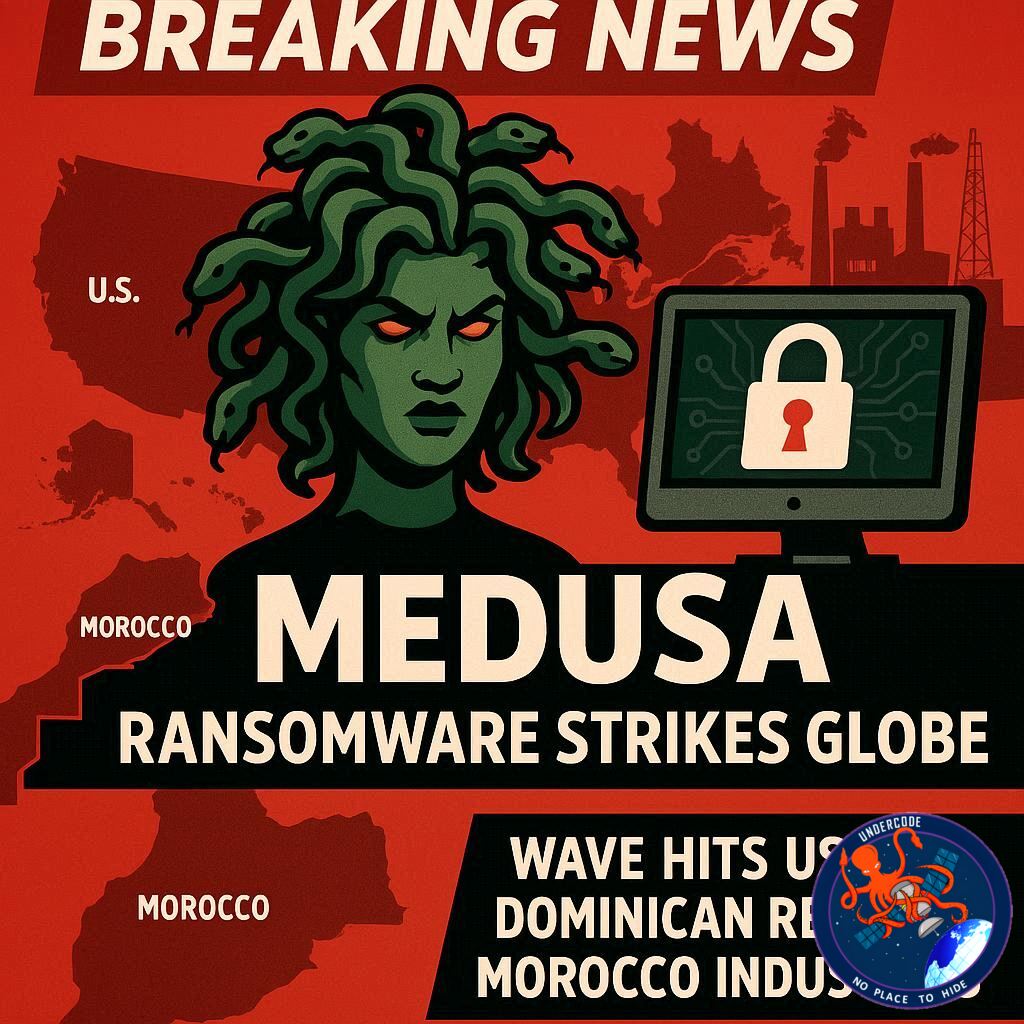
The cyber battlefield has erupted once again — this time, the notorious Medusa ransomware has set its sights on a new tri-continental range of victims. In a chilling escalation, the group has targeted companies in the United States, the Dominican Republic, and Morocco, striking across key industrial veins: manufacturing, oil, printing, and logistics.
What makes this wave alarming isn’t just the diversity of its targets — it’s the precision. Medusa isn’t a scattergun attacker; it’s a patient predator. After months of dormancy, it’s back with a vengeance, using refined tactics to breach critical systems, exfiltrate massive data troves, and leak proof-of-compromise evidence publicly.
The leaks, shared through dark web channels and Medusa’s dedicated leak site, reveal that confidential internal files, invoices, customer data, and infrastructure maps are already circulating. Analysts confirm that these leaks serve a double purpose — to pressure victims into paying ransoms and to demonstrate Medusa’s operational power.
The affected sectors represent the backbone of national stability — manufacturing for industrial production, oil for energy security, logistics for supply chain flow, and printing for communications. By targeting them, Medusa aims to create systemic fear, showing that no economy is safe from the tendrils of cyber extortion.
Cybersecurity agencies across all three nations are on alert. In the U.S., CISA (Cybersecurity and Infrastructure Security Agency) has issued fresh warnings for enterprises to patch vulnerabilities related to remote desktop protocols and unsecured backups. Meanwhile, Dominican and Moroccan authorities are coordinating with international experts to contain the spread and prevent further data exploitation.
Early evidence points toward Medusa’s evolution. Once seen as just another ransomware group, it now operates like a full-fledged digital syndicate, blending corporate espionage, data extortion, and media manipulation. Its new leaks appear tailored for maximum media impact — complete with timestamps, digital signatures, and a psychological edge designed to humiliate victims.
Experts describe this as part of a growing “theater of cyberwarfare” — a world where data is not just stolen but weaponized for public spectacle. The Medusa attacks reinforce that ransomware has evolved beyond criminal profit; it’s now a tool for influence, chaos, and global disruption.
What Undercode Say:
Medusa’s current campaign exposes a troubling evolution in cybercriminal strategy. The group’s choice of three geographically distinct targets — North America, the Caribbean, and North Africa — reflects a deliberate attempt to test the resilience of global cybersecurity infrastructure. It’s not coincidence; it’s choreography.
Each of these regions holds strategic importance:
The U.S. remains the epicenter of industrial digitization.
The Dominican Republic acts as a logistical and trade hub in the Caribbean.
Morocco anchors North Africa’s growing industrial and energy networks.
By hitting all three, Medusa achieves a psychological narrative of global reach, positioning itself as a borderless menace. This is cyberterrorism in corporate form — profit-driven, but politically potent.
The group’s tactics also show a shift from encryption to exposure. Traditional ransomware relied on locking systems and demanding ransom keys. Medusa, however, leverages public shaming. The leaks are not an afterthought; they are the core weapon. This mirrors the trend seen in other groups like LockBit and ALPHV (BlackCat), where reputational damage is as lethal as data loss.
From a technical lens, these breaches likely exploited weak points in remote access infrastructure or unpatched enterprise software — the same cracks that have fueled 80% of ransomware entries worldwide. What’s new is how the stolen data is curated for narrative effect — almost like a press release for crime.
For industries like oil and logistics, the timing is critical. Global energy prices are volatile, and any operational disruption can ripple through international markets. Medusa’s attacks could therefore have indirect economic consequences, even if the primary targets are relatively small.
Undercode observes a dangerous convergence here: ransomware as propaganda. Medusa isn’t just demanding money; it’s shaping perception. Each leak plants seeds of distrust — between companies and clients, between governments and citizens, between industries and their digital systems.
This blurring line between cybercrime and psychological warfare is what makes the Medusa campaign uniquely threatening. It represents not just an attack on servers, but on confidence itself — a slow erosion of trust in digital security frameworks.
The ultimate question now is whether global cyber defense will adapt fast enough. Security experts have long warned that reactive cybersecurity — patching after the breach — is a losing game. Medusa thrives on delay, denial, and bureaucracy. The only effective countermeasure lies in predictive, intelligence-driven security models that can forecast and isolate attack vectors before they strike.
Medusa’s reappearance is more than a technical headline — it’s a warning shot. It’s a glimpse into a future where ransomware operates like organized media — publishing, broadcasting, and branding its crimes in real time. For every company that falls silent and pays, the message to the next target is clear: fear works faster than firewalls.
Fact Checker Results:
✅ Multiple cybersecurity monitors confirm Medusa’s latest activity across the three countries.
✅ Data samples leaked online match legitimate corporate information.
❌ No verified evidence yet of critical national infrastructure being permanently damaged.
Prediction:
🔮 Expect Medusa to expand its operations to Asia and Europe next, using its leak-based strategy as a brand of psychological warfare. As ransomware evolves into a narrative weapon, global cybersecurity will need to rethink not just defense — but communication. The next frontier isn’t code — it’s control of the story.
🕵️📝✔️Let’s dive deep and fact‑check.
References:
Reported By: x.com
Extra Source Hub (Possible Sources for article):
https://www.stackexchange.com
Wikipedia
OpenAi & Undercode AI
Image Source:
Unsplash
Undercode AI DI v2
Bing
🔐JOIN OUR CYBER WORLD [ CVE News • HackMonitor • UndercodeNews ]
📢 Follow UndercodeNews & Stay Tuned:
𝕏 formerly Twitter 🐦 | @ Threads | 🔗 Linkedin | 🦋BlueSky | 🐘Mastodon


