
Listen to this Post
 Introduction: Strategic Acceleration of Custom AI Silicon at Global Scale
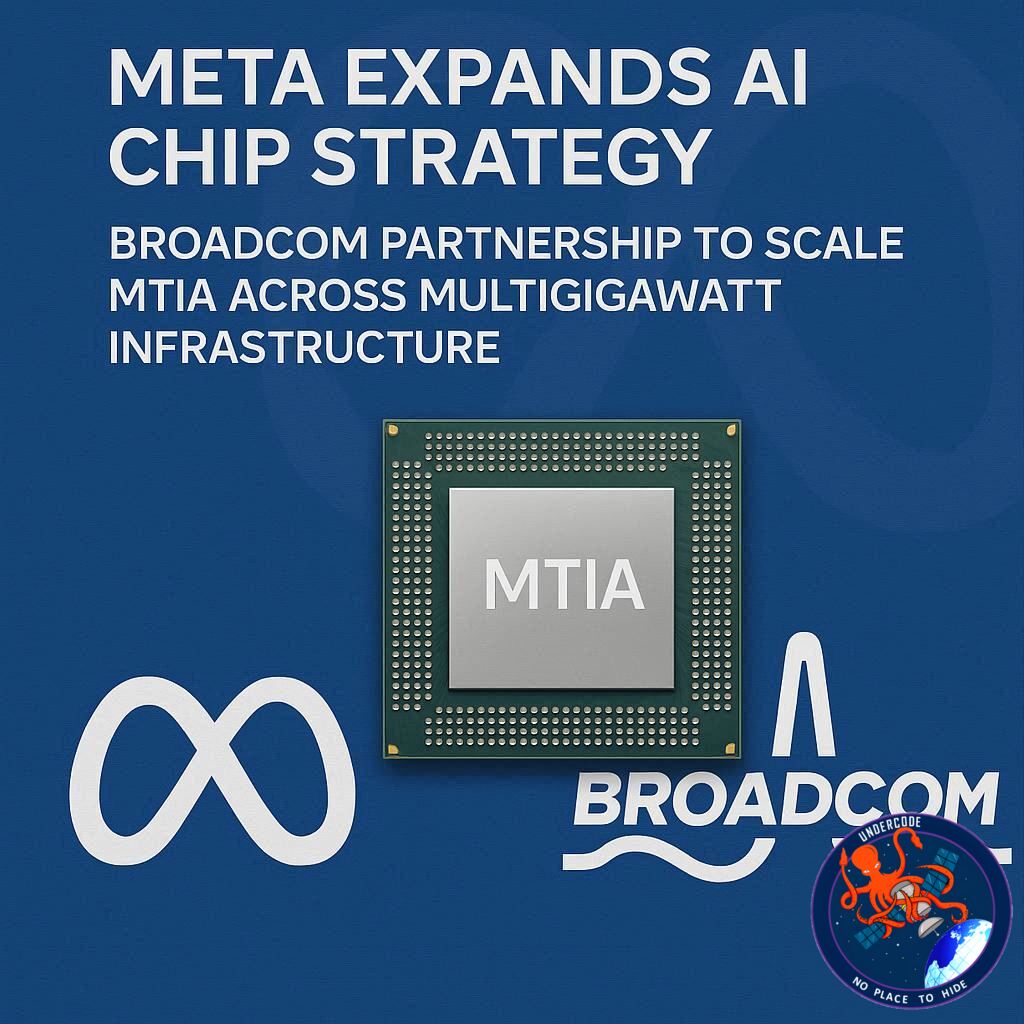
Meta has entered a new phase of artificial intelligence infrastructure expansion by strengthening its partnership with Broadcom to co-develop future generations of its MTIA chips. This move signals a deeper commitment to custom silicon designed specifically for large-scale AI workloads, including recommendation systems, ranking engines, and generative AI. As global demand for real-time AI experiences grows, Meta is aligning hardware innovation with long-term computational needs, aiming to optimize both performance and cost efficiency across its ecosystem of billions of users.
Expanded the Broadcom–Meta MTIA Partnership
Meta has officially announced an expanded collaboration with Broadcom focused on the co-development of multiple generations of MTIA (Meta Training and Inference Accelerator) chips. These chips represent Meta’s custom-built silicon designed to power AI workloads across its platforms. The strategy reflects Meta’s broader approach of using a diversified AI hardware portfolio, ensuring that each workload is matched with the most efficient type of accelerator. MTIA is specifically optimized for inference tasks and large-scale recommendation systems, which are central to user engagement across Meta apps. The new partnership accelerates Meta’s roadmap, which already includes the development and deployment of four new MTIA generations within the next two years. These chips will support both ranking systems and generative AI applications. Broadcom will contribute expertise in chip design, advanced packaging, and networking infrastructure, enabling Meta to build high-performance AI compute clusters. The collaboration is built on Broadcom’s XPU platform, which is designed for custom AI accelerator development and scalable optimization across multiple hardware generations. In addition, Broadcom’s advanced Ethernet technologies will support high-bandwidth, low-latency communication between distributed AI systems. The agreement includes a commitment exceeding 1 gigawatt of computing capacity, marking the first step in a broader multi-gigawatt infrastructure rollout. This signals a long-term strategic alignment between the two companies. Broadcom CEO Hock Tan emphasized the importance of sustained collaboration in enabling large-scale AI growth and infrastructure transformation. Meta CEO Mark Zuckerberg highlighted the goal of building “personal superintelligence” for billions of users worldwide. As part of the agreement, Hock Tan will transition from Meta’s board to an advisory role, continuing to contribute expertise in silicon architecture and system design. Meta also clarified that forward-looking statements are subject to risks and uncertainties, reinforcing the experimental and evolving nature of AI infrastructure development.
What Undercode Say:
Industrial Shift Toward Custom AI Silicon Dominance
The partnership between Meta and Broadcom represents a structural shift in how Big Tech approaches AI infrastructure. Instead of relying solely on external GPU providers, Meta is aggressively moving toward vertically integrated silicon development. This reduces dependency on third-party supply chains and gives Meta direct control over performance tuning at the hardware level.
MTIA as a Strategic Counterweight to GPU Ecosystems
MTIA is not just a chip initiative, it is Meta’s strategic answer to dominant GPU ecosystems. By focusing on inference and recommendation workloads, Meta targets the most cost-intensive and scale-sensitive part of AI deployment. This allows efficiency gains where billions of daily requests require ultra-low latency processing.
Multi-Generational Roadmap Indicates Long-Term AI Commitment
The announcement of four MTIA generations within two years reflects an unusually aggressive hardware iteration cycle. This suggests Meta expects rapid evolution in AI workloads and is preparing infrastructure that can adapt continuously rather than statically.
Broadcom’s XPU Platform as a Customization Engine
Broadcom’s XPU framework plays a central role in enabling tailored silicon solutions. Unlike general-purpose accelerators, XPUs allow workload-specific optimization. This creates a hybrid model where Meta defines system requirements while Broadcom translates them into scalable silicon architecture.
Networking Becomes as Critical as Compute Power
The inclusion of advanced Ethernet networking highlights a critical truth in modern AI systems: compute alone is not enough. As clusters scale into gigawatt territory, interconnect efficiency becomes a bottleneck. High-bandwidth, low-latency networking ensures that distributed AI models function as unified systems.
Gigawatt Scale Computing Signals Infrastructure Supercycle
A commitment exceeding 1GW of compute power is not incremental, it signals an infrastructure supercycle. Meta is effectively preparing for AI systems that operate at national-grid levels of energy consumption, reshaping how data centers are engineered and powered.
Competitive Pressure in AI Hardware Ecosystems
This move increases competitive pressure on companies relying purely on generalized GPU supply chains. Custom silicon strategies may create performance and cost gaps that redefine competitive positioning in AI services.
Boardroom Transition Reflects Strategic Deepening
Hock Tan’s transition from board member to advisor suggests a shift from governance-level involvement to technical specialization. This ensures continuity of expertise while aligning leadership focus with execution-heavy infrastructure development.
Fact Checker Results
Accuracy of Partnership Announcement
✅ Meta and Broadcom collaboration aligns with publicly stated AI infrastructure expansion strategies.
Claims on Multi-Gigawatt Deployment
⚠️ Infrastructure scale projections are forward-looking and depend on long-term execution and energy availability.
MTIA Development Timeline
✅ Meta has consistently signaled rapid iteration cycles for custom silicon development.
Prediction: Future of Meta’s AI Infrastructure Expansion
Acceleration Toward Fully Integrated AI Hardware Ecosystems ⚡
Meta is likely to continue reducing reliance on external GPU vendors, shifting toward fully integrated hardware-software ecosystems optimized internally for its platforms.
Expansion of Multi-Gigawatt AI Data Centers 🌐
The infrastructure roadmap suggests continued scaling of AI data centers into multi-gigawatt clusters, potentially reshaping global data center energy distribution models.
Emergence of Custom Silicon as Industry Standard 🧠
If MTIA succeeds at scale, custom AI accelerators may become a standard strategy among major tech companies, reducing dependence on generalized compute architectures.
🕵️📝✔️Let’s dive deep and fact‑check.
References:
Reported By: about.fb.com
Extra Source Hub (Possible Sources for article):
https://stackoverflow.com
Wikipedia
OpenAi & Undercode AI
Image Source:
Unsplash
Undercode AI DI v2
Bing
🔐JOIN OUR CYBER WORLD [ CVE News • HackMonitor • UndercodeNews ]
📢 Follow UndercodeNews & Stay Tuned:
𝕏 formerly Twitter 🐦 | @ Threads | 🔗 Linkedin | 🦋BlueSky | 🐘Mastodon


