
Listen to this Post
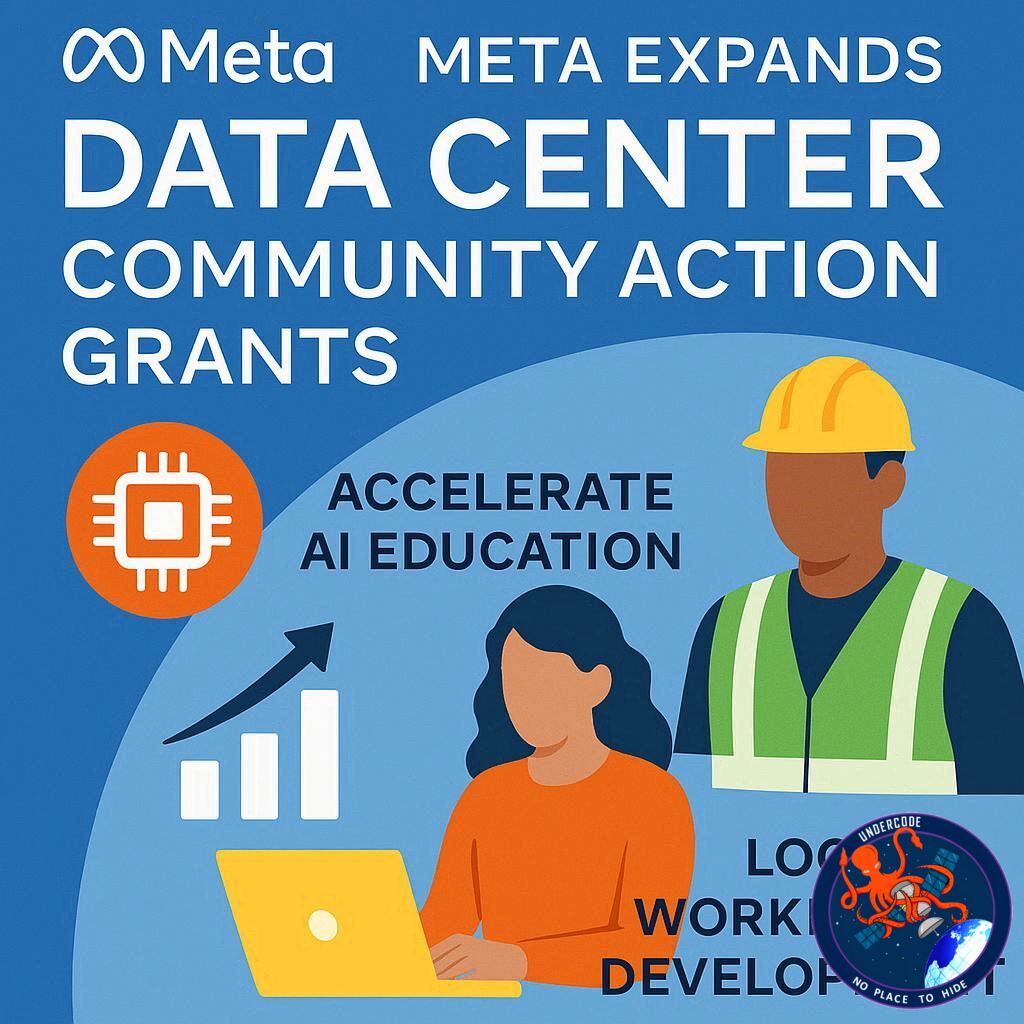 A Strategic Investment in Communities at the Heart of the Digital Economy
As artificial intelligence reshapes industries and redefines workforce demands, technology companies are under growing pressure to prove that innovation benefits more than shareholders. This year’s announcement of new recipients under Meta’s Data Center Community Action Grants program signals a broader commitment, one that links infrastructure growth to educational access, workforce preparation, and long term community resilience. With millions already distributed and new regions added in 2026, the initiative is positioning data center communities not just as hosts of digital infrastructure, but as future engines of economic and technological leadership.
Building Stronger Communities Through Direct Funding
The Data Center Community Action Grants program channels direct financial support to schools, nonprofits, and community organizations located near Meta’s data center operations. The objective is clear. Strengthen the long term vitality of the communities that sustain the company’s digital backbone. Rather than symbolic sponsorships, the grants target measurable outcomes such as workforce development, digital literacy, sustainability, and STEAM education.
Now active in 27 data center regions, including 24 cities across the United States and three international locations, the program continues to scale. In 2026 alone, seven new communities are receiving grants for the first time. To date, more than 3,700 projects have been funded globally, supported by over $94 million in direct allocations. These numbers reflect not only corporate philanthropy but also a calculated investment in the ecosystems that power the modern internet.
Aligning With the White House AI Youth Education Pledge
A notable feature of this year’s grants is alignment with the White House AI Youth Education Pledge. As AI tools become integrated into education, business, and daily life, preparing young people to navigate this shift responsibly has become a national priority. Many of the newly funded initiatives are directly focused on AI literacy, responsible usage, and workforce readiness.
By embedding AI training into local educational systems, the grants are helping create a distributed network of digitally fluent communities. This approach recognizes a critical reality. The AI revolution will not be confined to Silicon Valley. It will shape agriculture in Louisiana, healthcare in Texas, manufacturing in North Carolina, and classrooms in Ohio.
Modernizing Agriculture in Northeast Louisiana
In Northeast Louisiana, the Louisiana 4 H Foundation is transforming how young people prepare for careers in agriculture. Through hands on educational programs supported by Louisiana State University AgCenter, students are gaining access to drone technology and smart board systems that expand virtual training in automated land management and data driven farming practices.
Agriculture is undergoing rapid digitization. Precision farming, satellite monitoring, and automated equipment are redefining productivity standards. By introducing these tools early, the program ensures that rural youth are not left behind as the industry evolves. Instead, they are positioned to lead it. The investment bridges technology gaps while strengthening leadership development and wellness education, reinforcing agriculture’s transition into a technology intensive sector.
Expanding Responsible AI Education in Ohio
In Perrysburg, Ohio, the Perrysburg Schools Foundation is focusing on AI literacy and ethical integration of emerging technologies. Educators will receive specialized training in practical AI applications, equipping them to integrate tools safely and effectively into the classroom. More than 4,000 students in the Bowling Green region are expected to benefit.
This initiative goes beyond student exposure. It establishes a core group of AI trained teachers who will mentor peers across the district, creating a multiplier effect. By strengthening staff capacity first, the program ensures sustainable implementation. The goal is not short term experimentation but long term fluency in responsible AI usage, preparing students for a world where algorithmic systems influence learning, employment, and daily decision making.
Advancing Preventive Healthcare Access in Texas
In Bell County, Texas, the nonprofit Healthier Texas is leveraging AI powered health coaching technology to expand preventive care access. Through a bilingual digital health tracking app, residents receive personalized guidance on nutrition, chronic disease prevention, and overall wellness.
Rural communities often face structural barriers to healthcare access, including transportation limitations and provider shortages. By introducing digital health tools directly into households, the program aims to reduce life expectancy gaps and chronic disease risk. Equitable access remains central. Language inclusivity and low cost accessibility ensure that families across income levels can benefit from personalized health support.
Creating an Autonomous Technology and AI Hub in North Carolina
In Rutherford County, North Carolina, Isothermal Community College is establishing a centralized Autonomous Technology and AI Hub. Designed to support agriculture, manufacturing, and aerospace sectors, the facility will provide students with hands on experience in computer vision and autonomous navigation technologies.
Equipped with GPU accelerated workstations, the hub transforms the Forest City data center community into a regional training center for future engineers and machine learning specialists. Rural students gain direct exposure to robotics and advanced computing resources that are often limited to urban institutions. The program strengthens regional competitiveness while expanding access to high demand technology careers.
Scaling Impact Across 27 Regions
The broader reach of the grants program underscores its growing strategic significance. By supporting projects across 27 data center regions, the initiative is embedding innovation directly into the communities that host critical infrastructure. Seven new regions receiving grants in 2026 further demonstrate geographic expansion and inclusivity.
The cumulative funding of more than $94 million reflects sustained commitment rather than episodic giving. From agriculture and healthcare to manufacturing and education, the supported projects span diverse sectors. Each initiative, while locally tailored, aligns with a common objective. Empower communities to harness technology for collective benefit.
What Undercode Say:
The expansion of this grants program reveals a deeper strategic layer that extends beyond philanthropy. Data centers are often criticized for their environmental footprint, energy consumption, and limited direct employment impact. By channeling funding into education, AI training, and workforce development, Meta is effectively reinforcing its social license to operate. The narrative shifts from extraction of local resources to co creation of opportunity.
There is also a forward looking workforce calculus at play. AI driven industries require a pipeline of technically skilled workers, not only in metropolitan hubs but across regional economies. Supporting rural and mid sized communities today reduces future talent shortages tomorrow. It creates distributed expertise, minimizing over reliance on a few coastal tech corridors.
Another dimension is reputational resilience. As artificial intelligence faces scrutiny around ethics, bias, and job displacement, investing in responsible AI literacy demonstrates alignment with public concerns. Training teachers, supporting ethical integration, and promoting equitable access signal awareness of AI’s societal impact. This is strategic brand positioning in an era of regulatory uncertainty.
The agricultural focus in Louisiana is particularly telling. Farming is one of the oldest industries, yet it is rapidly becoming one of the most technologically complex. Drones, sensors, and automated systems are rewriting operational models. Preparing youth for this shift is not merely educational reform. It is economic preservation. Regions that fail to modernize risk falling behind in productivity and competitiveness.
Healthcare innovation in Texas highlights another macro trend. Preventive care supported by AI tools could significantly reduce long term healthcare costs. If digital coaching applications prove effective in rural areas, similar models may scale nationwide. That potential carries implications for insurers, public health agencies, and technology developers alike.
The creation of AI hubs in community colleges may ultimately prove the most transformative aspect. Four year universities are not the only gateways to high tech careers. By embedding advanced computing resources into local colleges, the program challenges traditional talent pipelines. It democratizes access to machine learning and robotics training, opening doors for students who might otherwise be excluded.
At a policy level, alignment with federal AI education initiatives also positions the company favorably in discussions about regulation and public private partnerships. Supporting national education pledges strengthens collaboration channels while demonstrating corporate responsibility.
The broader question is sustainability. Will these investments produce measurable long term outcomes, or remain isolated success stories? If the funded projects develop durable ecosystems, mentorship networks, and scalable curricula, the return on social investment could compound significantly over the next decade.
Fact Checker Results
✅ The program operates in 27 data center regions and includes new communities in 2026.
✅ More than 3,700 projects have received funding totaling over $94 million.
❌ The grants are not limited to AI projects alone; they also support broader STEAM and community initiatives.
Prediction
🔮 AI focused community grants will increasingly become a competitive differentiator among major tech infrastructure companies.
📈 Rural and mid sized regions supported today may emerge as unexpected AI talent hubs within the next decade.
🤖 Education systems that integrate responsible AI training early are likely to see measurable workforce advantages by 2030.
▶️ Related Video (78% Match):
🕵️📝✔️Let’s dive deep and fact‑check.
References:
Reported By: about.fb.com
Extra Source Hub (Possible Sources for article):
https://www.facebook.com
Wikipedia
OpenAi & Undercode AI
Image Source:
Unsplash
Undercode AI DI v2
Bing
🔐JOIN OUR CYBER WORLD [ CVE News • HackMonitor • UndercodeNews ]
📢 Follow UndercodeNews & Stay Tuned:
𝕏 formerly Twitter 🐦 | @ Threads | 🔗 Linkedin | 🦋BlueSky | 🐘Mastodon


