
Listen to this Post
The Coming Storm in the Memory Market
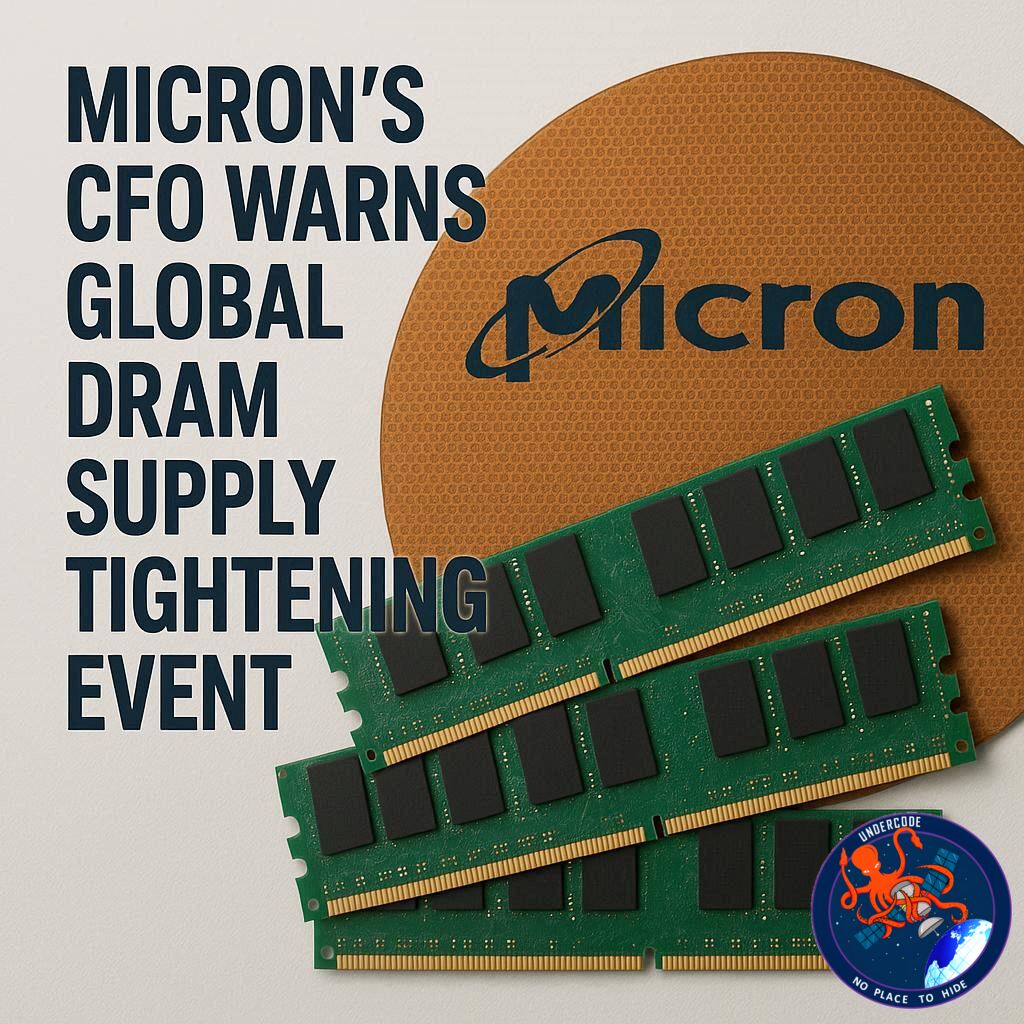
The global semiconductor industry is heating up again, and this time, the pressure is coming from artificial intelligence. U.S. chip giant Micron Technology has projected a stunning 40–47% year-over-year revenue increase for the September–November 2025 quarter. The driving force behind this surge is Micron’s HBM (High Bandwidth Memory)—a high-speed, high-efficiency memory crucial for AI computing.
In a recent interview, Sumit Sadana, Micron’s Chief Business Officer (CBO), revealed that demand for DRAM far exceeds supply, and the imbalance is expected to persist. As AI data centers expand and tech firms race to upgrade infrastructure, memory chips have become the new gold. Sadana’s statement underscores a reality many in the semiconductor industry already feel: the AI revolution is straining production capacity to its limits.
Micron’s strong forecast isn’t just optimism—it’s a reflection of a market in transformation. From smartphones and PCs to autonomous systems and AI servers, the appetite for faster, denser, and more energy-efficient memory is exploding. Yet, even as chipmakers ramp up production, technological complexity and limited fabrication capacity are throttling supply.
Sadana hinted that 2026 might bring even sharper competition in the DRAM market. AI workloads are now driving a shift toward specialized memory architectures, where traditional DRAM must coexist with HBM to handle massive data streams. Micron’s positioning in this space—alongside Samsung and SK Hynix—will be critical.
He also noted that while consumer electronics demand remains uneven, enterprise and cloud customers are fueling a “supercycle” of AI-driven hardware upgrades. The result is a perfect storm: booming demand, constrained supply, and soaring prices for memory chips.
Micron’s leadership appears determined to seize this moment. Investments in new fabs, advanced packaging, and next-gen DRAM nodes are underway. Yet, the CBO’s tone carries caution. Supply chain fragility, geopolitical uncertainty, and the technical limits of scaling memory density could all derail the delicate balance.
In summary, Micron expects sustained growth through 2026 as AI accelerates the entire memory ecosystem. But the underlying message is clear: the DRAM market is entering a critical phase of structural scarcity.
What Undercode Say:
Micron’s projection offers more than corporate optimism—it signals a deeper tectonic shift in the semiconductor landscape. The current squeeze in DRAM supply is not just a temporary cycle; it’s the symptom of a broader transition where AI is redefining hardware economics.
Let’s break it down. DRAM, traditionally a commodity product, has always moved in predictable boom-bust cycles. But AI has disrupted that rhythm. Training massive models like GPT and inference workloads for real-time applications demand memory with ultra-high bandwidth and low latency. Conventional DRAM cannot keep up alone, which is why HBM has emerged as the new strategic core of modern computing.
Micron, long perceived as the “third player” behind Samsung and SK Hynix, now finds itself in a rare position to lead. Its HBM3E and upcoming HBM4 technologies align perfectly with hyperscaler demand. Yet, this leadership won’t come cheap. The HBM production process is far more complex, involving 3D stacking, advanced thermal design, and ultra-precise manufacturing—all of which limit how fast supply can grow.
From an economic perspective, this creates a structural supply ceiling—a condition where demand continues to rise even when production lines run at full tilt. Such a scenario leads to price resilience, protecting memory makers from traditional market collapses. This could mark the end of the “memory winter” era that haunted the industry for decades.
Still, risks remain. The geopolitical landscape—especially tensions around Taiwan, South Korea, and U.S.-China tech policies—could inject volatility into this fragile equilibrium. The semiconductor supply chain is interdependent, and any disruption in raw materials, equipment exports, or energy costs could ripple across the industry.
Another factor is capital intensity. Expanding memory production requires billions in investment, long lead times, and complex ecosystem coordination. If global demand slows or inflation bites, those investments could strain profitability. Micron must walk a fine line between expansion and financial discipline.
From a strategic viewpoint, Micron’s stance makes sense: control the bottleneck, and you control the industry’s pace. In AI infrastructure, memory is now the ultimate choke point. The company’s decision to lean aggressively into HBM and advanced DRAM gives it leverage—not just in sales, but in shaping the roadmap of the AI era.
Technically, the evolution of DRAM and HBM will also define how far AI models can scale. Faster, denser, and more energy-efficient memory translates directly into larger context windows, faster inference, and more affordable AI deployment. Micron’s success or failure in this arena could therefore ripple far beyond its own balance sheet—it could shape the computational limits of the next generation of AI.
In essence, what Sadana hinted at is a simple but profound truth: the world’s data appetite is growing faster than its ability to remember. Micron’s challenge is not just to produce more memory, but to redefine what memory means in an age where intelligence is measured in terabytes.
🔍 Fact Checker Results
✅ Micron’s official forecast for 2025 Q4 revenue indeed projects a 40–47% YoY increase.
✅ HBM (High Bandwidth Memory) demand is surging due to AI data center growth.
❌ Claims of DRAM oversupply are false; industry reports confirm tightening supply.
📊 Prediction
By mid-2026, the DRAM market will likely enter a sustained “tight phase”, with prices climbing 20–30% across enterprise-grade memory modules. 💹
AI-related memory (HBM and DDR6) will dominate production pipelines, while legacy DRAM gradually declines in profitability. ⚙️
Micron, if it maintains supply discipline and technological leadership, could challenge Samsung’s long-standing dominance in the memory hierarchy. 🚀
🕵️📝✔️Let’s dive deep and fact‑check.
References:
Reported By: xtechnikkeicom_d5842b6bcce39cc6f4326ed6
Extra Source Hub (Possible Sources for article):
https://www.github.com
Wikipedia
OpenAi & Undercode AI
Image Source:
Unsplash
Undercode AI DI v2
Bing
🔐JOIN OUR CYBER WORLD [ CVE News • HackMonitor • UndercodeNews ]
📢 Follow UndercodeNews & Stay Tuned:
𝕏 formerly Twitter 🐦 | @ Threads | 🔗 Linkedin | 🦋BlueSky | 🐘Mastodon


