
Listen to this Post
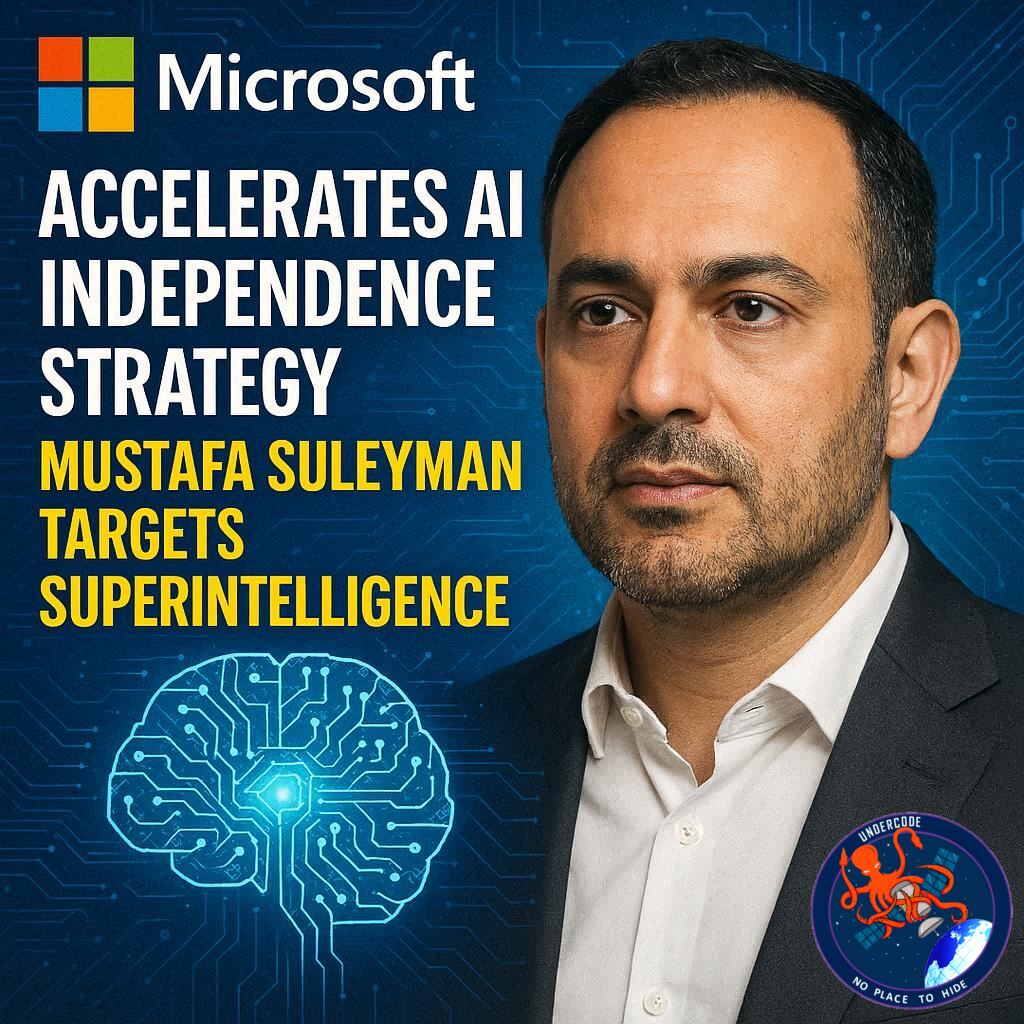
Introduction: A Strategic Shift in the AI Power Balance
Microsoft is no longer satisfied with being the infrastructure behind someone else’s artificial intelligence revolution. In a decisive shift that could redefine the AI industry’s balance of power, the company is now aggressively pursuing technological self-sufficiency. Under the leadership of AI chief Mustafa Suleyman, Microsoft is making it clear that reliance on OpenAI is no longer a long-term strategy but a temporary bridge. While the partnership between the two giants remains intact on paper, the message from Redmond is unmistakable. Microsoft wants its own frontier models, its own compute dominance, and ultimately its own path to artificial general intelligence.
Microsoft’s Public Declaration of AI Self-Sufficiency
In a recent interview with the Financial Times, Suleyman openly declared his mission to build “superintelligence” at Microsoft. The ambition is not incremental improvement. It is structural independence. He emphasized the necessity of developing frontier foundation models powered by gigawatt-scale computing infrastructure and trained by elite AI researchers. This language signals a deliberate pivot from platform dependency toward technological sovereignty.
Microsoft’s strategy is not framed as rebellion against OpenAI. It is framed as survival in an era where AI capability determines economic and geopolitical leverage. The company recognizes that controlling core models means controlling product evolution, cost structure, and long-term innovation cycles.
MAI-1-Preview:
This transformation is already underway. In August 2025, Microsoft introduced MAI-1-preview, an in-house mixture-of-experts model trained on approximately 15,000 Nvidia H100 GPUs. This is not a small experimental system. It represents industrial-scale training infrastructure and serious computational ambition.
MAI-1-preview is expected to power certain Copilot text use cases, gradually replacing OpenAI models within Microsoft’s ecosystem. The move is subtle but significant. By integrating its own model into Microsoft 365 Copilot and other enterprise services, Microsoft reduces exposure to external pricing, policy changes, and strategic divergence.
The long-term implication is clear. If Microsoft can match or surpass OpenAI performance benchmarks internally, dependency becomes optional rather than structural.
Expanding the AI Supplier Ecosystem Beyond OpenAI
Microsoft’s diversification strategy extends beyond building its own model. The company has broadened its AI supplier base dramatically. It now hosts models from xAI, Meta, Mistral, and Black Forest Labs within its data centers.
Reports suggest that Microsoft even tested models from Anthropic, particularly Claude systems, for certain Microsoft 365 Copilot tasks. Internal benchmarks reportedly showed advantages in specific Office workloads. In an ironic twist, Microsoft paid rival cloud provider Amazon Web Services to access those models.
This diversification strategy functions as both hedge and leverage. It reduces single-point risk while increasing competitive pressure among suppliers.
The October 2025 Restructuring Redefined the Partnership
The evolving dynamic became formal in October 2025 when Microsoft and OpenAI restructured their partnership. Microsoft converted its profit-sharing rights into a 27 percent ownership stake in OpenAI’s newly formed Public Benefit Corporation, valued at approximately USD 135 billion.
The agreement extended Microsoft’s intellectual property rights to OpenAI models through 2032, including post-AGI systems. At the same time, OpenAI gained freedom to seek computing resources beyond Azure and attract additional investors.
Crucially, Microsoft secured the right to pursue AGI independently or in partnership with third parties. The restructuring effectively acknowledged that both companies would build their own futures, even while remaining financially intertwined.
Investor Anxiety and Market Shockwaves
Wall Street has noticed the strategic recalibration. During a recent earnings call, Jefferies analyst Brent Thill highlighted OpenAI’s 45 percent share of Microsoft’s backlog of future sales. He raised concerns about exposure and durability if the partnership’s dynamics shifted further.
The market reaction was swift and dramatic. Microsoft’s stock lost USD 357 billion in value in a single day, one of the largest single-session market capitalization drops in history. The decline was not directly tied to deteriorating financial fundamentals. It reflected investor sensitivity to concentration risk in the AI era.
Dependency, even when profitable, can unsettle markets when strategic uncertainty enters the equation.
Suleyman’s Timeline for Superintelligence
Suleyman, who co-founded Google DeepMind before joining Microsoft in March 2024, stated that he expects Microsoft to have its own superintelligence model ready sometime this year. That timeline is aggressive, signaling internal confidence in both talent acquisition and computational capacity.
The ambition goes beyond incremental model iteration. It aims at frontier capability that competes at the highest global tier of AI research.
What Undercode Say:
Microsoft’s pivot toward AI self-sufficiency is not merely about technological pride. It is about structural power in the next industrial cycle. Control over foundation models determines cost curves, enterprise lock-in, and geopolitical alignment. By reducing reliance on OpenAI, Microsoft is insulating itself from pricing volatility, strategic disagreements, and regulatory constraints that could emerge from an independent OpenAI trajectory.
The diversification strategy reveals calculated pragmatism. Hosting models from multiple AI developers allows Microsoft to act as a neutral AI marketplace while simultaneously building its own flagship system. This dual strategy ensures revenue continuity even if its internal models lag temporarily behind competitors.
The October restructuring was less a breakup and more a maturity phase in the relationship. Both companies recognized that long-term dependency would eventually create friction. By formalizing independence pathways, they reduced future conflict risk while preserving economic ties.
From a competitive standpoint, Microsoft’s move pressures OpenAI to innovate faster. If Microsoft can replace portions of Copilot’s stack with MAI-1-preview, OpenAI loses leverage in pricing and negotiation. Conversely, OpenAI’s freedom to source compute beyond Azure reduces Microsoft’s infrastructure dominance. The balance is delicate.
Investor anxiety reflects a deeper truth about the AI economy. Concentration risk is magnified when one supplier accounts for nearly half of backlog exposure. Markets dislike uncertainty more than they dislike competition. Microsoft’s diversification narrative is designed partly to calm those fears.
Suleyman’s leadership style also matters. Coming from DeepMind, he understands frontier model training at scale. His emphasis on gigawatt-level compute signals that Microsoft is preparing for capital-intensive AI escalation. Training superintelligence-level systems requires not only GPUs but power infrastructure, cooling efficiency, and long-term chip supply agreements.
The broader implication is that AI partnerships are evolving from dependency alliances into strategic hedges. The era of single-model dominance within enterprise ecosystems may be ending. Instead, enterprises will demand model flexibility, cost transparency, and performance optimization across tasks.
Microsoft’s ambition to deliver its own superintelligence this year may be optimistic. Yet even partial success would strengthen negotiating leverage. In technology power structures, perception often precedes reality. The announcement alone shifts industry psychology.
Ultimately, this is less about replacing OpenAI and more about ensuring Microsoft controls its AI destiny. In the race toward AGI, dependency is vulnerability. Self-sufficiency is strategic insurance.
Fact Checker Results
✅ Microsoft introduced MAI-1-preview trained on roughly 15,000 Nvidia H100 GPUs.
✅ The October 2025 restructuring granted Microsoft a 27 percent ownership stake in OpenAI’s PBC valued near USD 135 billion.
❌ The stock drop was not caused by operational failure but by investor concern over AI dependency exposure.
Prediction
📊 Microsoft will increasingly integrate MAI-1-derived systems into Copilot products, reducing OpenAI workload share by measurable margins within 12 months.
📊 Competitive AI marketplaces inside Azure will expand, positioning Microsoft as both model creator and neutral AI distributor.
📊 Investor sentiment will stabilize if Microsoft demonstrates benchmark parity or cost advantages with its internal superintelligence systems.
▶️ Related Video (88% Match):
🕵️📝✔️Let’s dive deep and fact‑check.
References:
Reported By: timesofindia.indiatimes.com
Extra Source Hub (Possible Sources for article):
https://www.digitaltrends.com
Wikipedia
OpenAi & Undercode AI
Image Source:
Unsplash
Undercode AI DI v2
Bing
🔐JOIN OUR CYBER WORLD [ CVE News • HackMonitor • UndercodeNews ]
📢 Follow UndercodeNews & Stay Tuned:
𝕏 formerly Twitter 🐦 | @ Threads | 🔗 Linkedin | 🦋BlueSky | 🐘Mastodon


