
Listen to this Post
Introduction
Passwords have long been one of the weakest links in digital security. Despite years of warnings from cybersecurity professionals, millions of users still rely on weak or reused passwords, leaving organizations exposed to phishing, credential stuffing, and brute-force attacks. In response to this persistent problem, the technology industry has been gradually shifting toward passwordless authentication systems that rely on stronger cryptographic methods rather than traditional login credentials.
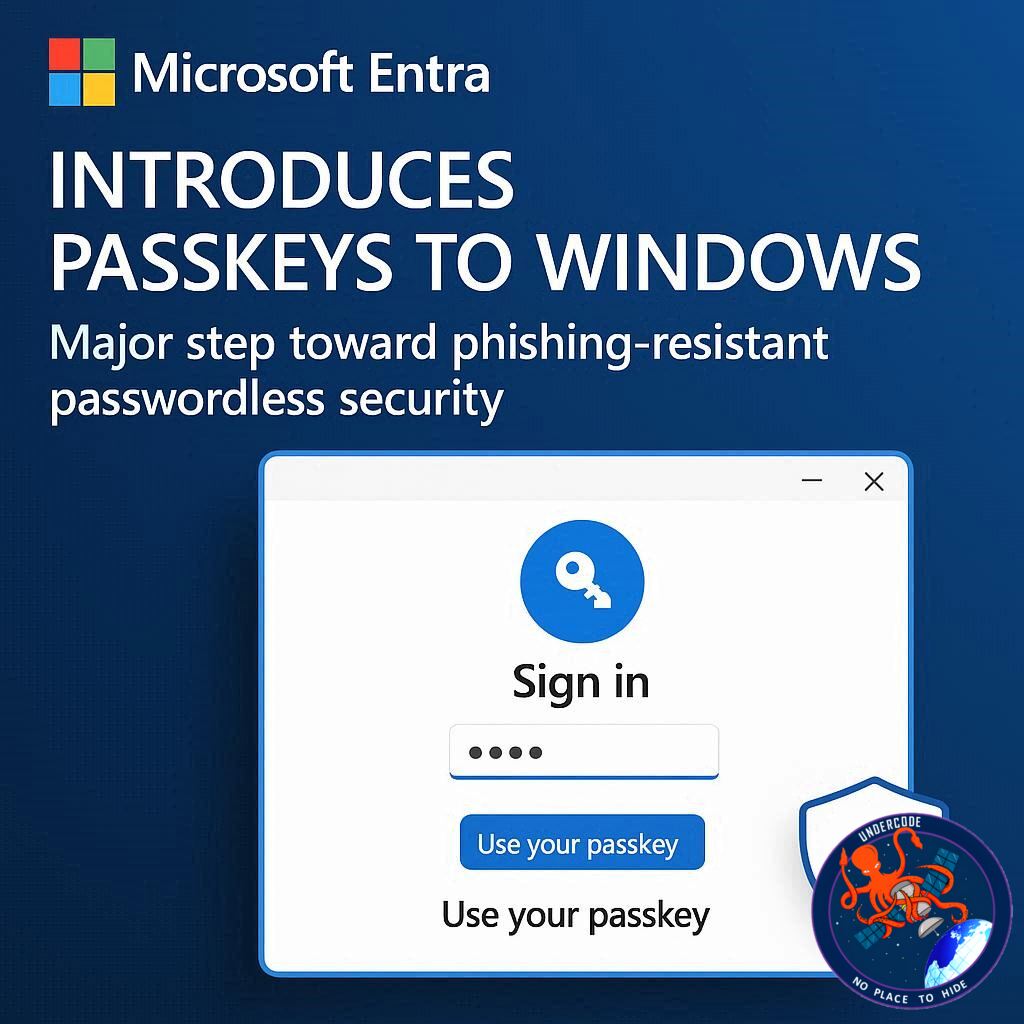
Microsoft is now pushing this transformation further by introducing passkey support for Microsoft Entra on Windows devices. The new feature integrates with Windows Hello and enables phishing-resistant authentication methods such as facial recognition, fingerprint scanning, or PIN verification. With this rollout, Microsoft aims to strengthen identity security across enterprise environments while reducing reliance on passwords entirely.
The announcement also addresses a long-standing gap in enterprise authentication. Previously, passwordless sign-in options were mostly limited to managed or corporate-registered devices. Now, Microsoft is extending these protections to unmanaged Windows devices, allowing organizations to secure personal or shared systems that were previously dependent on password-based authentication.
Microsoft Brings Passkeys to Microsoft Entra on Windows
Microsoft has officially begun rolling out passkey support for Microsoft Entra on Windows devices. The feature introduces passwordless authentication that is resistant to phishing attacks by leveraging Windows Hello as the authentication layer.
The rollout will begin as an opt-in feature and enter public preview between mid-March and late April 2026 for tenants worldwide. Government cloud environments, including GCC, GCC High, and Department of Defense deployments, will receive the feature slightly later, with rollout windows scheduled between mid-April and mid-May.
With this update, users can create device-bound passkeys stored securely within the Windows Hello container. These passkeys allow users to authenticate into Entra-protected resources using biometric methods or a secure PIN without relying on traditional passwords.
Microsoft explained that the passkeys will enable secure sign-in using Windows Hello authentication methods such as facial recognition, fingerprint scanning, or PIN verification. This integration ensures that credentials remain securely tied to the device and cannot be easily intercepted or stolen.
One of the most important aspects of this update is the expansion of passwordless authentication to unmanaged Windows devices. Previously, devices that were not joined or registered with Entra often required password-based authentication, leaving organizations vulnerable to phishing attempts. By extending passkey capabilities to these environments, Microsoft is closing a security gap that many enterprises struggled to address.
The passkeys generated by the system are cryptographically bound to the device. This means the authentication credentials never leave the device and are not transmitted over the network during login processes. As a result, attackers cannot capture or reuse them through phishing campaigns or malware attacks.
Microsoft also clarified that each Entra account must register its own passkey for each device. While multiple Entra accounts can exist on the same machine, each account maintains its own independent passkey registration.
Another important limitation is that passkeys are device-bound and cannot be synchronized across multiple devices. Users who access services from multiple systems will therefore need to register passkeys separately on each device.
For organizations interested in participating in the public preview, administrators must configure several settings in the Entra authentication policies. This includes enabling the Passkeys (FIDO2) authentication method and creating a passkey profile with the appropriate Windows Hello AAGUID identifiers. Once configured, administrators can assign these authentication policies to selected user groups.
Microsoft’s long-term push toward passwordless authentication is not new. In May 2025, the company announced that all new Microsoft accounts would be passwordless by default. This initiative was designed to protect users from common attack methods such as phishing campaigns, credential stuffing attempts, and automated password brute-force attacks.
Even earlier, Microsoft introduced passkey support for personal Microsoft accounts. This capability arrived alongside a built-in passkey manager integrated into Windows Hello through the Windows 11 22H2 feature update.
With the addition of Entra passkeys on Windows devices, Microsoft continues to expand its passwordless ecosystem, aiming to eliminate traditional passwords from enterprise authentication workflows.
What Undercode Say:
The introduction of passkeys within Microsoft Entra represents a significant evolution in enterprise identity security. For years, passwords have remained the primary authentication method despite being one of the most exploited vulnerabilities in cybersecurity. Microsoft’s move demonstrates how large technology providers are attempting to shift the industry away from shared secrets toward cryptographic identity verification.
Passkeys fundamentally change how authentication works. Instead of storing passwords that must be transmitted or verified against servers, passkeys rely on asymmetric cryptography. A private key remains securely stored on the user’s device, while the corresponding public key is registered with the service. During authentication, the system verifies cryptographic proof rather than a reusable secret.
This architecture dramatically reduces the effectiveness of phishing attacks. Even if a user is tricked into visiting a fake login page, the attacker cannot capture the private key because it never leaves the device. Traditional phishing attacks rely on stealing credentials that can be reused elsewhere, but passkeys remove that possibility.
Microsoft’s decision to bind passkeys to individual devices is also important from a security standpoint. By preventing synchronization across devices, the company reduces the risk of credential replication attacks or cloud synchronization breaches. While this may introduce some inconvenience for users who operate across multiple machines, the trade-off significantly strengthens security guarantees.
Another major development in this rollout is the inclusion of unmanaged devices. In modern workplaces, employees frequently use personal laptops, shared terminals, or contractor systems that are not enrolled in corporate device management programs. These systems often represent a security blind spot for IT teams.
Allowing passwordless authentication on such devices gives organizations a stronger security posture without requiring full device management enrollment. This is particularly valuable for hybrid workforces, freelancers, or temporary staff who may not use company-issued hardware.
The integration with Windows Hello is also a strategic move. Windows Hello has already built a large ecosystem around biometric authentication. By connecting Entra passkeys directly to this infrastructure, Microsoft simplifies adoption for organizations that already use Windows authentication features.
However, there are still challenges ahead. One of the biggest obstacles in passwordless adoption is user behavior. Many users remain accustomed to passwords and may initially resist new authentication methods. Organizations will need to provide education and training to ensure smooth transitions.
Another consideration is cross-platform compatibility. While passkeys are part of the broader FIDO2 standard supported by major technology companies, implementation differences between ecosystems can sometimes create friction for users switching between platforms.
From a broader cybersecurity perspective, the shift toward passwordless authentication reflects a fundamental change in how identity protection is approached. Instead of layering more defenses around passwords, companies are gradually removing passwords entirely from authentication flows.
The introduction of passkeys for enterprise identity platforms like Entra could accelerate adoption across the entire industry. As more organizations deploy passwordless systems, attackers will be forced to shift their tactics toward other methods such as session hijacking, device compromise, or social engineering.
Ultimately, Microsoft’s rollout shows that the passwordless future is no longer theoretical. It is actively being deployed at scale across enterprise infrastructure.
Fact Checker Results
✅ Microsoft is introducing passkey authentication for Microsoft Entra on Windows devices during a public preview rollout beginning in March 2026.
✅ Passkeys generated for Entra accounts are cryptographically bound to the device and stored in the Windows Hello container.
❌ Passkeys cannot currently be synchronized across multiple devices, requiring separate enrollment per device.
Prediction
🔐 Passwordless authentication will become the default security standard for enterprise identity platforms within the next five years.
📉 As passkeys replace traditional credentials, phishing campaigns targeting passwords are expected to decline significantly.
⚠️ Attackers will increasingly focus on device compromise and session token theft as alternative methods to bypass passwordless security systems.
🕵️📝✔️Let’s dive deep and fact‑check.
References:
Reported By: www.bleepingcomputer.com
Extra Source Hub (Possible Sources for article):
https://www.reddit.com
Wikipedia
OpenAi & Undercode AI
Image Source:
Unsplash
Undercode AI DI v2
Bing
🔐JOIN OUR CYBER WORLD [ CVE News • HackMonitor • UndercodeNews ]
📢 Follow UndercodeNews & Stay Tuned:
𝕏 formerly Twitter 🐦 | @ Threads | 🔗 Linkedin | 🦋BlueSky | 🐘Mastodon


