
Listen to this Post
Introduction
For years, Windows users have blamed random crashes, blue screens, overheating laptops, battery drain, and unstable gaming performance on “Windows updates.” But behind many of those issues was a deeper problem that Microsoft rarely addressed publicly: poor driver quality across the Windows ecosystem.
Now, Microsoft is finally acknowledging the problem openly.
At WinHEC 2026, the company announced a major shift in strategy for Windows 11 stability and reliability. Instead of focusing only on visual upgrades like rounded corners, AI integration, or redesigned menus, Microsoft says it wants to rebuild trust in Windows from the hardware level upward. The centerpiece of that effort is a new program called the Driver Quality Initiative (DQI), designed to improve how drivers are developed, tested, approved, and distributed across Windows devices.
The announcement represents one of Microsoft’s most important admissions in years. The company is essentially saying that Windows stability cannot improve unless hardware manufacturers and software partners improve alongside it. That includes stricter driver controls, better verification systems, reduced kernel access, and more aggressive removal of outdated drivers.
If Microsoft succeeds, Windows 11 users could finally experience fewer crashes, smoother performance, lower temperatures, better battery life, and more reliable gaming and productivity systems.
Microsoft Admits Windows Stability Has Been a Serious Problem
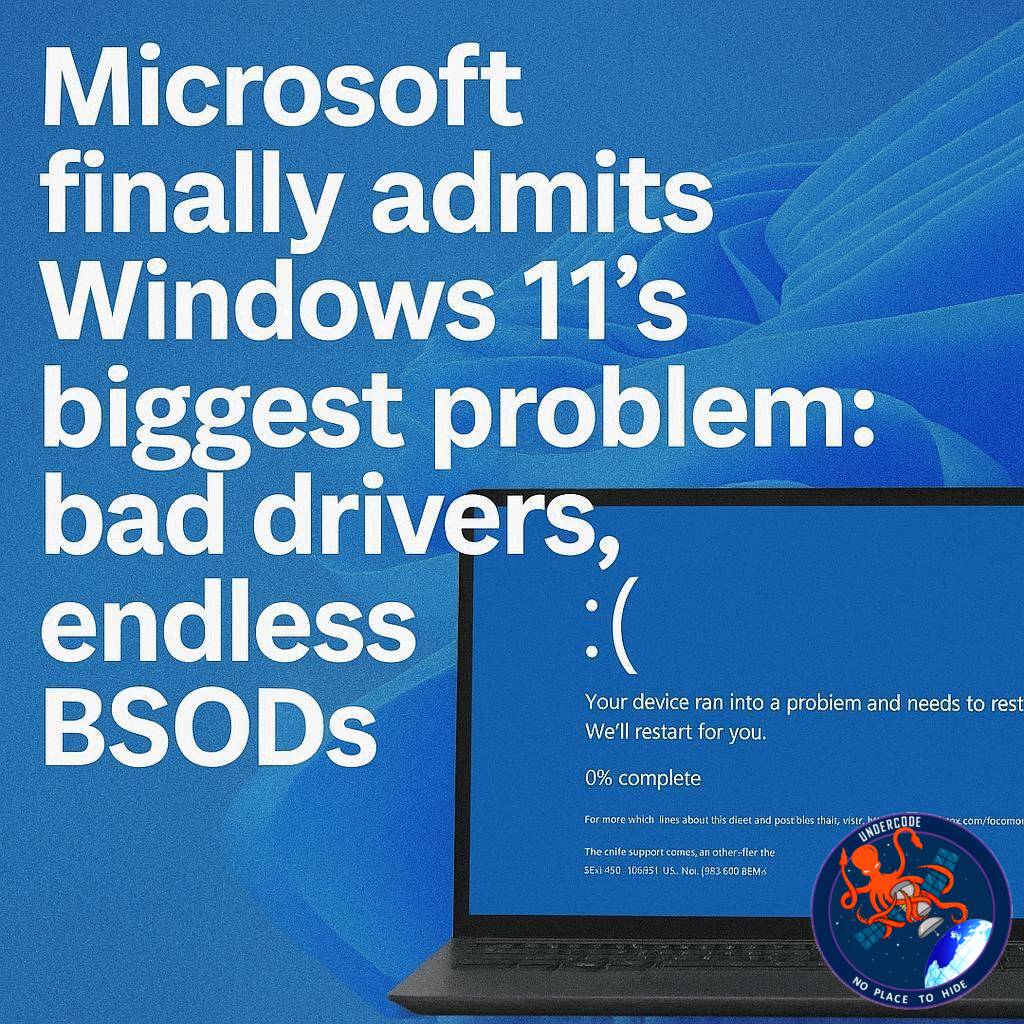
Microsoft confirmed that Windows quality is deeply connected to the reliability of drivers supplied by OEMs and hardware partners. Drivers act as the communication layer between hardware and the operating system, meaning a single faulty driver can destabilize an entire PC.
For years, users have dealt with recurring BSODs, graphics crashes, unstable updates, and inconsistent hardware behavior. While Microsoft often improved the Windows interface, many users felt the company ignored the core reliability problems underneath.
After Windows 11 launched, Microsoft concentrated heavily on visual redesigns, AI features, and user experience updates. Meanwhile, long-standing stability concerns remained unresolved. The company even reduced emphasis on hardware collaboration by stepping away from major Windows engineering conferences like WinHEC for a period of time.
Now, Microsoft appears to be reversing course.
CEO Satya Nadella reportedly wants to “win back” Windows customers, and the renewed focus on drivers suggests Microsoft finally understands that flashy UI changes mean little if systems continue crashing or overheating.
The company recently confirmed up to 18 new improvements for Windows 11, including:
Faster Start Menu Performance
Microsoft says the Start menu will become significantly faster and more responsive, especially on lower-end systems and older hardware configurations.
More Reliable File Explorer
File Explorer has long been criticized for lag, crashes, and inconsistent responsiveness. Microsoft claims reliability improvements are now a priority.
Reduced Ads During Setup
Windows users have repeatedly complained about excessive recommendations and promotional content during the out-of-box experience (OOBE). Microsoft plans to reduce that clutter.
Better UI and UX Consistency
The company also announced numerous user interface refinements intended to make Windows 11 feel cleaner and less fragmented.
However, the most important announcement was clearly the Driver Quality Initiative.
What Is Microsoft’s Driver Quality Initiative (DQI)?
Microsoft describes DQI as an ecosystem-wide strategy to improve driver reliability, security, and performance across all Windows devices.
The company believes drivers are “at the heart of every Windows experience,” which is why the initiative focuses on both software architecture and partner accountability.
The initiative is built around four core principles.
1. Microsoft Wants Drivers Away From the Kernel
One of the most important changes involves reducing direct kernel access for drivers.
Traditionally, many Windows drivers operate inside the kernel, which gives them deep access to the operating system. While this provides performance benefits, it also creates enormous risks. A single driver bug can crash the entire system instantly.
Microsoft now wants OEMs to adopt more user-mode drivers instead.
User-mode drivers operate in isolated environments, meaning if one fails, the crash can potentially remain contained rather than bringing down the entire operating system.
According to Microsoft’s internal testing, systems using authorized class drivers and user-mode driver structures are significantly more reliable and secure.
This change could dramatically reduce catastrophic BSOD events over time.
2. Microsoft Is Tightening Trust and Certification Rules
Microsoft also plans to strengthen the Windows Hardware Compatibility Program.
Historically, some low-quality drivers still passed into the Windows ecosystem with minimal restrictions. Under the new system, Microsoft says verification requirements will become much stricter.
That means:
More aggressive driver validation
Stronger partner approval systems
Tighter security verification
Better oversight of OEM driver quality
The goal is to stop unstable or poorly optimized drivers from reaching millions of users through Windows Update.
3. Old and Low-Quality Drivers Will Be Removed
One of the biggest frustrations for Windows users has been the Windows Update Catalog itself.
The catalog often contains multiple versions of drivers, including outdated, unstable, or poorly optimized releases. Users sometimes unknowingly install problematic drivers simply because they appear newer.
Microsoft now says it will begin deprecating outdated or low-quality drivers from the Windows Update ecosystem.
This could significantly improve reliability because users will no longer be exposed to legacy drivers that should have been retired years ago.
Better lifecycle management may also prevent Windows from installing incorrect drivers automatically, something that has caused countless issues for gamers and laptop users alike.
Microsoft additionally confirmed it will stop downgrading graphics drivers automatically, which has been one of the most heavily reported complaints in recent years.
4. Microsoft Is Redefining What “Quality” Means
Perhaps the most interesting part of the announcement is Microsoft’s decision to redefine driver quality itself.
Previously, Microsoft mainly measured quality through crash frequency.
That approach ignored many real-world problems users experience daily, including:
System slowdowns
Battery drain
Excessive heat
Performance inconsistencies
Power inefficiency
Hardware instability
Under the new DQI system, Microsoft says it will evaluate drivers using broader signals such as:
Stability
Performance
Functionality
Power efficiency
Thermal impact
This is a major shift because it recognizes that a PC can feel “broken” even without technically crashing.
A laptop running excessively hot or draining battery rapidly may not trigger a BSOD, but it still creates a poor user experience.
Microsoft now wants hardware partners to optimize for overall system behavior rather than simply preventing crashes.
AMD Supports Microsoft’s New Direction
AMD publicly supported Microsoft’s initiative during WinHEC 2026.
David Harmon, AMD’s Director of Software Engineering, stated that delivering stable drivers is a shared responsibility between Microsoft and hardware vendors.
According to AMD, improving platform reliability requires joint accountability across the entire ecosystem.
That statement matters because it signals broader industry cooperation rather than Microsoft acting alone. Driver issues often originate from hardware manufacturers, chipset vendors, GPU developers, or OEM customizations.
Without cooperation from those companies, Microsoft’s goals would be difficult to achieve.
What Undercode Say:
Microsoft’s announcement feels less like a normal feature update and more like a quiet admission that Windows quality declined over the last several years.
The company spent enormous energy redesigning Windows visually while many users continued suffering from the same underlying technical frustrations. Random crashes, unstable updates, broken drivers, GPU conflicts, and thermal issues became normalized to the point where users simply expected problems after updates.
That normalization damaged trust in Windows.
The Driver Quality Initiative is important because it targets the actual foundation of the operating system instead of cosmetic features. Most users do not care about rounded corners if their laptop overheats during video calls or crashes during gaming sessions.
The shift toward user-mode drivers is especially significant. This is arguably one of the biggest architectural changes Microsoft has pushed in years. Reducing kernel-level exposure can dramatically improve resilience because isolated failures no longer automatically destroy system stability.
This approach mirrors strategies used in modern secure operating system design where isolation is prioritized over raw unrestricted access.
The removal of low-quality drivers from Windows Update may also become one of the most impactful changes for ordinary users. Many people unknowingly install unstable drivers through automatic updates without understanding why their system suddenly becomes unreliable afterward.
By curating the driver ecosystem more aggressively, Microsoft could reduce a huge amount of invisible system instability.
Another critical point is Microsoft’s new definition of “quality.”
For years, Windows telemetry likely focused too heavily on crash statistics. But real-world frustration often comes from systems that technically function while delivering terrible experiences. High fan noise, battery drain, overheating, micro-stutters, and degraded responsiveness all contribute to the perception that Windows is unreliable.
By including thermal impact and power efficiency in quality measurements, Microsoft is finally measuring what users actually feel every day.
There is also a competitive reason for this shift.
Apple’s ecosystem is tightly controlled, allowing the company to optimize hardware and software together. Windows, by contrast, operates across thousands of hardware combinations. That openness gives Windows flexibility, but it also creates chaos when driver standards are inconsistent.
Microsoft appears to be trying to narrow that quality gap without sacrificing ecosystem openness.
The challenge, however, will be enforcement.
Historically, Microsoft has struggled to force OEMs into strict compliance because hardware vendors often prioritize release schedules and compatibility over long-term optimization. If DQI remains optional or loosely enforced, improvements could be inconsistent.
But if Microsoft truly mandates these standards across the ecosystem, Windows 11 could become substantially more stable over the next few years.
Gamers may benefit the most initially.
Graphics driver issues have plagued PC gaming for years, especially after Windows updates. The promise that Microsoft will stop downgrading GPU drivers automatically is extremely important for gaming reliability and performance consistency.
Laptop users may also see major improvements in thermals and battery longevity if OEMs are forced to optimize drivers more carefully.
In many ways, this initiative feels like Microsoft returning to engineering fundamentals after years dominated by aesthetics and AI marketing.
Windows users have waited a long time for that.
Fact Checker Results
✅ Microsoft officially announced the Driver Quality Initiative (DQI) during WinHEC 2026 as part of a broader Windows reliability effort.
✅ The company confirmed it will evaluate drivers beyond crash frequency, including thermal impact, performance, and power efficiency.
❌ Microsoft has not yet confirmed whether all OEM partners will be forced to comply with every new DQI standard immediately across the ecosystem.
Prediction
🔮 Windows 11 updates released throughout late 2026 and 2027 will likely show noticeably fewer BSOD-related complaints compared to previous years.
🔮 Microsoft may eventually require most consumer hardware partners to adopt user-mode drivers for critical components to improve long-term OS stability.
🔮 If DQI succeeds, Windows laptops could see measurable gains in battery efficiency, thermal management, and gaming reliability without requiring major hardware upgrades.
🕵️📝Let’s dive deep and fact‑check.
References:
Reported By: www.windowslatest.com
Extra Source Hub (Possible Sources for article):
https://stackoverflow.com
Wikipedia
OpenAi & Undercode AI
Image Source:
Unsplash
Undercode AI DI v2
Bing
🔐JOIN OUR CYBER WORLD [ CVE News • HackMonitor • UndercodeNews ]
📢 Follow UndercodeNews & Stay Tuned:
𝕏 formerly Twitter 🐦 | @ Threads | 🔗 Linkedin | 🦋BlueSky | 🐘Mastodon


