
Listen to this Post
Introduction: A Small Misconfiguration With Massive Consequences
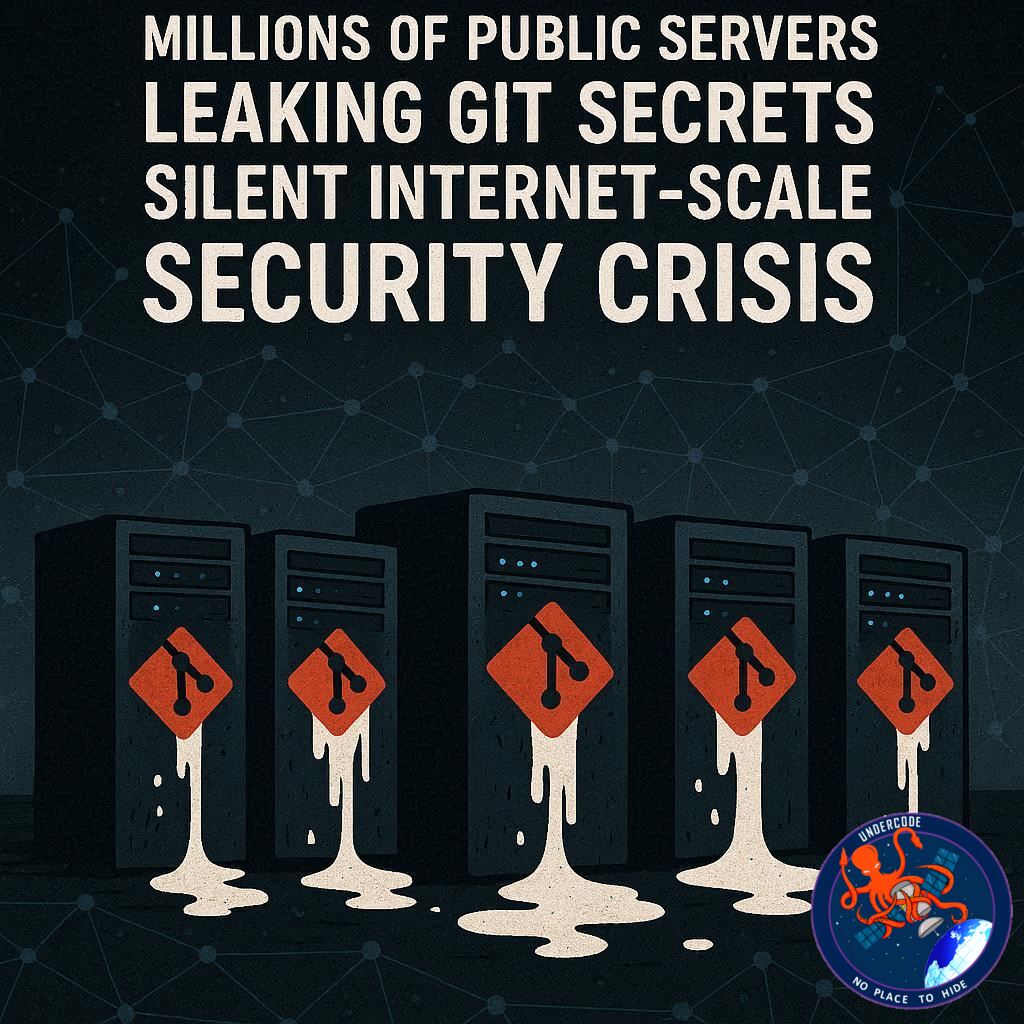
A quiet but deeply dangerous security issue is unfolding across the internet. According to a new 2026 study conducted by the Mysterium VPN research team, millions of public-facing web servers are unintentionally exposing Git repository metadata. What sounds like a minor technical oversight is, in reality, enabling attackers to reconstruct source code, steal deployment credentials, and pivot into cloud infrastructure at scale. The findings confirm that this is not an edge-case vulnerability affecting careless developers, but a systemic weakness rooted in modern deployment practices and default server configurations.
the Original Research Findings
The Mysterium VPN study uncovered a staggering 4.96 million IP addresses with publicly accessible .git directories. Even more alarming, 252,733 of those exposed .git/config files contained active deployment credentials, representing roughly 5 percent of all exposed repositories. At internet scale, that percentage translates into hundreds of thousands of usable secrets available to attackers with minimal effort.
The exposed Git metadata allows threat actors to fully reconstruct private source code repositories, analyze internal project structures, and identify sensitive configuration details. In cases where credentials are embedded in configuration files, attackers can gain direct access to production servers, cloud services, and third-party platforms. This creates a clear path from a simple misconfiguration to full infrastructure compromise.
Geographically, the issue is concentrated in major hosting and cloud hubs. The United States leads by a significant margin, followed by Germany and France, with broader exposure across Europe and the Asia-Pacific region. These concentrations reflect where large-scale hosting providers and development infrastructure are most heavily deployed.
The root causes are consistent and repeatable. Git directories are accidentally pushed to production environments, hidden folders are made public by default server behavior, and access controls are either missing or misconfigured. Many teams incorrectly assume that dot-prefixed directories are automatically protected, an assumption that modern web servers do not reliably enforce.
The risks extend far beyond source code theft. Exposed repositories can be abused for malicious commits, supply-chain attacks, internal network mapping, and lateral movement into connected cloud and SaaS services. What begins as a development artifact left behind during deployment can rapidly escalate into a major security breach affecting customers, partners, and downstream users.
The report emphasizes that remediation is straightforward but urgent. Public access to .git directories must be blocked at the server level, Git data should never reside in production environments, and all potentially exposed credentials must be rotated immediately. Preventative controls such as secrets management systems, pre-commit scanning, automated monitoring, and incident response playbooks are critical to stopping this class of exposure before it occurs.
What Undercode Say:
This research highlights one of the most underestimated truths in modern cybersecurity: scale turns negligence into catastrophe. A five percent credential exposure rate may look statistically small on paper, but when multiplied across millions of servers, it becomes one of the largest secret-leak vectors on the internet.
What makes exposed Git metadata particularly dangerous is not just the data itself, but how efficiently it can be exploited. Attackers do not need zero-day exploits, phishing campaigns, or social engineering. Discovery can be fully automated, indexed, and continuously scanned. Once found, the repository becomes a blueprint of the organization’s internal logic, tooling choices, cloud providers, and security assumptions.
This issue also exposes a cultural problem in DevOps workflows. Speed and convenience often take priority over isolation and hygiene. Repositories are cloned directly onto production servers, deployment scripts are reused across environments, and secrets are embedded for simplicity. These shortcuts accumulate silently until a scanner finds them.
Another overlooked factor is supply-chain amplification. When attackers gain access to private repositories, they do not need to attack the organization directly. They can poison dependencies, inject backdoors, or wait for trusted software updates to distribute malicious code downstream. In this context, an exposed .git folder is not just a local risk, it is a global one.
The persistence of this problem suggests that awareness alone is not enough. Many teams know this is bad practice, yet it continues due to legacy systems, unclear ownership between development and operations, and the false belief that obscurity equals security. Modern infrastructure requires explicit denial, not assumed protection.
From a defensive standpoint, this class of vulnerability is one of the cheapest to fix and one of the most expensive to ignore. Simple server rules, enforced CI checks, and secret rotation policies eliminate the majority of risk. The organizations that fail here are not lacking tools, they are lacking discipline and accountability.
Ultimately, this study reinforces a hard lesson. Security failures at scale rarely come from sophisticated attacks. They come from ordinary mistakes repeated millions of times, quietly waiting to be exploited.
🔍 Fact Checker Results
✅ The exposure of nearly 5 million .git directories is supported by large-scale internet scanning data.
✅ Credential leakage via .git/config files is a well-documented and highly exploitable risk.
❌ The assumption that hidden directories are protected by default is technically false.
📊 Prediction
🔮 Automated exploitation of exposed Git repositories will increase, driven by AI-powered scanning tools.
🔮 Regulatory pressure may rise as source code leaks trigger supply-chain and compliance incidents.
🔮 Organizations that fail to enforce Git hygiene will face higher breach frequency and faster compromise timelines.
▶️ Related Video (82% Match):
🕵️📝✔️Let’s dive deep and fact‑check.
References:
Reported By: securityaffairs.com
Extra Source Hub (Possible Sources for article):
https://www.discord.com
Wikipedia
OpenAi & Undercode AI
Image Source:
Unsplash
Undercode AI DI v2
Bing
🔐JOIN OUR CYBER WORLD [ CVE News • HackMonitor • UndercodeNews ]
📢 Follow UndercodeNews & Stay Tuned:
𝕏 formerly Twitter 🐦 | @ Threads | 🔗 Linkedin | 🦋BlueSky | 🐘Mastodon


