
Listen to this Post
Introduction
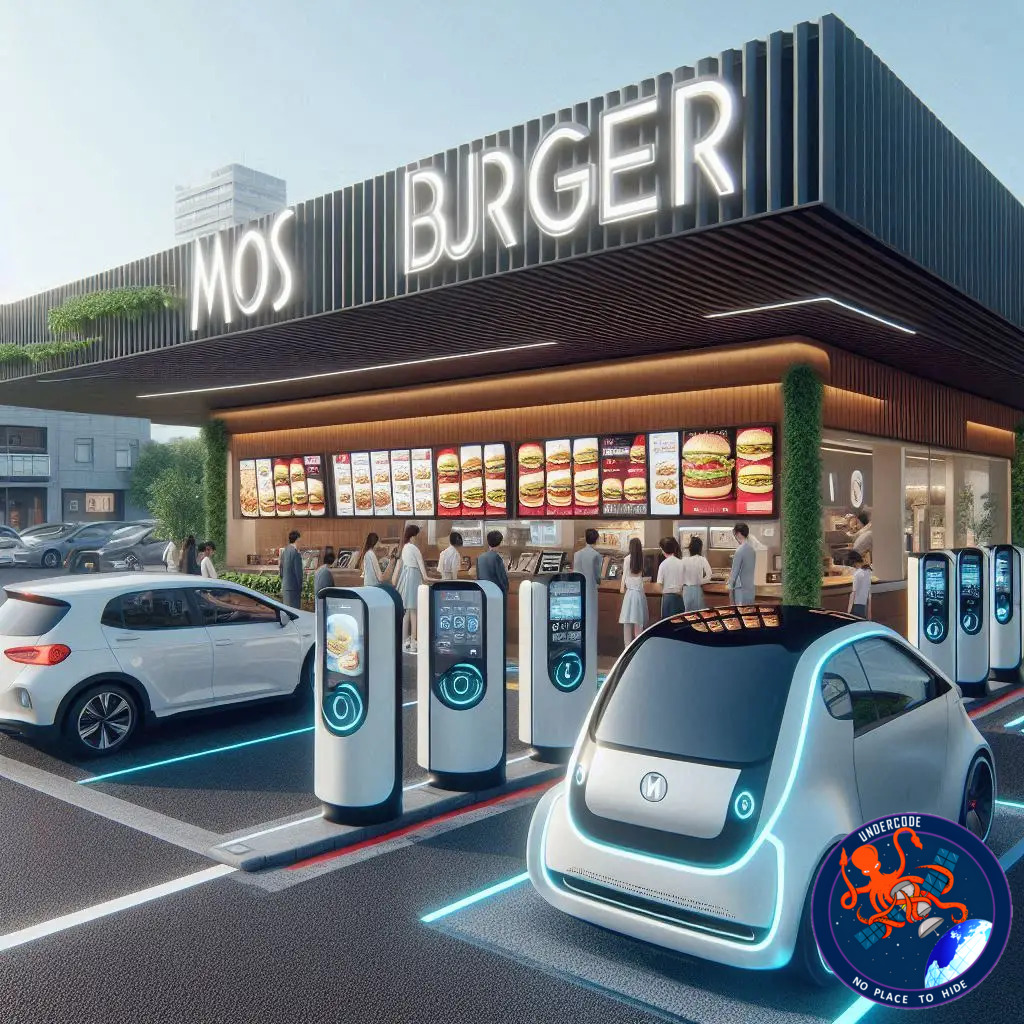
Japan’s fast food industry is quietly stepping into a new era of automation. MOS Food Services has begun testing an AI-powered voice recognition system at its drive-thru counters, signaling a shift in how customer orders may be handled in the coming years. At a time when labor shortages, efficiency pressures, and rising service expectations are reshaping the restaurant business, this move places MOS Burger at the forefront of operational innovation among domestic fast food chains.
the Original
MOS Food Services announced that it has launched a pilot program using artificial intelligence to receive customer orders at drive-thru lanes in selected MOS Burger locations. The experiment aims to reduce the need for staff at ordering counters and allow employees to focus more on in-store hospitality tasks such as food delivery and customer support. The company plans to expand the system to approximately five stores by the end of March 2027.
The first trial began in December 2025 at the MOS Burger Yoshikawa Minami location in Yoshikawa City, Saitama Prefecture. The system was developed by New Innovations, a Tokyo-based company known for labor-saving robots and automation technologies. While the AI handles voice-based ordering, store staff remain responsible for manual register input and resolving errors or special cases during the ordering process.
According to MOS Food Services, this is the first time a domestic fast food chain in Japan has introduced AI-based voice recognition for drive-thru ordering. The system integrates microphones, speakers, and AI software into a single unit capable of communicating with customers through spoken language. It has been designed to function accurately even in noisy environments, such as areas with engine sounds and traffic.
Customers place their orders by speaking into the microphone, after which the AI interprets the request, confirms the order details, and informs customers if certain menu items are unavailable. During a press briefing held on the 21st, Shinichiro Hamasaki, Head of the Store Innovation Office at MOS Food Services, stated that the company intends to use drive-thru AI adoption as a starting point for broader operational evolution across MOS Burger locations.
Looking ahead, the company is also considering more advanced applications of AI, including personalized menu suggestions based on customer-defined calorie limits. This would mark a significant step toward customized, health-conscious fast food experiences powered by artificial intelligence.
What Undercode Say:
The introduction of voice recognition AI at MOS Burger drive-thru lanes may appear modest on the surface, but it represents a strategically important experiment in the future of quick-service restaurants. Japan’s food service sector has long struggled with staffing shortages, particularly in suburban and late-night operations. Automating the order-taking process directly addresses one of the most labor-intensive and error-prone stages of fast food service.
Unlike touchscreen kiosks, drive-thru environments are uniquely challenging for AI. Background noise, varying speech patterns, dialects, and rushed customers create a hostile environment for accurate voice recognition. MOS’s decision to test this technology in real-world conditions, rather than controlled settings, suggests confidence in recent advances in speech recognition and noise filtering.
There is also a brand consideration at play. MOS Burger positions itself as a higher-quality, more thoughtful alternative to mass-market fast food. By keeping staff available for hospitality and problem-solving instead of basic order intake, the company can reinforce its service-oriented identity rather than replacing human interaction entirely.
The long-term implications are even more significant. If AI systems can eventually recommend menus based on calorie limits, dietary preferences, or past orders, fast food could shift from standardized offerings to semi-personalized experiences. This would blur the line between quick service and health-focused dining, an area where Japanese consumers are increasingly selective.
However, the success of this initiative will depend on execution. Even minor recognition errors can frustrate customers, especially in drive-thru situations where speed is critical. MOS’s choice to keep staff involved for error handling is a realistic acknowledgment that AI, at least for now, works best as an assistant rather than a replacement.
If the trial proves successful, competitors will almost certainly follow. What MOS Burger is testing today could become a standard operational model across Japan’s fast food industry within the next decade, reshaping cost structures, customer expectations, and the role of human workers.
Fact Checker Results
✅ MOS Food Services has officially confirmed the AI drive-thru pilot and its expansion plan through 2027.
✅ The system is developed by New Innovations and is currently in a real-world test environment.
❌ Full automation without human staff involvement is not yet implemented or announced.
Prediction
📊 AI-powered ordering systems will gradually expand beyond drive-thru lanes into in-store and mobile ordering integration.
📊 Fast food chains in Japan are likely to adopt hybrid AI-human service models rather than full automation.
📊 Personalized, health-aware menu recommendations could become a competitive differentiator within five years.
▶️ Related Video (74% Match):
🕵️📝✔️Let’s dive deep and fact‑check.
References:
Reported By: xtechnikkeicom_d7b513a5fa17f9cade79392f
Extra Source Hub (Possible Sources for article):
https://www.linkedin.com
Wikipedia
OpenAi & Undercode AI
Image Source:
Unsplash
Undercode AI DI v2
Bing
🔐JOIN OUR CYBER WORLD [ CVE News • HackMonitor • UndercodeNews ]
📢 Follow UndercodeNews & Stay Tuned:
𝕏 formerly Twitter 🐦 | @ Threads | 🔗 Linkedin | 🦋BlueSky | 🐘Mastodon


