
Listen to this Post
Introduction
MTN Nigeria’s temporary suspension of its popular airtime and data lending service, Xtratime, has triggered widespread public discussion across the country. The move comes at a time when many subscribers rely heavily on credit-based mobile access to stay connected during financial constraints or emergencies. While the telecom giant cites regulatory compliance as the main reason, the decision highlights the growing tension between consumer convenience and tightening financial oversight in Nigeria’s digital lending ecosystem.
Summary of the Original Report
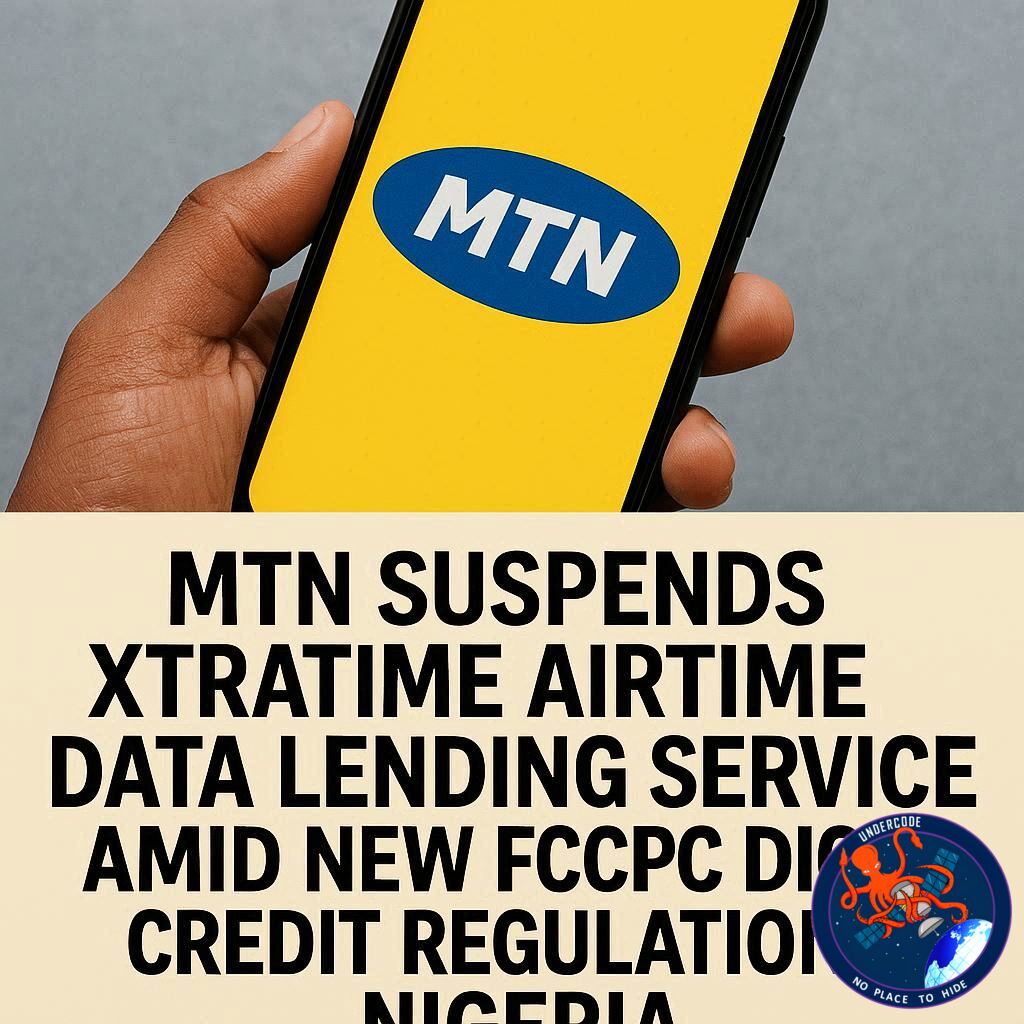
MTN Nigeria has temporarily suspended its airtime and data lending service known as Xtratime following new regulatory requirements introduced by authorities overseeing digital lending in the country. The company disclosed this in a filing to the Nigerian Exchange Limited, explaining that the suspension is part of compliance efforts with the Digital, Electronic, Online or Non-Traditional Consumer Lending Regulations of 2025 issued by the Federal Competition and Consumer Protection Commission (FCCPC). These regulations establish a formal licensing and compliance structure for all entities involved in digital credit services, including telecom operators offering airtime advances.
The new framework is designed to bring transparency and oversight to non-traditional lending systems that have expanded rapidly in Nigeria. MTN confirmed that while Xtratime is temporarily unavailable, customers can still purchase airtime and data through alternative digital channels. The company also reassured investors that the suspension is not expected to significantly affect its financial performance due to the service’s scale within its broader revenue structure.
The FCCPC regulations build on earlier rules introduced in 2022 and require all digital lenders to register with the commission. Operators in this category have been given a compliance deadline of April 2026 or risk regulatory penalties. The changes affect not only fintech companies but also telecom operators that have integrated micro-lending services into their ecosystems.
Public reactions have been mixed, with many Nigerians expressing frustration over the sudden disruption. A significant number of prepaid users depend on airtime borrowing as a financial fallback when they cannot recharge immediately. Online discussions reflect concerns about accessibility, affordability, and the increasing cost of communication in a challenging economic environment. Some users described the service as essential for daily connectivity, especially during emergencies.
MTN users attempting to access Xtratime now receive a message informing them that the service is unavailable and directing them to alternative recharge options. Meanwhile, industry observers note that the development signals a broader shift toward stricter regulation of digital credit systems in Nigeria. In a related update, the Nigerian Communications Commission has also announced that from April 2026, telecom operators will be required to compensate users automatically for poor service quality, adding further pressure on operators to improve service delivery standards.
What Undercode Say:
The suspension of Xtratime reflects a deeper restructuring of Nigeria’s digital credit environment rather than a simple service interruption.
Regulators are increasingly concerned about unmonitored micro-lending practices embedded within telecom services.
Airtime lending, once seen as a convenience feature, is now being treated as a formal credit product under financial regulation.
This shift signals that telecom companies are no longer just communication providers but also de facto financial service operators.
The FCCPC move suggests a push toward tighter consumer protection in a rapidly expanding digital economy.
MTN’s compliance response indicates that large operators prefer temporary suspension over legal and licensing uncertainty.
The impact on users reveals how deeply embedded micro-credit systems have become in daily life for many Nigerians.
For lower-income users, airtime borrowing often functions as a short-term financial buffer rather than a luxury feature.
The removal of this buffer exposes vulnerabilities in digital inclusion and affordability of telecom services.
It also raises questions about whether alternative recharge channels are truly accessible for all user groups.
While MTN claims no significant financial impact, user dependency patterns suggest potential behavioral shifts in usage.
Some customers may reduce mobile activity due to friction in recharging processes.
Others may migrate to competing networks or informal credit alternatives if available.
The regulatory framework could ultimately reshape how telecom revenue models are structured in Nigeria.
It may force operators to separate communication services from embedded financial tools more clearly.
The timing of the suspension suggests companies are preparing for stricter enforcement ahead of the 2026 deadline.
This indicates regulatory certainty is becoming a stronger driver of corporate decision-making than short-term user retention.
Public frustration highlights a gap between policy intentions and consumer realities on the ground.
The reliance on airtime credit underscores broader economic pressure affecting disposable income levels.
It also shows how telecom infrastructure has become essential for both communication and financial survival.
The development could accelerate innovation in regulated micro-lending platforms outside telecom networks.
Banks and fintech firms may attempt to fill the gap left by telecom-based credit systems.
However, increased compliance requirements could raise barriers to entry for smaller digital lenders.
The FCCPC approach may also improve transparency and reduce predatory lending practices in the long term.
Yet in the short term, users are likely to experience reduced flexibility in mobile access.
The telecom sector may need to redesign user experience flows to reduce dependency on credit services.
This could include better low-cost bundles or emergency micro-payment systems under regulation.
Overall, the situation represents a transition phase in Nigeria’s digital financial ecosystem.
It highlights the tension between innovation, regulation, and everyday economic survival.
The next few months will be critical in determining how users adapt to the absence of airtime lending.
Operators that respond quickly with compliant alternatives may retain stronger user loyalty.
Those that delay adaptation may face increased churn and customer dissatisfaction.
Ultimately, the policy shift aims to formalize a previously informal credit system within telecom services.
Fact Checker Results
✔ FCCPC regulations on digital lending expansion are consistent with Nigeria’s ongoing fintech oversight policies.
✔ MTN’s suspension aligns with compliance-based operational adjustments commonly seen in regulated telecom markets.
✔ Public reactions reported online reflect verifiable user sentiment trends but are not individually independently confirmed.
Prediction
The suspension of Xtratime is likely to be temporary but may lead to permanent structural changes in telecom credit services.
By 2026, airtime borrowing could become a fully licensed and tightly regulated financial product in Nigeria.
Users may gradually shift toward bundled data plans and prepaid-only consumption models.
Telecom operators will likely introduce new regulated micro-credit systems with stricter eligibility rules.
Overall mobile accessibility may become more formalized, but less flexible for low-income users.
🕵️📝✔️Let’s dive deep and fact‑check.
References:
Reported By: www.legit.ng
Extra Source Hub (Possible Sources for article):
https://www.quora.com/topic/Technology
Wikipedia
OpenAi & Undercode AI
Image Source:
Unsplash
Undercode AI DI v2
Bing
🔐JOIN OUR CYBER WORLD [ CVE News • HackMonitor • UndercodeNews ]
📢 Follow UndercodeNews & Stay Tuned:
𝕏 formerly Twitter 🐦 | @ Threads | 🔗 Linkedin | 🦋BlueSky | 🐘Mastodon


