
Listen to this Post
Introduction
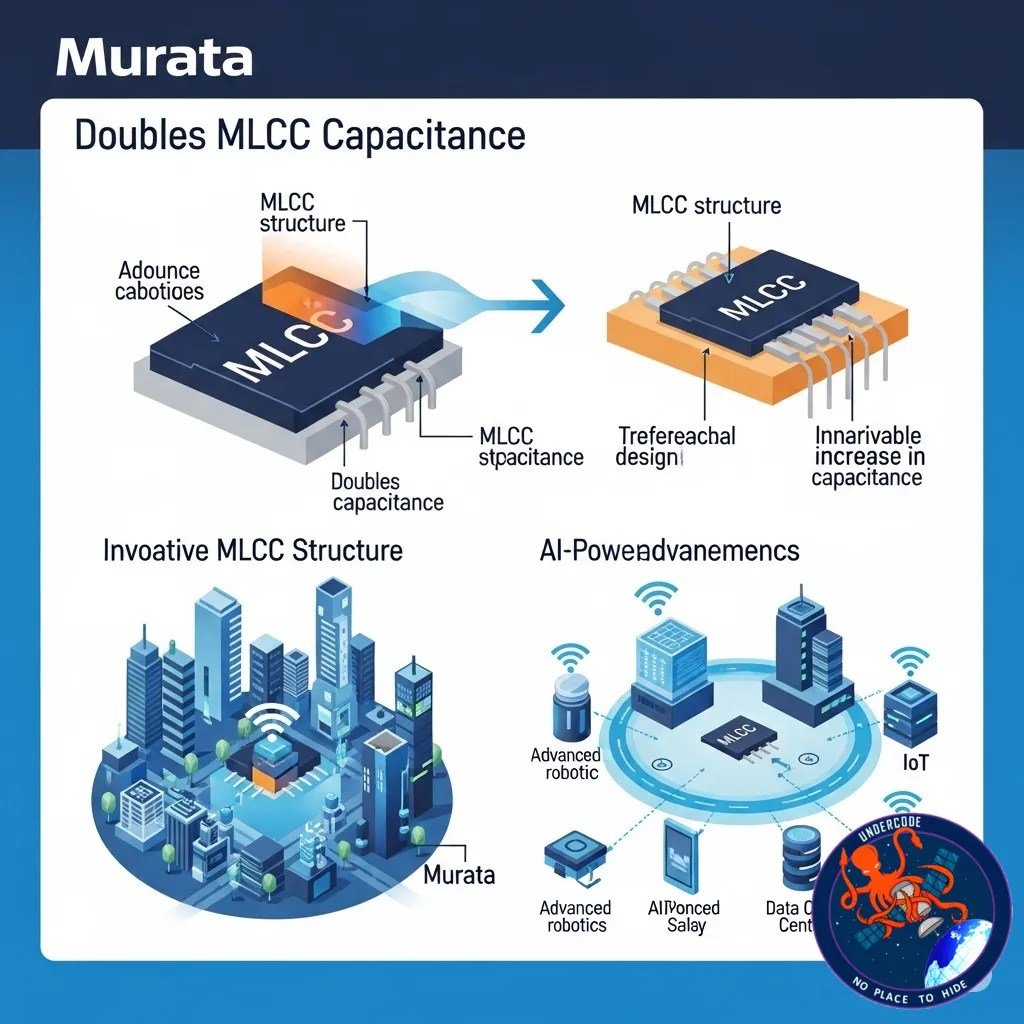
In a significant move that could reshape the infrastructure of next-generation AI data centers, Murata Manufacturing has begun mass production of a revolutionary multilayer ceramic capacitor (MLCC) boasting twice the capacitance of its previous models. As the global race for AI supremacy heats up, the demand for powerful and efficient server hardware has skyrocketed. Murata’s innovation addresses one of the fundamental challenges in server design: power stability and delivery in high-performance computing environments. This development may mark a pivotal moment in the evolution of AI hardware infrastructure.
the Original
Murata Manufacturing has launched mass production of a next-generation MLCC (Multilayer Ceramic Capacitor) tailored for AI servers and data center applications. These capacitors are vital components in electronic circuits, responsible for storing and releasing electrical energy. The newly developed MLCC features double the capacitance of existing models, capable of holding 47 microfarads of charge. This substantial increase caters to the rising energy demands of AI-driven semiconductors, which require rapid and stable power delivery.
Production has commenced at Murata’s factory in Fukui Prefecture. Despite its miniature dimensions—1mm wide and 0.5mm tall, roughly half the size of a sesame seed—this MLCC packs an impressive electrical punch. The capacitor includes over 1,000 ultrathin ceramic layers, which are necessary to enhance charge storage. By leveraging proprietary material science and advanced manufacturing technologies, Murata has succeeded in creating uniform and ultra-thin ceramic layers, thus boosting performance without increasing size.
This technological feat strengthens
What Undercode Say:
Murata’s breakthrough in MLCC technology is not just a product innovation—it’s a structural shift in how we power AI workloads. Here’s why this matters deeply, beyond just the electronics industry.
1. The Silent Engine Behind AI
While GPUs and processors often steal the spotlight, MLCCs are the silent backbone of server reliability. Without stable energy flow, AI accelerators can’t operate at full capacity. Murata’s move to double capacitance ensures that AI servers can handle higher computational loads without voltage instability or power lags.
2. Miniaturization Meets Power Density
At just 1mm × 0.5mm, the new MLCC represents peak miniaturization—a core demand in server architecture. As rack space becomes more premium, every millimeter matters. The ability to fit more power in less space is gold in the data center economy.
3. AI Infrastructure Demands Are Exploding
AI models are growing exponentially in size. From LLMs to real-time data analytics, today’s workloads demand sustained high-voltage stability. This MLCC is purpose-built for such scenarios. Think of it as upgrading a water pipe to handle the flow of a firehose—essential when processing petabytes of data in real time.
4. Materials Science as a Differentiator
Murata’s strength lies in its proprietary material engineering. The ability to craft uniform and ultra-thin ceramic layers is no small feat. It gives Murata a technical moat in a market where not all competitors can match this level of precision.
5. Geopolitical and Economic Timing
In a world where AI server supply chains are under scrutiny—with increasing calls for domestic production and tech sovereignty—Murata’s domestic production in Fukui Prefecture is geopolitically advantageous. It aligns with national strategies in Japan and possibly avoids bottlenecks faced by overseas chipmakers.
6. Strategic Industry Influence
Murata isn’t just chasing demand—it’s shaping the AI infrastructure roadmap. By setting a new benchmark for energy components, it may compel other component makers to accelerate R\&D, potentially catalyzing a new wave of innovation across the semiconductor supply chain.
🔍 Fact Checker Results:
✅ Murata has officially announced mass production of a 47μF MLCC, verified via company statements and Japanese tech media.
✅ The reported dimensions (1mm × 0.5mm) and layering method align with standard high-density MLCC engineering practices.
✅ AI server demand for higher capacitance components is corroborated by industry reports from TrendForce and Gartner.
📊 Prediction:
Murata’s high-capacitance MLCC will become an industry standard in AI server design within the next 12–18 months. Expect rapid adoption among major hyperscalers like AWS, Google Cloud, and Microsoft Azure. Moreover, this development will likely trigger a race in the passive component sector, pushing rivals like TDK and Samsung Electro-Mechanics to unveil competing high-density capacitor products soon.
References:
Reported By: xtechnikkeicom_269b754bd72eb977ade6cbf0
Extra Source Hub:
https://www.discord.com
Wikipedia
OpenAi & Undercode AI
Image Source:
Unsplash
Undercode AI DI v2


