
Listen to this Post
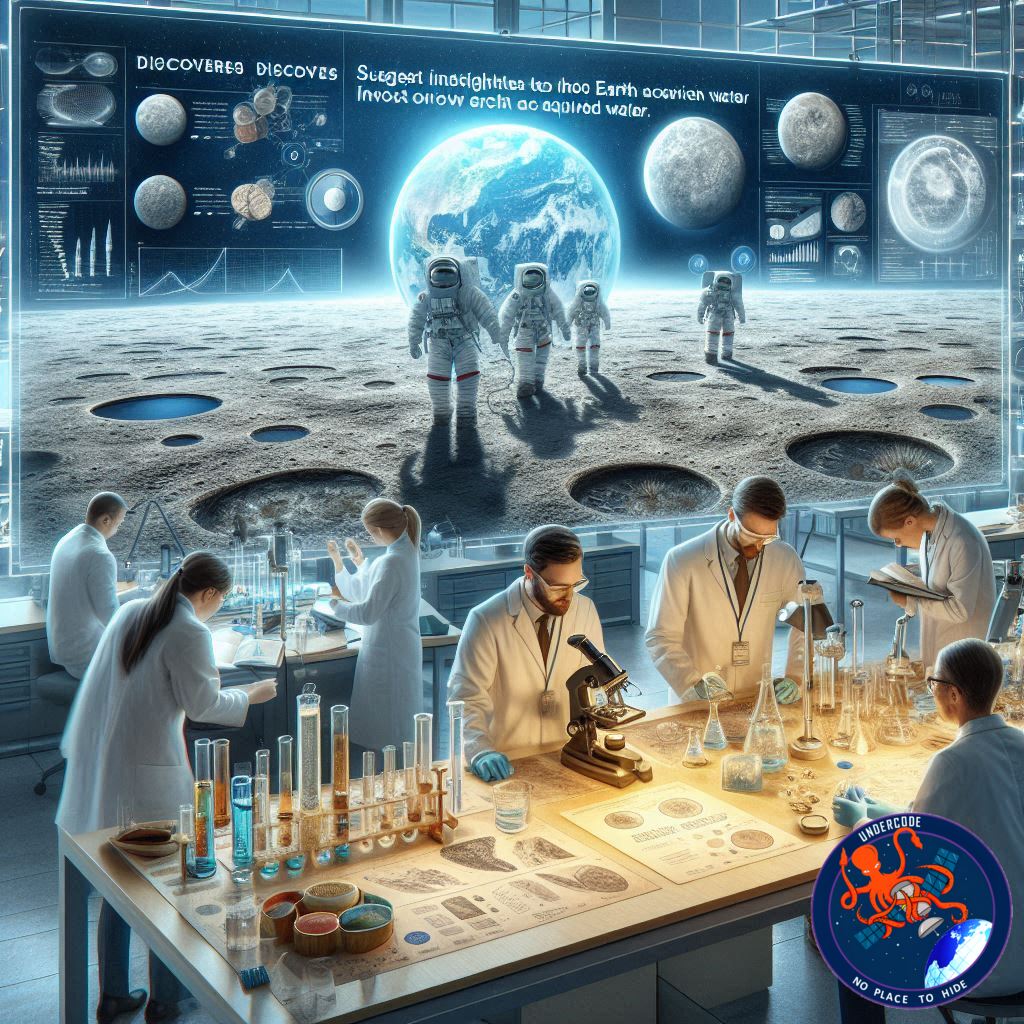 Introduction: The Moon as a Time Capsule of Cosmic History
For decades, scientists have debated a fundamental question about our planet’s origins: where did Earth’s vast oceans come from? One long-standing theory argues that water-rich meteorites bombarded the young Earth, delivering the building blocks of life from space. Now, a new NASA-led study based on Apollo-era lunar samples offers one of the clearest tests of that idea yet. By reading the Moon’s preserved record of ancient impacts, researchers have placed firm limits on how much water meteorites could realistically have delivered to Earth over the last four billion years. The answer, it turns out, is far more modest than many theories once suggested.
Summary of the Original Study: A New Look at Old Lunar Dust
NASA researchers analyzed lunar soil collected during the Apollo missions to better understand the history of meteorite impacts across the Earth-Moon system. Unlike Earth, where geological activity and weather erase ancient evidence, the Moon preserves a near-pristine archive of cosmic collisions stretching back billions of years. This makes lunar regolith — the fine dust and broken rock covering the Moon’s surface — a uniquely valuable scientific record.
Why Previous Methods Fell Short
Earlier studies relied heavily on so-called “metal-loving” elements to trace meteoritic material in lunar soil. However, repeated impacts, melting, and vaporization over time have mixed and altered these elements, making it difficult to accurately reconstruct the original composition of incoming meteorites. This limitation has long complicated efforts to quantify how much water those impacts might have delivered.
The Breakthrough: Triple Oxygen Isotopes
The new study, led by Tony Gargano of NASA’s Johnson Space Center and the Lunar and Planetary Institute, introduced a more reliable approach. Researchers measured triple oxygen isotopes in lunar regolith, a technique that uses subtle variations in oxygen atoms as high-precision fingerprints. Oxygen is the dominant element in rocks and, crucially, remains chemically stable even during violent impacts. This stability allows scientists to isolate the original meteoritic signal from billions of years of lunar reworking.
Carbon-Rich Meteorites in Lunar Soil
Using oxygen isotope analysis, the team determined that at least about 1% of the lunar regolith by mass contains material from carbon-rich meteorites. These meteorites are known to carry water locked within their mineral structures. Some of this material was partially vaporized upon impact, but enough chemical evidence remained to estimate the total water content delivered over time.
Scaling the Results to Earth
Because Earth has a much stronger gravitational pull than the Moon, it experiences far more impacts. The researchers scaled their lunar findings by roughly a factor of 20 to account for this difference. Even under generous assumptions, the total amount of water delivered to Earth by meteorites since around four billion years ago amounts to only a small fraction of Earth’s current ocean volume.
A Challenge to the Late-Delivery Hypothesis
These findings directly challenge the idea that water-rich meteorites arriving late in Earth’s history were the dominant source of Earth’s oceans. While meteorites clearly contributed some water, the Moon’s long-term impact record makes it extremely difficult to argue that they supplied most of it.
What the Results Do — and Do Not — Say
The researchers emphasize that their conclusions do not rule out meteorites as a source of water entirely. Instead, they narrow the window of possibility. Meteorites likely played a supporting role, not a starring one, in Earth’s hydration story.
Implications for the Moon’s Own Water
Although the delivered water appears negligible on an Earth-ocean scale, it is far from insignificant for the Moon. Lunar water is concentrated in permanently shadowed regions near the Moon’s poles, some of the coldest places in the solar system. Even small amounts of water delivered over billions of years could accumulate in these regions and remain trapped.
Relevance to Artemis and Future Exploration
Understanding how water arrived on the Moon has practical implications for future exploration. NASA’s Artemis program aims to return astronauts to the lunar surface, including polar regions where water ice may be accessible. These resources could support long-term human presence by providing drinking water, oxygen, and even rocket fuel.
The Enduring Value of Apollo Samples
All samples used in this study were collected more than 50 years ago from equatorial regions on the Moon’s near side. Despite their age, these materials continue to yield new insights thanks to modern analytical techniques. However, they also represent only a small fraction of the Moon’s surface.
A New Generation of Lunar Science
Researchers involved in the study describe themselves as part of the “next generation” of Apollo scientists — scientists who did not fly the missions but were trained on the priceless samples they returned. The upcoming Artemis missions promise to expand this legacy by returning samples from entirely new regions of the Moon.
What Undercode Say:
The Moon as the Ultimate Scientific Control Sample
This study underscores the Moon’s unique role as a control sample for planetary science. Earth’s surface constantly resets itself through tectonics and erosion, but the Moon quietly records everything. That makes lunar regolith not just dust, but a historical ledger of the solar system’s most violent events.
Why Oxygen Isotopes Change the Game
The use of triple oxygen isotopes marks a methodological leap forward. Instead of relying on elements easily distorted by impacts, this approach tracks something far more stable. It represents a shift toward cleaner, more defensible reconstructions of ancient planetary processes.
Reframing Earth’s Water Origin Story
If late-arriving meteorites cannot explain Earth’s oceans, attention shifts back to earlier epochs. Water may have been incorporated into Earth during its initial formation, or delivered by larger, earlier bodies when the solar system was still young and chaotic.
Implications for Exoplanet Science
Understanding how Earth acquired water informs how scientists assess the habitability of distant exoplanets. If water delivery depends less on late bombardment and more on early planetary formation, it changes how researchers evaluate which worlds might host life.
The Moon as a Resource Map, Not Just a Mystery
For lunar exploration, this research quietly reframes expectations. The Moon may never have been soaked with water, but its limited supplies are still precious. Knowing how and when that water arrived helps mission planners target the most promising locations.
Apollo’s Scientific Afterlife
This study is a reminder that Apollo is not finished delivering science. Each technological advance in laboratory analysis effectively reopens those sample boxes, allowing new generations to ask better questions than were imaginable in the 1970s.
Artemis Will Redefine the Dataset
Artemis samples, especially from polar regions, will likely refine or even challenge current models. If isotopic fingerprints from those regions differ, they could reveal new chapters in the Moon’s water history that Apollo never touched.
A Quiet but Profound Shift
This is not a flashy discovery, but it is a foundational one. It tightens constraints, removes speculation, and replaces it with numbers grounded in physical evidence. In planetary science, that is how real progress happens.
Fact Checker Results:
Claim: Meteorites delivered most of Earth’s water
❌ Evidence from lunar regolith places strict upper limits that contradict this idea.
Claim: The Moon preserves a reliable impact record
✅ Lunar samples provide a time-integrated archive unmatched by Earth.
Claim: New methods improve accuracy over older studies
✅ Triple oxygen isotopes offer clearer, less distorted compositional data.
Prediction:
The Next Decade of Lunar Science 🌑
Artemis-returned samples will likely confirm that Earth’s water story began earlier than previously thought.
Shifts in Planetary Formation Models 🚀
Expect increased emphasis on water retention during planet formation rather than late-stage delivery.
Lunar Resources as Strategic Assets ❄️
Even small water inventories at the Moon’s poles will become central to long-term human exploration strategies.
🕵️📝✔️Let’s dive deep and fact‑check.
References:
Reported By: science.nasa.gov
Extra Source Hub (Possible Sources for article):
https://www.reddit.com/r/AskReddit
Wikipedia
OpenAi & Undercode AI
Image Source:
Unsplash
Undercode AI DI v2
Bing
🔐JOIN OUR CYBER WORLD [ CVE News • HackMonitor • UndercodeNews ]
📢 Follow UndercodeNews & Stay Tuned:
𝕏 formerly Twitter 🐦 | @ Threads | 🔗 Linkedin | 🦋BlueSky | 🐘Mastodon


