
Listen to this Post
Introduction
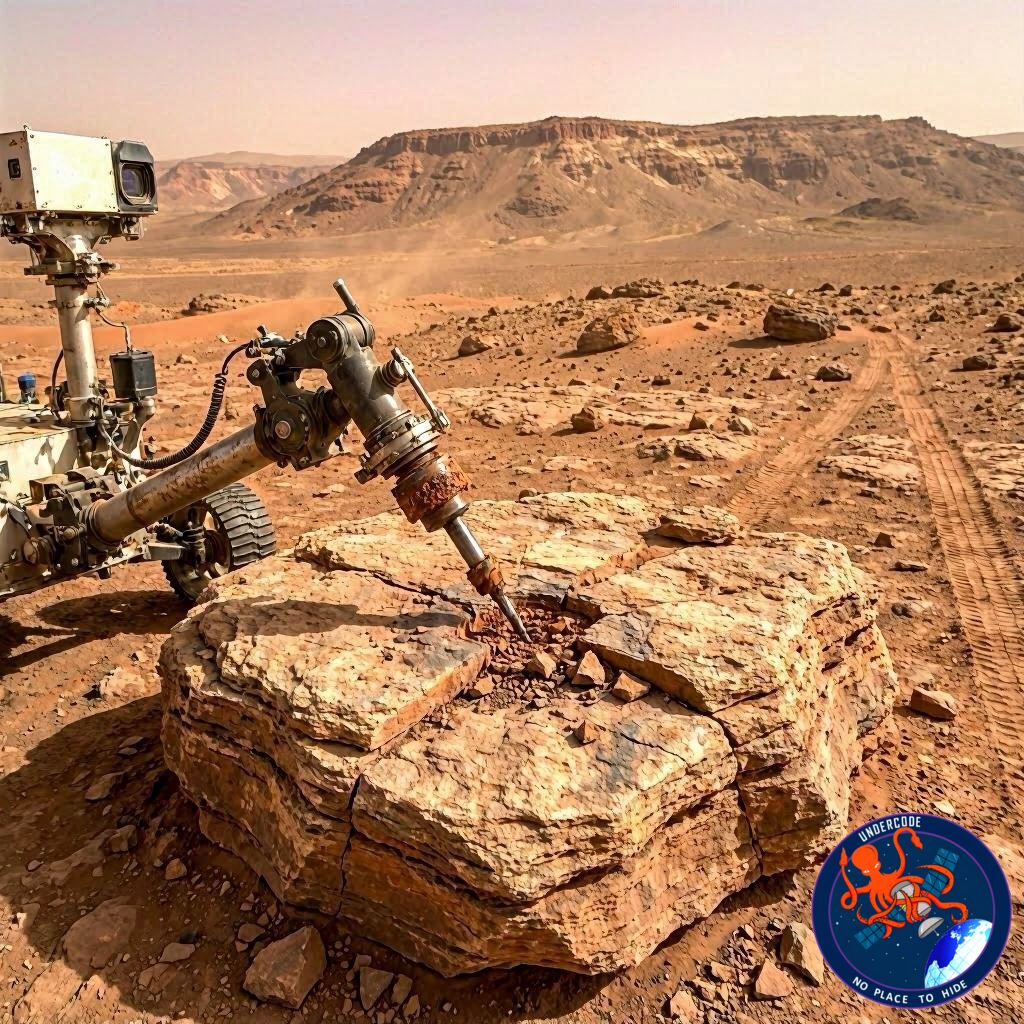
A small rock on Mars has turned into a surprisingly important engineering story for NASA’s Curiosity mission. What began as a routine drilling operation inside Gale Crater evolved into a multi-day recovery effort after a rock became stuck to the rover’s drill. The event highlights both the unpredictable nature of planetary exploration and the precision required to operate robotic systems millions of miles away from Earth.
Summary of the Original Report
NASA’s National Aeronautics and Space Administration Curiosity rover recently captured detailed images of a Martian rock nicknamed “Atacama” using its Mast Camera system on May 6, 2026.
The observation took place on sol 4,877 of the mission, marking another milestone in the rover’s long operational history.
The rock had unexpectedly become attached to the rover’s drill during an operation on April 25.
Engineers on Earth monitored the situation closely as the rover continued to function on Mars.
Attempts were made to dislodge the rock using mechanical repositioning of the robotic arm.
The team also activated controlled vibration sequences in the drill mechanism.
After several days of careful adjustments, the rock was finally freed on May 1.
The object, “Atacama,” measures approximately 1.5 feet in diameter at its base.
Its thickness is estimated at around 6 inches.
On Earth, it would weigh roughly 28.6 pounds, or about 13 kilograms.
On Mars, its effective weight would be significantly lower due to reduced gravity.
The drill hole created during sampling is clearly visible in the rock’s surface.
The images released are part of a stitched mosaic composed of eight separate frames.
These images were transmitted back to Earth and combined for scientific clarity.
Color correction was applied to approximate natural daylight conditions on Earth.
The Curiosity rover is managed by Jet Propulsion Laboratory.
JPL operates under the oversight of California Institute of Technology.
The mission is part of NASA’s Mars Exploration Program portfolio.
The Mastcam instrument was developed by Malin Space Science Systems.
The rover continues to study Martian geology and surface composition in Gale Crater.
What Undercode Say:
The “Atacama” incident may look minor, but it reflects a deeper reality of robotic planetary exploration.
Every mechanical interaction on Mars carries uncertainty because engineers cannot physically intervene in real time.
Even a simple rock can become a technical obstacle when gravity, dust, and terrain interact in unexpected ways.
The fact that the drill became temporarily stuck shows how delicate sampling operations truly are.
Curiosity’s robotic arm is one of the most advanced systems ever deployed on another planet.
Yet it still faces limitations when encountering irregular rock structures.
The successful removal of the rock demonstrates strong fault recovery design in NASA engineering systems.
Remote vibration techniques suggest how adaptable rover tools have become over time.
This event also highlights the importance of redundancy in space robotics.
If one method fails, engineers must quickly design alternative recovery strategies.
The delay of several days reflects careful risk management rather than operational weakness.
Rushing could have caused permanent damage to the drill assembly.
The captured mosaic image serves both scientific and diagnostic purposes.
It allows engineers to visually inspect the interaction point between drill and rock.
It also helps geologists study the physical properties of Martian sedimentary formations.
The naming of the rock “Atacama” follows a tradition of drawing parallels with Earth deserts.
This comparison helps scientists interpret Martian environments using Earth analogs.
The incident underscores how Mars missions are as much about engineering resilience as science.
Each anomaly becomes a learning opportunity for future rover designs.
Long-distance autonomy is essential because communication delays prevent instant control.
This forces systems like Curiosity to operate with semi-independent decision frameworks.
The success of this operation reinforces confidence in long-duration planetary missions.
It also validates decades of robotic systems engineering at NASA and partner institutions.
The rover’s continued functionality after the event shows strong mechanical robustness.
Such resilience is critical for missions that may last far beyond their original timelines.
The data collected still contributes to broader Mars geology research goals.
Even operational challenges become valuable scientific case studies.
Future missions may incorporate improved drill release mechanisms inspired by this event.
Ultimately, this incident reflects exploration in its purest form: controlled uncertainty.
Fact Checker Results
✔ NASA confirmed Curiosity captured mosaic imagery of rock “Atacama” on Mars.
✔ Engineering intervention using robotic arm vibration was used to free the stuck rock.
✔ All mission operations are consistent with known Curiosity rover capabilities and procedures.
Prediction
Future Mars drilling systems will likely include smarter autonomous release mechanisms to prevent similar sticking events.
AI-assisted rover diagnostics may reduce recovery time during mechanical anomalies.
Curiosity’s experience will directly influence the design of next-generation Mars exploration hardware.
🕵️📝Let’s dive deep and fact‑check.
References:
Reported By: science.nasa.gov
Extra Source Hub (Possible Sources for article):
https://www.twitter.com
Wikipedia
OpenAi & Undercode AI
Image Source:
Unsplash
Undercode AI DI v2
Bing
🔐JOIN OUR CYBER WORLD [ CVE News • HackMonitor • UndercodeNews ]
📢 Follow UndercodeNews & Stay Tuned:
𝕏 formerly Twitter 🐦 | @ Threads | 🔗 Linkedin | 🦋BlueSky | 🐘Mastodon


