
Listen to this Post
Introduction
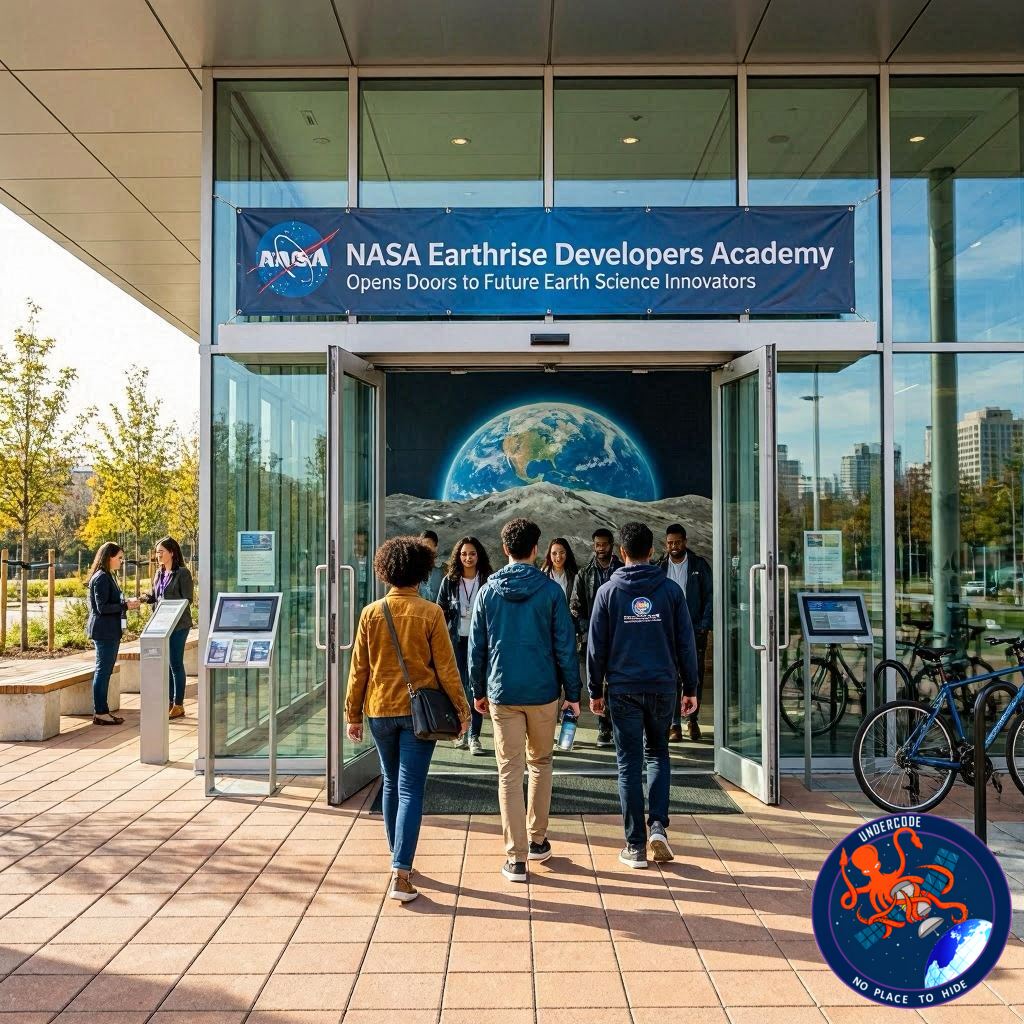
For students, recent graduates, and early-career professionals interested in Earth science, technology, remote sensing, and environmental research, the NASA EarthRISE Developers Academy represents a unique opportunity to gain hands-on experience while contributing to meaningful scientific work. The program combines research, collaboration, technical development, and professional growth into an intensive learning environment designed to prepare participants for future careers connected to Earth observation and environmental problem-solving.
NASA EarthRISE Developers Academy welcomes individuals from diverse educational and professional backgrounds. Rather than focusing solely on technical expertise, the program values curiosity, collaboration, and a willingness to learn. Through project-based experiences involving remote sensing technologies, GIS tools, scientific communication, and interdisciplinary teamwork, participants develop skills that extend beyond traditional classroom learning.
Broad Eligibility Encourages Diverse Participation
One of the most notable aspects of the NASA EarthRISE Developers Academy is its openness to participants from multiple academic disciplines. Applicants may come from Earth sciences, environmental science, geography, computer science, coding, GIS, remote sensing, and related technical fields.
The Academy specifically emphasizes interdisciplinary collaboration. Successful applicants are not only technically capable but also demonstrate enthusiasm for learning and knowledge-sharing within their project teams.
Eligibility requirements include maintaining a minimum GPA of 3.0 on a 4.0 scale, calculated either through cumulative performance or the most recent semester.
Applicants must also hold U.S. citizenship or Legal Permanent Resident status to qualify.
Flexible Learning Options With Important Location Rules
The Academy offers both in-person and virtual opportunities.
Participants selected for in-person programs must work onsite throughout the program duration. Those participating remotely may work virtually, but geographic restrictions apply. Virtual participants must remain physically located within the 50 United States or Washington, D.C. during the term.
Remote work from U.S. territories or international locations is not permitted.
Applicants can indicate preferred project locations during the application process, creating some flexibility while maintaining operational consistency.
Time Commitment Reflects Professional Expectations
NASA EarthRISE Developers Academy is not structured as a casual extracurricular experience.
Participants are expected to dedicate approximately 25 to 29 hours per week, typically from Monday through Thursday. Work schedules are coordinated according to office operating hours, generally between 8 a.m. and 5 p.m., while considering participant availability.
This commitment creates an environment that mirrors real-world professional research settings.
Application Process Designed for Accessibility
The application system allows applicants to save drafts and return later, reducing pressure during submission.
Candidates are encouraged to prepare essay responses separately before transferring them into the application portal. This minimizes risks associated with accidental data loss and improves application quality.
Applicants are categorized according to their status at the beginning of the selected term:
Currently Enrolled Students
Individuals actively attending educational institutions apply under this category.
Recent Graduates
Applicants who completed their studies within the previous two years fall into this classification.
Early or Transitioning Career Professionals
Individuals with more than two years of post-graduation professional experience belong in this category.
Recommendation Letters Play a Major Role
Applicants must provide at least two recommenders.
Once recommender information is entered, automated emails are generated containing secure recommendation forms.
Recommendation forms remain open for submission up to two weeks after the application deadline closes.
Applicants can monitor recommendation status directly within the application portal.
The system also provides flexibility for replacing recommenders if circumstances change, with support for up to five recommender entries.
Submission Rules Leave Little Room for Error
To complete submission requirements, candidates must finish:
Profile Information
Applicants provide personal and academic details.
Eligibility Questions
Basic qualification verification occurs here.
Application Form
Primary application details are entered.
Essay Responses
Short written components help evaluators assess candidate potential.
Recommendation Section
External endorsements strengthen application evaluation.
Once submitted, applications become locked from editing.
Applicants receive email confirmation verifying successful submission.
Late applications are not accepted under any circumstances.
The application portal closes precisely at 11:59 PM Eastern Time on the final application date.
Competitive Selection Process
NASA EarthRISE Developers Academy operates in a highly competitive environment.
Following deadline closure, submitted applications undergo review.
Not all applicants receive interviews.
Selected candidates are contacted by email and typically participate in virtual interviews conducted through Microsoft Teams.
Selection notifications occur on a rolling basis, meaning response timelines can vary.
Hands-On Earth Science Research Defines the Experience
Participants spend substantial time conducting applied Earth science research.
Project activities include literature review, data analysis, GIS applications, and utilization of NASA remote sensing resources.
Teams collaborate with organizations that may benefit from project findings and analytical methods.
Professional communication receives equal emphasis.
Participants create technical reports, posters, and presentations designed to communicate research findings to multiple audiences.
The Academy also integrates professional development opportunities including team-building exercises, networking activities, and personal growth programs.
Interdisciplinary Teams Strengthen Collaboration
Participants work in teams of four to five members.
Each team receives support from project coordinators, science advisors, mentors, and NASA Langley EarthRISE Office personnel.
This structure mirrors professional scientific collaboration environments where interdisciplinary cooperation drives innovation.
Research Areas Address Real-World Challenges
Projects align with NASA Earth Action thematic priorities.
Research areas include:
Agriculture
Improving environmental understanding and agricultural outcomes.
Disaster Response
Supporting decision-making during natural disasters.
Ecological Conservation
Protecting ecosystems using Earth observation technologies.
Energy and Infrastructure
Analyzing environmental impacts and infrastructure resilience.
Health and Air Quality
Investigating atmospheric conditions and public health implications.
Water Resources
Monitoring water systems and sustainability challenges.
Wildland Fires
Understanding and improving wildfire management capabilities.
Project durations vary seasonally.
Spring programs generally run January through April.
Summer terms often occur June through August.
Fall sessions commonly operate September through November.
Each project cycle typically lasts between 10 and 14 weeks.
What Undercode Say:
NASA EarthRISE Developers Academy reflects an increasingly important trend across scientific organizations: blending technical education with operational experience.
Traditional classroom education often struggles to provide direct exposure to large-scale scientific workflows. Programs like EarthRISE bridge that gap by exposing participants to research methodologies, collaborative problem-solving, and technical communication practices early in their careers.
One particularly strong aspect is the interdisciplinary design.
Modern environmental challenges rarely fit neatly into a single field. Climate monitoring, disaster prediction, wildfire analysis, and infrastructure planning require experts from multiple backgrounds working together.
EarthRISE recognizes this reality.
Computer scientists increasingly need environmental understanding.
Environmental researchers increasingly rely on coding.
GIS specialists benefit from stronger communication skills.
Programs that force interaction across disciplines produce professionals better prepared for future workforce demands.
Another strategic advantage is the emphasis on communication.
Scientific discoveries have limited impact when findings cannot be effectively translated into actionable information.
The requirement to create posters, reports, and presentations trains participants in a critical but often overlooked skill set.
Professional development activities also deserve attention.
Networking, team-building exercises, and mentor interactions frequently become long-term career accelerators.
Many scientific careers advance not only because of technical competence but also because of collaboration quality and relationship-building.
The remote participation option further reflects evolving workforce expectations.
Scientific institutions increasingly support distributed collaboration environments.
EarthRISE exposes participants to hybrid research workflows now becoming standard across industries.
The program also mirrors broader workforce trends emphasizing applied learning.
Employers increasingly prioritize practical experience alongside academic credentials.
Programs combining research exposure, communication training, and interdisciplinary collaboration align closely with evolving hiring expectations.
NASA EarthRISE Developers Academy serves not merely as an educational opportunity but as a career preparation platform.
Participants leave with technical exposure, research familiarity, communication experience, and collaborative practice that extend beyond a traditional internship structure.
For students and early-career professionals pursuing Earth science, environmental technology, remote sensing, or data-driven environmental research, experiences like these may significantly influence long-term career trajectories.
Fact Checker Results
✅ NASA EarthRISE accepts interdisciplinary applicants from multiple scientific and technical backgrounds.
✅ Participants are expected to commit approximately 25 to 29 hours weekly during program terms.
✅ Project topics include agriculture, disasters, ecological conservation, health, infrastructure, water resources, and wildland fire research.
Prediction
🔍 Scientific workforce development programs will increasingly emphasize interdisciplinary collaboration.
📊 Remote sensing, GIS, and environmental data analysis skills will continue growing in industry demand.
🚀 Programs like NASA EarthRISE may become increasingly important pathways connecting education with real-world environmental technology careers.
▶️ Related Video (86% Match):
🕵️📝Let’s dive deep and fact‑check.
References:
Reported By: science.nasa.gov
Extra Source Hub (Possible Sources for article):
https://www.medium.com
Wikipedia
OpenAi & Undercode AI
Image Source:
Unsplash
Undercode AI DI v2
Bing
🔐JOIN OUR CYBER WORLD [ CVE News • HackMonitor • UndercodeNews ]
📢 Follow UndercodeNews & Stay Tuned:
𝕏 formerly Twitter 🐦 | @ Threads | 🔗 Linkedin | 🦋BlueSky | 🐘Mastodon | 📺Youtube


