
Listen to this Post
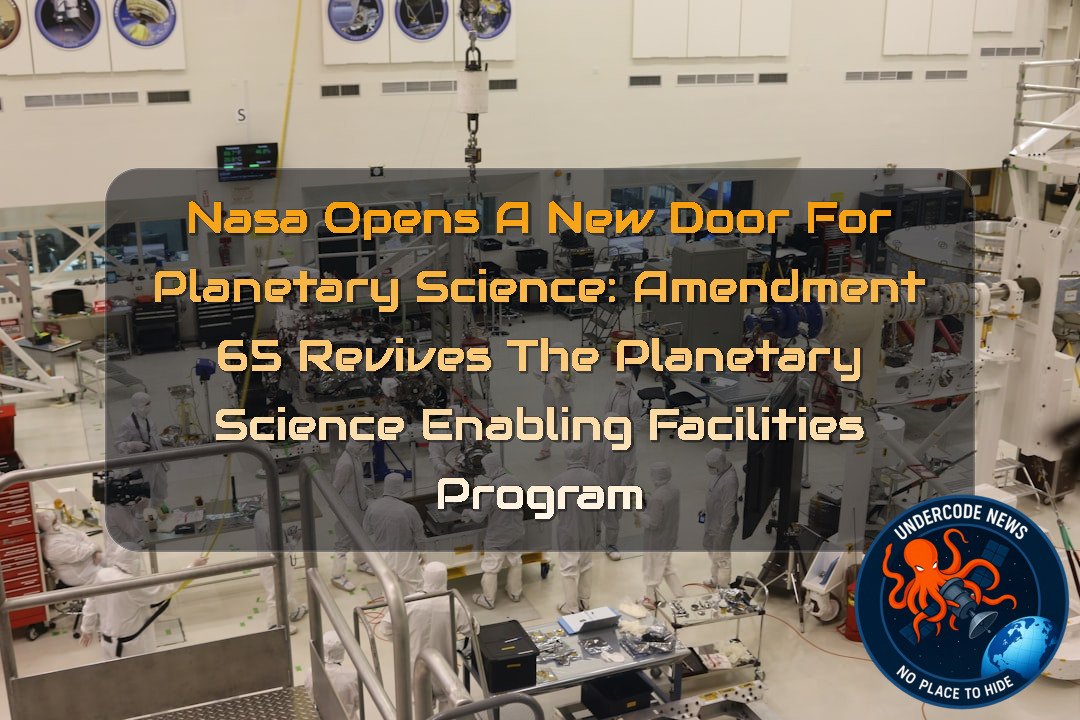 Introduction: A Strategic Investment in the Future of Space Exploration
Scientific breakthroughs in planetary exploration do not begin with rockets lifting off from launch pads—they begin inside laboratories, research centers, and highly specialized scientific facilities where researchers analyze planetary materials, develop cutting-edge instruments, and prepare for future missions. Every successful spacecraft sent to Mars, Europa, Titan, or the Moon depends on years of behind-the-scenes work performed by scientists using advanced experimental and analytical infrastructure.
Recognizing the importance of these resources, NASA has officially announced a significant update to its Research Opportunities in Space and Earth Sciences (ROSES-2025) program. Through Amendment 65, the agency has revived the Planetary Science Enabling Facilities (PSEF) opportunity, transforming what was previously listed as “not solicited” into a fully funded proposal opportunity. This unexpected change provides laboratories and research institutions with a valuable chance to secure support for facilities that will benefit the broader planetary science community.
The announcement represents more than a routine administrative update. It reflects NASA’s continued commitment to strengthening the scientific foundation that supports current and future planetary missions.
NASA’s Amendment 65 Changes the Landscape
NASA announced that the C.4 Planetary Science Enabling Facilities (PSEF) program element is now officially accepting proposals as part of the ROSES-2025 research opportunities.
Previously, researchers believed that this funding opportunity would not be available during this cycle. Amendment 65 completely changes that expectation by reopening the program and inviting proposals from qualified institutions.
The decision immediately creates new opportunities for universities, laboratories, research organizations, and scientific institutions that maintain experimental or analytical facilities capable of supporting NASA’s Planetary Science Division.
Understanding the Planetary Science Enabling Facilities Program
Unlike traditional research grants that primarily fund scientific investigations, the PSEF program focuses on supporting facilities that enable research across the planetary science community.
These facilities may include:
Advanced analytical laboratories
Planetary material characterization centers
High-precision spectroscopy equipment
Experimental simulation chambers
Geochemistry laboratories
Planetary analog research facilities
Instrument calibration centers
Specialized imaging laboratories
Rather than funding a single research project, NASA aims to strengthen scientific infrastructure that many researchers can access over multiple years.
This approach maximizes scientific return by allowing numerous investigators to utilize shared resources instead of duplicating expensive equipment across multiple institutions.
Scientific Value Must Be Clearly Demonstrated
NASA emphasizes that successful proposals must clearly explain why the proposed facility provides significant scientific value.
Applicants are expected to demonstrate:
The importance of the facility to planetary science research.
The unique scientific capabilities offered.
The broader benefits to NASA-funded investigators.
Evidence of an active and sustainable research community.
A clear plan for community access.
Facilities that simply possess advanced equipment will not automatically qualify. NASA wants to invest in resources that serve as essential scientific infrastructure for a large and active user base.
Strong Community Demand Is a Critical Requirement
Another major evaluation criterion involves demonstrating that the facility already serves—or has the potential to serve—a substantial number of planetary researchers.
NASA specifically notes that applicants must provide convincing evidence showing there is significant community demand for the proposed facility.
This ensures taxpayer-funded infrastructure delivers broad scientific benefits rather than supporting only a small number of investigators.
The emphasis on community accessibility also aligns with NASA’s long-standing strategy of promoting collaborative research across universities, government laboratories, and international partners.
Proposal Timeline and Important Dates
Amendment 65 establishes a clear submission schedule for interested applicants.
The proposal deadline has been set for November 10, 2026, giving research organizations several months to prepare competitive submissions.
Importantly, NASA has clarified that applicants do not need to submit either a Notice of Intent (NOI) or a Step-1 proposal before preparing their complete application.
This simplified process may encourage wider participation and reduce administrative overhead for research institutions.
Additional Program Updates
Alongside Amendment 65, NASA also updated C.1 The Planetary Science Research Program Overview to reflect the inclusion of the newly solicited PSEF opportunity.
Keeping both program documents synchronized helps applicants understand how enabling facilities integrate into NASA’s broader planetary science research strategy.
Researchers are encouraged to review both updated documents carefully before preparing proposals.
NASA Continues Building the Scientific Foundation for Future Missions
While headlines often focus on spacecraft launches and planetary discoveries, programs like PSEF remind us that scientific infrastructure is equally essential.
Future missions to Mars, icy moons, asteroids, Venus, and other destinations require increasingly sophisticated laboratory capabilities here on Earth.
Facilities supported under this program could contribute to:
Analysis of returned planetary samples
Development of next-generation instruments
Improved understanding of planetary chemistry
Better mission planning
Enhanced interpretation of spacecraft observations
These foundational investments frequently produce scientific advances long before the next spacecraft ever leaves Earth.
Deep Analysis
The reopening of PSEF is strategically important because it addresses a growing challenge in planetary science: maintaining world-class research infrastructure while scientific demand continues to increase.
Several trends make this announcement particularly significant:
Planetary missions are generating unprecedented volumes of complex scientific data.
Upcoming sample-return missions require highly specialized laboratory capabilities.
Advanced analytical instruments continue becoming more expensive.
Shared national research facilities improve efficiency and reduce duplicated investments.
Institutions preparing proposals should focus on measurable community impact rather than equipment specifications alone.
Typical preparation workflow may include:
Review updated ROSES documentation
Download Amendment 65
Review C.4 PSEF requirements
Compare with updated C.1 Program Overview
Facility Assessment
Inventory laboratory capabilities
Document current users
Estimate future community demand
Proposal Preparation
Prepare scientific justification
Develop operations plan
Document community access policies
Collect support letters
Finalize budget
Submit before November 10, 2026
A successful proposal will likely combine technical excellence with clear evidence that the facility serves as a long-term national resource rather than an institution-specific laboratory. NASA’s focus on accessibility suggests that collaborative facilities capable of supporting multiple universities and research teams may receive particularly strong consideration.
As planetary exploration accelerates—with missions targeting Mars, the Moon, asteroid systems, and the icy worlds of the outer Solar System—the need for robust terrestrial research infrastructure will continue to grow. Amendment 65 can therefore be viewed as an investment not only in laboratories but also in the scientific ecosystem that enables future exploration.
What Undercode Say:
NASA’s decision to revive the Planetary Science Enabling Facilities program is much more important than the announcement initially appears.
Many funding announcements focus on individual scientific projects, but infrastructure funding often creates a much larger long-term impact.
Every major planetary discovery depends on reliable laboratory infrastructure.
Without advanced facilities, even the most ambitious space missions cannot achieve their full scientific potential.
Shared facilities reduce unnecessary duplication across institutions.
Researchers gain access to expensive equipment that many universities could never afford independently.
This increases collaboration across the scientific community.
It also improves scientific reproducibility.
Standardized analytical methods become easier to establish.
Future NASA missions will likely depend even more heavily on laboratory analysis.
Returned lunar samples.
Martian materials.
Asteroid specimens.
Potential icy moon samples.
All require world-class laboratories.
Investment in infrastructure usually produces scientific returns for decades.
The simplified proposal process is another positive sign.
Removing preliminary submissions lowers barriers for applicants.
Smaller institutions may now compete more effectively.
NASA appears interested in expanding participation.
Community accessibility remains the strongest message in this amendment.
Facilities serving hundreds of researchers will likely stand out.
Open access often generates higher scientific productivity.
The timing is also noteworthy.
Planetary science is entering a period of renewed global competition.
NASA.
ESA.
JAXA.
ISRO.
CNSA.
Private aerospace companies.
All are increasing exploration activities.
That means demand for analytical laboratories will continue growing.
Infrastructure investments made today may directly support missions launched years from now.
Scientific facilities often outlive individual missions.
Many become national resources for decades.
The PSEF program recognizes this reality.
Overall, Amendment 65 demonstrates that NASA continues investing not only in spacecraft but also in the scientific backbone required to interpret the discoveries those spacecraft make.
✅ Fact 1: NASA officially reopened the C.4 Planetary Science Enabling Facilities opportunity.
Analysis: This matches Amendment 65, which changes the program from “not solicited” to an active solicitation under ROSES-2025.
✅ Fact 2: Proposals are due on November 10, 2026.
Analysis: The published amendment identifies November 10, 2026, as the submission deadline, and it also confirms that no Notice of Intent or Step-1 proposal is required.
✅ Fact 3: The program supports research facilities rather than individual science investigations.
Analysis: The solicitation explicitly focuses on experimental and analytical facilities that provide broad access to the planetary science research community, making this characterization accurate.
Prediction
(+1) NASA’s renewed investment in shared planetary science infrastructure is likely to strengthen collaboration across research institutions and improve scientific readiness for future Moon, Mars, asteroid, and outer Solar System missions. Facilities funded through this program could become critical resources supporting discoveries for many years, helping researchers analyze increasingly complex planetary data and returned samples while maximizing the scientific return of NASA’s exploration portfolio.
▶️ Related Video (74% Match):
🕵️📝Let’s dive deep and fact‑check.
🎓 Live Courses & Certifications:
Join Undercode Academy for Verified Certifications
🚀 Request a Custom Project:
Secure, high-velocity infrastructure and disruptive technological engineering. Contact our engineering team for high-tier development and proprietary systems:
[email protected]
💎 Smart Architecture | 🛡️ Secure by Design | ⭐ Trusted by Thousands
References:
Reported By: science.nasa.gov
Extra Source Hub (Possible Sources for article):
https://stackoverflow.com
Wikipedia
OpenAi & Undercode AI
Image Source:
Unsplash
Undercode AI DI v2
🔐JOIN OUR CYBER WORLD [ CVE News • HackMonitor • UndercodeNews ]
📢 Follow UndercodeNews & Stay Tuned:
𝕏 formerly Twitter 🐦 | @ Threads | 🔗 Linkedin | 🦋BlueSky | 🐘Mastodon | 📺Youtube


