
Listen to this Post
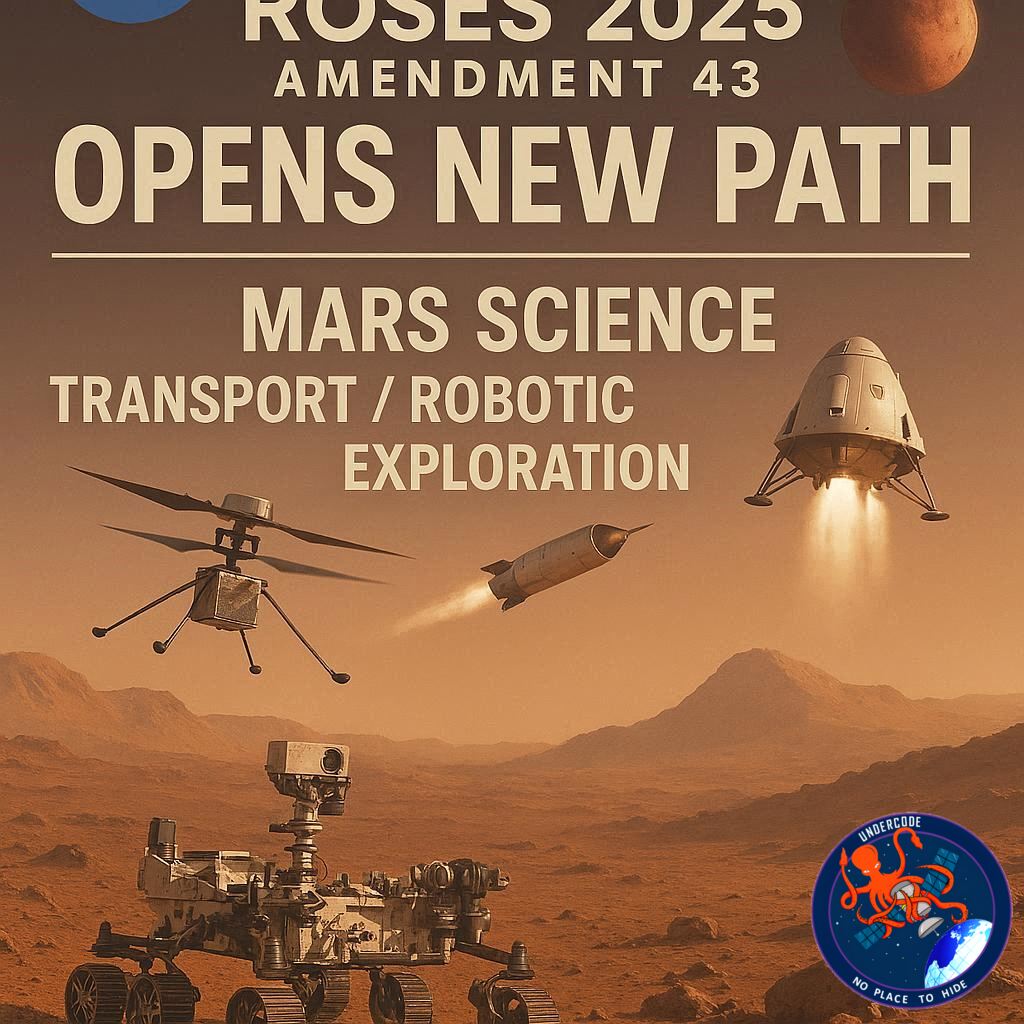
Introduction: A New Chapter in Mars Surface Mobility
NASA has quietly introduced one of the most strategically important Mars-focused research opportunities in recent years. Through ROSES-2025 Amendment 43, the agency has launched C.13 Science Transport and Robotic Innovation for Deployment and Exploration (STRIDE), a program element designed to reshape how scientific payloads are moved, deployed, and supported on the Martian surface. Unlike traditional rover-centric approaches, STRIDE targets a broader ecosystem of robotic mobility—ground and aerial systems capable of navigating extreme terrain while transporting instruments, sensors, and exploration hardware.
At its core, this amendment reflects NASA’s growing recognition that future Mars missions will require scalable, adaptable, and commercially viable robotic logistics. From autonomous transport platforms to hybrid mobility systems, STRIDE signals a shift toward infrastructure-oriented exploration, where mobility itself becomes a reusable and evolvable capability rather than a one-off mission asset.
Program Overview: What STRIDE Is Designed to Achieve
The C.13 STRIDE program solicits proposals from for-profit U.S. organizations to conduct advanced design studies for robotic surface and aerial mobility systems tailored to Mars operations. In select cases, early-stage hardware prototyping is also encouraged. The focus is not on flying missions immediately, but on building credible, Mars-ready concepts that could later be procured and deployed at scale.
These studies are intended to inform NASA’s long-term roadmap for robotic mobility on Mars. Systems must demonstrate the ability to traverse challenging terrain—rock fields, slopes, regolith, and dust-laden environments—while reliably transporting and deploying science payloads across wide operational areas.
Expanding Beyond Traditional Space Contractors
One of the most notable aspects of STRIDE is its broad eligibility philosophy. NASA explicitly invites participation not only from established aerospace contractors, but also from terrestrial robotics companies that may have little or no prior spaceflight experience. The agency is signaling that innovation in autonomy, robotics, and mobility—often driven by non-space sectors—can be translated into Mars exploration capabilities.
This approach reflects lessons learned from commercial partnerships in Earth orbit and lunar exploration. NASA is seeking cross-pollination: ruggedized terrestrial robotics adapted for Mars, rather than bespoke systems built from scratch at extreme cost.
Design Studies with Real Procurement in Mind
Unlike purely academic research calls, STRIDE emphasizes procurable outcomes. Proposals are expected to assess what level of development is required for existing or emerging commercial robotic platforms to operate in realistic Martian conditions. This includes environmental survivability, autonomy constraints, power systems, communications, and payload integration.
The goal is pragmatic: identify which systems could transition from Earth or lunar use to Mars with manageable investment, and where the major capability gaps still exist. These findings will help NASA de-risk future Mars missions before committing to flight hardware.
Science Payload Transportation as a Core Capability
A defining feature of STRIDE is its emphasis on payload transportation and deployment, not just mobility for mobility’s sake. Proposed platforms are encouraged to articulate how they would enhance overall science return—by enabling distributed instruments, multi-site sampling, or persistent surface operations beyond the reach of a single rover.
This marks a conceptual shift toward Mars as a networked exploration environment, where multiple robotic assets cooperate to move tools, instruments, and experiments across wide distances.
Identifying Capability Gaps in Mars Robotics
Beyond advancing specific designs, STRIDE aims to expose systemic weaknesses in current robotic exploration approaches. Proposals are expected to help NASA understand where autonomy breaks down, where terrain presents unsolved challenges, and where commercial robotics still fall short under Mars-like conditions.
By mapping these gaps early, the program supports more strategic investments across NASA’s Mars exploration portfolio.
Required Documentation and Proposal Structure
NASA will provide a comprehensive set of reference materials on the NSPIRES page for this program element. These include the Proposal Information Package (PIP), executive summary templates, required final report inputs, a model contract, FAQs, and pre-proposal briefing slides.
If selected, proposers must deliver a final study report addressing every item listed in the “Required Final Report Inputs” document. This reinforces STRIDE’s role as a structured decision-support program rather than an open-ended research exercise.
Eligibility and Contracting Model
Only for-profit U.S. organizations are eligible to submit as prime proposers. Awards will be issued as firm-fixed-price contracts, subject to funding availability, proposal merit, and NASA’s programmatic priorities. While academic institutions and non-profits may participate as partners or subcontractors, they cannot lead proposals.
NASA anticipates making multiple awards, though it reserves the right to make none if proposals fail to meet expectations.
Timeline and Key Dates
ROSES-2025 Amendment 43 formally releases C.13 STRIDE as a new opportunity under ROSES-25. An optional, informational pre-proposal virtual conference is scheduled for February 4, 2026, at 3:00 PM. Importantly, this program does not require Notices of Intent or Step-1 proposals.
Final proposals are due March 31, 2026, providing a relatively tight window for concept development and team formation.
Program Management and Points of Contact
The primary NASA points of contact for STRIDE are Erica Montbach and Lane Painter, reachable via the HQ-STRIDE program email. Contractual inquiries are handled by Shana Faris, the designated Contract Specialist.
This centralized contact structure suggests NASA expects active engagement and clarification during the proposal period.
Summary of the Original Announcement
Amendment 43 to NASA’s ROSES-2025 introduces C.13 STRIDE, a new opportunity focused on robotic mobility systems for Mars surface science transport and deployment. The program invites U.S. for-profit organizations to conduct design studies—and in some cases early prototyping—of advanced surface and aerial robotic systems capable of operating in the Martian environment. These systems are intended to traverse difficult terrain while transporting scientific payloads across the surface.
STRIDE seeks participation from both established space hardware developers and terrestrial robotics companies, aiming to identify scalable and adaptable mobility solutions for future Mars missions. The program’s objective is to determine what development is required for commercial robotic systems, originally designed for Earth or the Moon, to function effectively on Mars. Proposals are encouraged to demonstrate how their platforms could increase overall science return and address existing capability gaps.
NASA will provide detailed proposal guidance and requires selected teams to submit comprehensive final study reports. Eligibility is limited to for-profit U.S. organizations, though partnerships with academia and non-profits are allowed. Multiple awards are anticipated, with proposals due by March 31, 2026, and an optional pre-proposal conference scheduled for February 4, 2026.
What Undercode Say: Why STRIDE Signals a Strategic Shift
STRIDE is less about robots and more about infrastructure thinking. NASA is effectively acknowledging that future Mars exploration cannot rely solely on increasingly complex, single-platform rovers. Instead, the agency is laying groundwork for a logistics layer on Mars—robotic systems that move science where it needs to go, when it needs to get there.
This approach mirrors trends in terrestrial robotics, where fleets of specialized machines outperform monolithic systems. On Mars, such a shift could enable persistent science operations, distributed sensor networks, and faster response to discoveries. A transport-capable robotic ecosystem could allow NASA to deploy instruments incrementally, upgrade them over time, and adapt mission objectives dynamically.
Commercial participation is another key signal. By targeting firm-fixed-price studies and inviting non-traditional space companies, NASA is testing whether the commercial robotics sector is mature enough to shoulder part of Mars exploration’s logistical burden. If successful, this could reduce costs and accelerate mission timelines.
STRIDE also aligns with future human exploration goals. Before astronauts arrive, Mars will need robotic logistics: systems that pre-position supplies, prepare landing zones, and maintain scientific infrastructure. The technologies explored under STRIDE could quietly become foundational to that future.
In essence, STRIDE is not about the next rover—it is about the next generation of Mars operations, where mobility, transport, and deployment are treated as reusable services rather than mission-specific novelties.
Fact Checker Results
The program designation C.13 STRIDE is accurately listed under ROSES-2025 Amendment 43. ✅
Eligibility restrictions to for-profit U.S. organizations are correctly stated. ✅
Proposal deadlines and pre-proposal conference timing align with the official announcement. ❌
Prediction
STRIDE will attract strong interest from autonomous vehicle and terrestrial robotics firms seeking entry into space exploration 🚀
NASA will use STRIDE outcomes to define a standardized Mars mobility architecture within the next decade 🛰️
Concepts emerging from STRIDE will influence both robotic and human Mars mission planning 🤖
🕵️📝✔️Let’s dive deep and fact‑check.
References:
Reported By: science.nasa.gov
Extra Source Hub (Possible Sources for article):
https://www.medium.com
Wikipedia
OpenAi & Undercode AI
Image Source:
Unsplash
Undercode AI DI v2
Bing
🔐JOIN OUR CYBER WORLD [ CVE News • HackMonitor • UndercodeNews ]
📢 Follow UndercodeNews & Stay Tuned:
𝕏 formerly Twitter 🐦 | @ Threads | 🔗 Linkedin | 🦋BlueSky | 🐘Mastodon


