
Listen to this Post
🎯 Introduction to a Visitor From the Stars
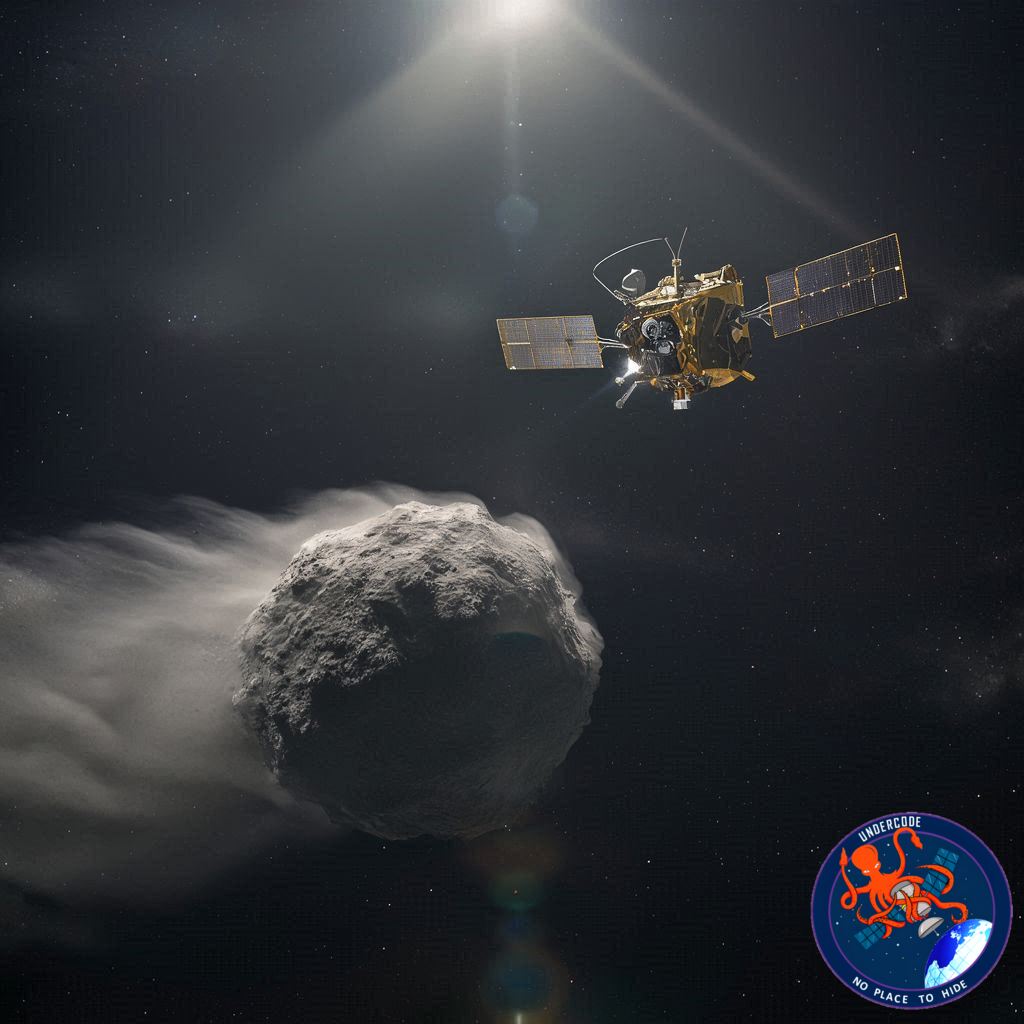
A mysterious wanderer from another star system has entered our cosmic neighborhood, and once again NASA’s Lucy spacecraft found itself at the center of an extraordinary moment. As comet 3I/ATLAS streaked inward toward the Sun, Lucy managed to seize rare, high-resolution images from hundreds of millions of miles away. This event marks only the third time in history that astronomers have been able to study an interstellar object inside our solar system, turning a brief cosmic encounter into a scientific treasure. The story that follows explores why these images matter, what they reveal, and how they open a window into the ancient ingredients of distant worlds.
🌌 Summary of the Original
A New Interstellar Arrival
In mid-September, NASA’s Lucy spacecraft captured detailed photos of the interstellar comet 3I/ATLAS, only the third known object from another star system to pass through our solar system. The comet was originally discovered on July 1 by the ATLAS survey telescope as it traveled inward from the solar system’s outer regions.
Lucy’s Distant Observation
Using its high-resolution L’LORRI camera, Lucy photographed 3I/ATLAS between September 15 and 17. At the time, the spacecraft was roughly 240 million miles away from the comet, far beyond Mars, as it journeyed toward its long-term mission to study eight Jupiter Trojan asteroids.
Protecting the Spacecraft
Capturing the images required Lucy to point its instruments inward toward both the comet and the Sun. Engineers had to carefully rotate and position the spacecraft so that its body would shield the sensitive instruments from excessive heat. Despite this protection, some scattered sunlight bounced off the spacecraft and entered the camera, creating faint arcs and blurry spots beneath the comet in the images.
A Rare Dual-Perspective Experiment
To deepen their understanding of the comet’s shape and behavior, Lucy’s team coordinated with astronomers at the Las Cumbres Observatory in Chile. These astronomers captured simultaneous images from Earth, separated from Lucy by 390 million miles. The drastically different angles allow scientists to create a three-dimensional model of the comet and analyze how its dust reflects sunlight. This comparison offers a rare opportunity to study ancient material from an entirely different solar system.
Lucy’s Ongoing Journey
Before this observation, Lucy had already flown by three asteroids named Dinkinesh, Selam, and Donaldjohanson. Its next major milestone will be the encounter with the Trojan asteroid Eurybates on August 12, 2027. Meanwhile, close to twenty different NASA science teams are examining the behavior and chemistry of the interstellar comet as it passes through the solar system.
What Undercode Say: Expert Analysis
Why 3I/ATLAS Matters Now
Interstellar objects like 3I/ATLAS carry chemical fingerprints that predate our solar system. They are fragments expelled from distant stellar nurseries, flung into interstellar space by gravitational chaos, collisions, or young stars ejecting debris. When one of these visitors arrives, scientists treat it as a once-in-a-generation opportunity to sample the history of another sun.
A Race Against Time
Interstellar comets move far faster than typical solar system comets. Their hyperbolic trajectories mean researchers have little time to observe them before they vanish into the void again. In this case, Lucy’s unique position in deep space allowed NASA to capture data that ground telescopes alone could never achieve.
Engineering Elegance in Harsh Conditions
Lucy was never designed to stare anywhere near the Sun during its mission. Its Trojan-asteroid mission profile normally keeps its instruments pointed far from intense sunlight. The fact that engineers successfully angled Lucy’s protective body to shield the instruments without compromising the spacecraft’s safety shows remarkable spacecraft management. This was not routine observation. It was a high-risk maneuver executed with precision.
A Multi-Angle View Rarely Achieved
Lucy and the Chilean observatories provided an impressive stereo vision of the comet. With nearly 400 million miles of separation, the data sets create a natural depth effect, similar to human binocular vision but on a galactic scale. This helps researchers determine the comet’s dust distribution, particle size, and even how sunlight interacts with the dust. These details reveal how foreign solar systems formed and what materials populate their protoplanetary disks.
A Glimpse Into Another Solar System
The dust emitted by 3I/ATLAS is ancient. Scientists believe such dust could carry amino acids, carbon chains, and other building blocks of organic chemistry. If interstellar comets deposit such materials on young planets across the galaxy, the seeds for life may be far more widespread than we realize. Studying this dust offers a chance to compare it with the material that built Earth billions of years ago.
Lucy’s Multi-Mission Advantage
Lucy’s unusual trajectory, spanning eight separate targets across Jupiter’s Trojan swarms, offers frequent opportunities to reroute data collection. Its instruments were built to withstand deep-space conditions, and this flexibility is one reason it could safely capture 3I/ATLAS despite not being designed for close-Sun orientation.
The Scientific Race Behind the Scenes
Nearly twenty NASA science teams have coordinated to capture, analyze, and model the comet’s behavior as it moves inward. Each team focuses on different aspects such as dust chemistry, orbital trajectory, brightness changes, rotation, and tail formation. These collaborative efforts will likely continue long after 3I/ATLAS exits the solar system.
What This Means for Future Missions
The brief but rich encounter with 3I/ATLAS will help shape future interstellar-object missions. There is increasing interest in designing spacecraft dedicated to intercepting such objects at high speed. Lucy’s success demonstrates that existing deep-space missions can be repurposed on the fly to capture valuable scientific moments.
A Reminder of How Little We Know
Interstellar visitors remind astronomers that our solar system is not isolated. It sits in a vast galactic ocean of drifting material. The more objects like 3I/ATLAS we discover, the clearer it becomes that star systems constantly shed and exchange debris. This raises profound questions about the movement of life-forming materials across the cosmos.
🔍 Fact Checker Results
Imaging occurred between September 15 and 17 using Lucy’s L’LORRI camera. ✅
3I/ATLAS is the third confirmed interstellar object. ✅
Lucy was not within the orbit of Mars during the photos. ❌ (It was beyond Mars’ orbit.)
📊 Prediction
In the coming years, astronomers will identify more interstellar visitors as survey telescopes grow sharper and automated detection improves. 🌠
Future missions may be designed specifically to chase these objects at high speed and sample their material directly. 🚀
The data from 3I/ATLAS will become a foundational reference for the chemistry of foreign planetary systems. 📘
🕵️📝✔️Let’s dive deep and fact‑check.
References:
Reported By: science.nasa.gov
Extra Source Hub (Possible Sources for article):
https://www.linkedin.com
Wikipedia
OpenAi & Undercode AI
Image Source:
Unsplash
Undercode AI DI v2
Bing
🔐JOIN OUR CYBER WORLD [ CVE News • HackMonitor • UndercodeNews ]
📢 Follow UndercodeNews & Stay Tuned:
𝕏 formerly Twitter 🐦 | @ Threads | 🔗 Linkedin | 🦋BlueSky | 🐘Mastodon


