
Listen to this Post
Introduction
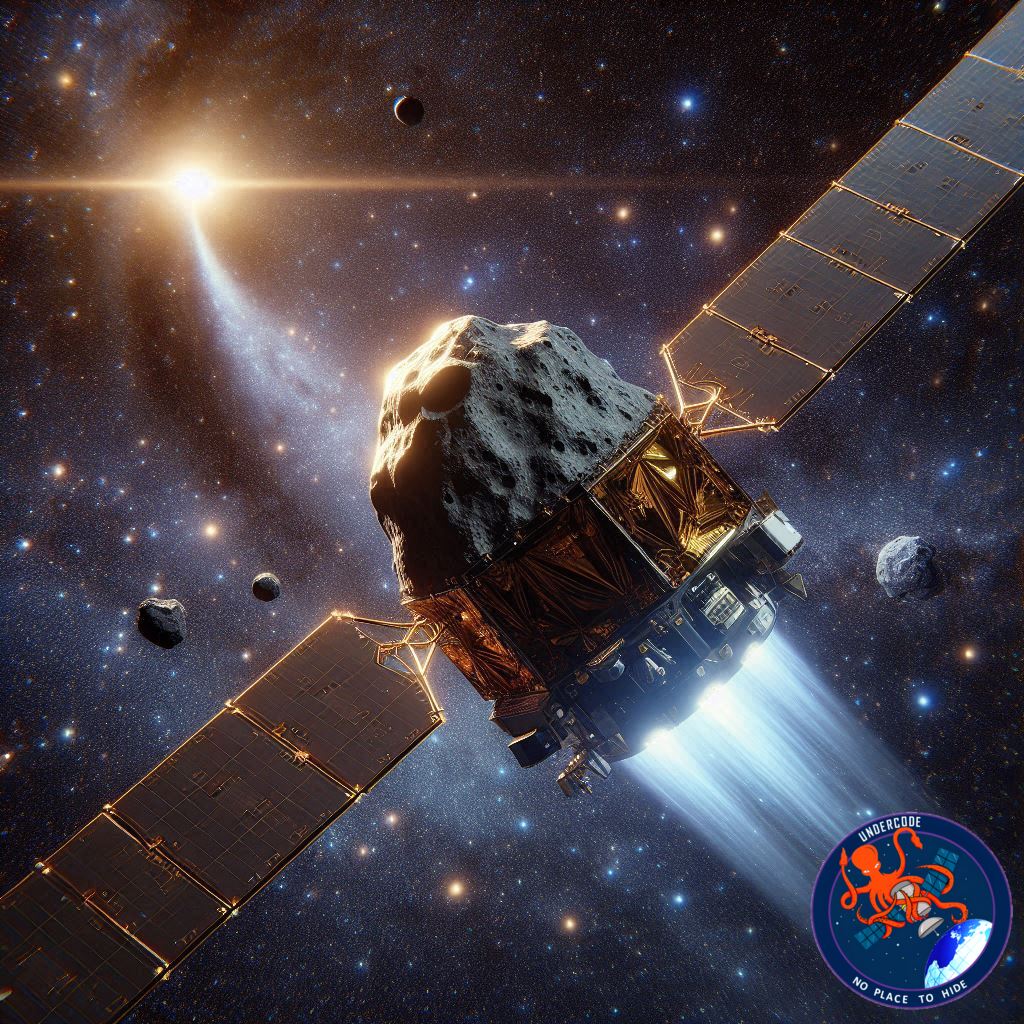
NASA’s Psyche mission, primarily designed to explore a unique metal-rich asteroid in the main belt, is now making unexpected contributions to interstellar science. In September 2025, the spacecraft captured detailed observations of interstellar comet 3I/ATLAS, offering astronomers valuable data on its trajectory and structure. These observations highlight how modern space missions can extend their impact beyond primary objectives, providing insights into distant objects passing through our solar system.
Tracking a Visitor from Beyond
Over eight hours on September 8 and 9, 2025, NASA’s Psyche spacecraft observed comet 3I/ATLAS when it was approximately 33 million miles (53 million kilometers) away. Using its multispectral imager, Psyche captured the comet’s reflected sunlight, allowing astronomers to refine the comet’s orbital path. Despite the comet’s distance, the spacecraft’s sensitive instruments revealed crucial details about its faint coma, a halo of gas and dust enveloping the comet’s icy nucleus.
Psyche’s Multispectral Imager in Action
The multispectral imager aboard Psyche consists of two identical cameras with telescopic lenses and specialized filters. Originally intended to study the metal-rich asteroid Psyche in multiple wavelengths, the instrument proved capable of tracking a moving target like 3I/ATLAS with remarkable precision. This demonstrates how spacecraft instruments designed for one purpose can be leveraged for broader scientific investigations, expanding the mission’s overall value.
A Collaborative Observation Effort
NASA is not alone in monitoring 3I/ATLAS. Psyche’s observations complement a global network of telescopes and space missions tracking the comet as it passes through the solar system. These coordinated efforts provide astronomers with a clearer understanding of interstellar visitors, their motion, and their physical characteristics, strengthening our knowledge of objects originating from outside the solar system.
No Threat to Earth
While interstellar comets like 3I/ATLAS capture public imagination, they pose no threat to Earth. Psyche’s tracking work underscores NASA’s broader commitment to planetary defense and solar system exploration. By refining trajectories and studying cometary composition, the agency enhances humanity’s readiness to understand and respond to both near-Earth and distant celestial objects.
Psyche’s Journey and Upcoming Milestones
Managed by NASA’s Jet Propulsion Laboratory in Southern California, Psyche remains in excellent health, currently located about 260 million miles (420 million kilometers) from Earth. In May 2026, the spacecraft will execute a flyby of Mars for a gravity assist, boosting its speed and altering its path toward the asteroid Psyche. The spacecraft is scheduled to enter orbit around Psyche in July 2029, marking the start of its primary mission, which is expected to last at least 26 months.
What Undercode Say:
NASA’s Psyche mission demonstrates the evolving versatility of modern space exploration. While designed for asteroid research, the spacecraft’s ability to track interstellar comet 3I/ATLAS shows that even highly specialized instruments can provide cross-disciplinary scientific insights. The detailed observations of 3I/ATLAS’s coma contribute to our understanding of how comets from other star systems behave as they enter our solar system, offering clues about the formation and composition of distant planetary systems.
The ability to observe an object at 33 million miles with sufficient precision to refine its trajectory reflects the extraordinary advancements in space imaging technology. Psyche’s multispectral imager, while optimized for metal detection, successfully captured reflected sunlight from a relatively faint and small comet, underlining the mission’s flexibility. Such adaptability is essential for maximizing the scientific return from costly deep-space missions.
This case also illustrates the importance of inter-agency collaboration. Combining Psyche’s data with observations from ground-based telescopes creates a richer, multi-perspective view of interstellar objects. Over time, this integrated approach allows astronomers to develop more accurate models of cometary motion and behavior, improving predictive capabilities for both scientific research and planetary defense.
Moreover, Psyche’s observations of 3I/ATLAS provide indirect insights into the early conditions of the universe. Interstellar comets carry material from other star systems, frozen since their formation billions of years ago. Studying their composition, even from a distance, offers astronomers a rare glimpse into regions of space beyond our immediate solar neighborhood.
Psyche’s ongoing mission highlights how long-term planning, advanced instrumentation, and opportunistic science can converge to yield unexpected discoveries. The spacecraft’s journey toward the metal-rich asteroid Psyche remains its primary goal, yet the additional data collected en route reinforces the principle that every observation can expand our cosmic understanding. As Psyche approaches Mars for its gravity assist, the mission will continue to serve as a testbed for precision navigation, deep-space imaging, and interstellar object tracking, potentially informing future missions designed specifically to intercept comets or asteroids.
Fact Checker Results:
✅ Psyche successfully tracked interstellar comet 3I/ATLAS from 33 million miles away.
✅ The multispectral imager captured data on the comet’s coma and nucleus.
❌ The comet poses no threat to Earth.
Prediction
📊 Psyche’s observations of 3I/ATLAS could pave the way for more frequent monitoring of interstellar objects, leading to potential future missions targeting these visitors directly. As technology improves, spacecraft may routinely track and study objects entering the solar system, offering unprecedented insights into the composition of distant planetary systems and the dynamics of interstellar travel. The next decade could see a surge in interstellar research missions, combining asteroid exploration with opportunistic cometary observations.
🕵️📝✔️Let’s dive deep and fact‑check.
References:
Reported By: science.nasa.gov
Extra Source Hub (Possible Sources for article):
https://www.quora.com/topic/Technology
Wikipedia
OpenAi & Undercode AI
Image Source:
Unsplash
Undercode AI DI v2
Bing
🔐JOIN OUR CYBER WORLD [ CVE News • HackMonitor • UndercodeNews ]
📢 Follow UndercodeNews & Stay Tuned:
𝕏 formerly Twitter 🐦 | @ Threads | 🔗 Linkedin | 🦋BlueSky | 🐘Mastodon


