
Listen to this Post
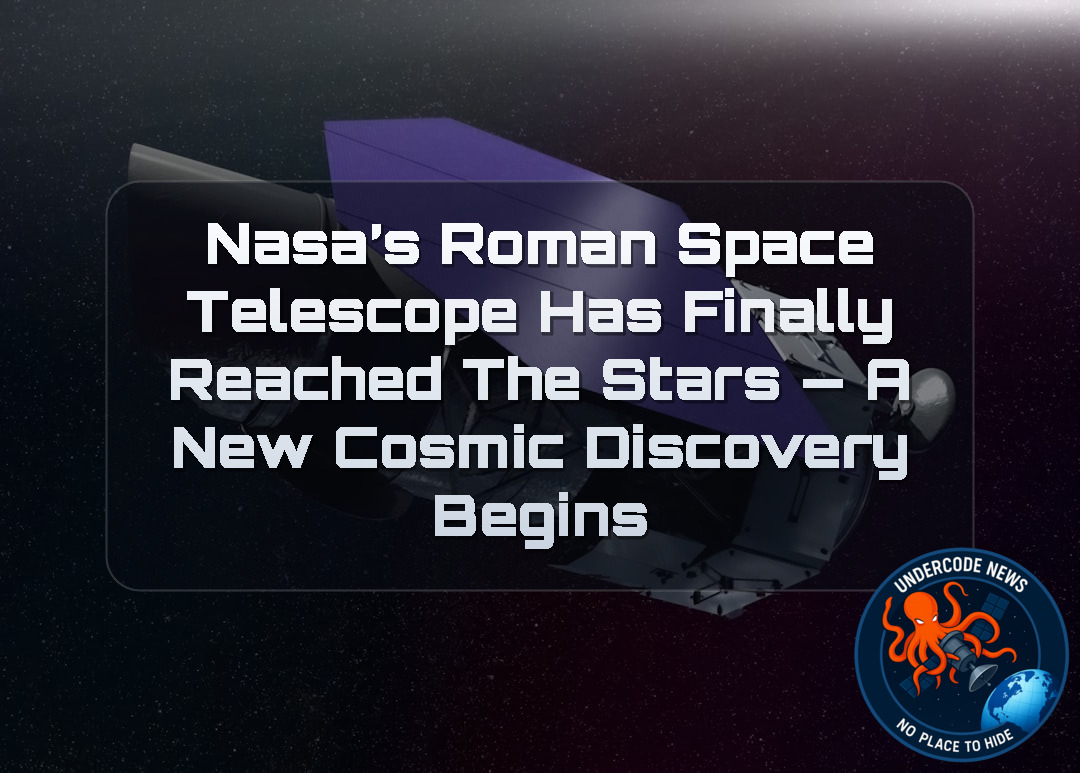
A Historic Morning for Astronomy
Humanity has just taken another extraordinary step into the unknown. On August 30, 2026, NASA’s Nancy Grace Roman Space Telescope lifted away from Earth aboard a powerful SpaceX Falcon Heavy, beginning a journey that could fundamentally change how scientists understand the universe. At 7:26 a.m. EDT, the rocket thundered away from Launch Complex 39A at NASA’s Kennedy Space Center in Florida, carrying one of the most ambitious space observatories ever built.
The launch marks the beginning of a mission designed not merely to take beautiful pictures of space, but to answer some of astronomy’s deepest questions. Roman will investigate dark energy and dark matter, map enormous portions of the cosmos, search for planets beyond our solar system, study black holes, and create a vast astronomical data archive that scientists around the world can explore for years to come.
What makes this moment particularly exciting is the scale of Roman’s vision. Where earlier observatories have often examined relatively narrow pieces of the sky in extraordinary detail, Roman is designed to survey huge areas rapidly. It is effectively built to turn the universe into a gigantic scientific dataset.
And that may be where its greatest discoveries are hiding.
The Falcon Heavy Roars Into the Sky
The Roman observatory began its journey on a SpaceX Falcon Heavy, one of the most powerful operational rockets available for missions of this class. Its first stage uses a central core flanked by two side boosters, while the upper stage carries the spacecraft toward its planned trajectory. NASA reported that the rocket’s 27 Merlin engines generated more than 5 million pounds of thrust during liftoff.
For the people watching from Florida, the launch was more than another rocket leaving the pad. The Falcon Heavy’s enormous plume marked the physical beginning of a scientific mission that has taken years of engineering, testing, integration, and preparation.
The launch sequence also highlights the incredible choreography required to send a sophisticated observatory into deep space. After liftoff, the vehicle passes through Max Q, the point where aerodynamic forces place the greatest mechanical stress on the rocket. The side boosters then separate, followed by subsequent stages of the ascent sequence.
Roman Is Not Simply Another Space Telescope
Calling Roman “another telescope” would undersell what NASA has built.
The Nancy Grace Roman Space Telescope is designed around a fundamentally different observing philosophy. Instead of concentrating primarily on a small number of targets, Roman will repeatedly survey enormous regions of the sky.
That wide-field strategy matters because some of the universe’s biggest mysteries cannot be solved by studying only a handful of galaxies or stars. Scientists need statistics. They need enormous samples. They need to compare billions of objects and search for subtle patterns that would otherwise remain invisible.
Roman is expected to map billions of galaxies and generate enormous quantities of astronomical data. NASA says the observatory’s surveys will support research ranging from dark matter and dark energy to exoplanets, black holes, stars, and the evolution of the universe itself.
The Dark Energy Mystery Gets a New Weapon
One of
Scientists know that the expansion of the universe is accelerating. What causes that acceleration remains one of the greatest unanswered questions in physics.
Dark energy is the name given to the unknown phenomenon associated with this acceleration, but the name should not be mistaken for an explanation. Scientists still do not know exactly what dark energy is.
Roman could dramatically improve the evidence available to researchers by surveying enormous cosmic volumes and measuring how galaxies and other structures are distributed across space and time.
Instead of asking only, “What is out there?” astronomers will be able to ask a much deeper question: “How has the universe changed?”
Dark Matter Will Also Come Under the Microscope
Dark matter presents another cosmic mystery.
Astronomers cannot directly see dark matter through ordinary light, yet its gravitational influence appears throughout the universe. Galaxies rotate as though they contain far more mass than what can be observed directly, while enormous structures such as galaxy clusters reveal additional evidence of unseen matter.
Roman’s wide surveys could help researchers reconstruct the distribution of dark matter by observing how its gravity affects visible objects.
This is particularly powerful because the telescope does not need to “see” dark matter itself to study its influence.
Gravity becomes the messenger.
A New Census of Alien Worlds
Roman’s mission extends far beyond cosmology.
The observatory will also search for planets outside our solar system, known as exoplanets. NASA expects Roman’s surveys to uncover roughly 100,000 new exoplanets, creating an extraordinary statistical census of planetary systems.
That number is important because astronomy is moving beyond simply discovering individual exoplanets.
Scientists increasingly want to understand planetary populations.
How common are Earth-sized planets?
How often do planetary systems resemble our own?
Are certain types of planets more common around particular stars?
How frequently do planets exist in potentially favorable environments?
Roman’s enormous survey capability could help transform exoplanet science from a collection of fascinating individual discoveries into a statistical science of planetary formation.
Black Holes Will Become Part of the Bigger Picture
Roman will also provide opportunities to study black holes and the galaxies that host them.
Supermassive black holes sit at the centers of many galaxies, including our own Milky Way. Their growth appears closely connected to the evolution of their host galaxies, but the precise relationship remains an active area of research.
By surveying large populations of galaxies rather than studying only a few famous examples, Roman could allow astronomers to investigate black-hole growth on a much broader scale.
That could reveal patterns that have been difficult to detect with narrower-field observatories.
Roman’s Most Important Discovery May Be Something Nobody Predicted
There is another reason this mission is so exciting.
Astronomers designed Roman around specific scientific objectives, but the telescope will also create a huge public scientific archive.
NASA describes the mission as offering practically limitless opportunities for additional science because of the enormous volume of the cosmos it will sample.
This means some of
History repeatedly demonstrates that powerful observatories can reveal unexpected phenomena.
When astronomers receive a new dataset covering billions of objects, anomalies inevitably appear.
A strange galaxy.
An unusual transient event.
A previously unknown population of stars.
A gravitational lens behaving differently than expected.
An unexpected planetary system.
A pattern that challenges an established theory.
The universe has a habit of surprising anyone who looks at it closely enough.
Roman and the Legacy of Hubble and Webb
Roman is not intended to replace the Hubble Space Telescope or the James Webb Space Telescope.
Instead, the observatories can complement one another.
Hubble has provided extraordinary high-resolution views of the universe across decades of observations. Webb has pushed infrared astronomy into remarkably distant and early cosmic epochs.
Roman brings another capability to the family: enormous survey speed and field of view.
That distinction could become incredibly valuable.
Roman can identify interesting targets across huge regions of sky, while other observatories can subsequently zoom in for detailed investigations.
In that sense, Roman could function partly as a cosmic discovery engine.
It finds the needles.
Other telescopes can examine them.
The Journey Is Only Beginning
Getting Roman off Earth was a spectacular achievement, but launch day is only the beginning.
NASA says the spacecraft is headed toward the second Sun-Earth Lagrange point, known as L2, roughly 1 million miles from Earth. The journey and subsequent deployments, activation, calibration, and testing will form part of an approximately three-month commissioning period.
This is an important reminder that a successful launch does not immediately mean a fully operational observatory.
Roman must deploy its systems, establish the correct configuration, communicate with Earth, cool and calibrate its instruments as required, and demonstrate that everything works as designed.
Only after that process will its main scientific campaign begin.
The Telescope Will Create an Astronomical Data Flood
Perhaps one of the most underestimated aspects of Roman’s mission is the sheer amount of information it will produce.
Modern astronomy is increasingly becoming a data science discipline.
A telescope capable of surveying enormous portions of the sky does not simply produce photographs. It creates catalogs, measurements, light curves, spectra, positional information, time-series observations, and countless other scientific datasets.
The result will be an astronomical archive that researchers can mine long after individual observations have been completed.
That changes the economics of discovery.
A scientist does not necessarily need to be observing at the exact moment an unusual object appears.
If Roman recorded it, the data may remain available for future investigation.
Artificial Intelligence Will Become Increasingly Important
This is where Roman intersects with another major transformation in science: artificial intelligence.
The scale of astronomical data being generated today is becoming difficult for humans to analyze manually.
Machine-learning systems can help classify galaxies, identify unusual objects, detect transient events, recognize patterns, prioritize targets, and search enormous datasets for statistical anomalies.
Roman therefore arrives at a time when astronomy and AI are increasingly becoming intertwined.
The telescope supplies the data.
Computational systems help organize and interpret it.
Human scientists decide what the patterns actually mean.
That combination could accelerate discovery dramatically.
Deep Analysis: How
Why Computational Astronomy Matters
Roman’s scientific value will not be measured only by the number of images it captures. Its real power will emerge from what researchers can extract from those observations.
A modern astronomy workflow can combine telescope data, catalogs, statistical analysis, visualization, and machine learning.
For example, researchers working with public astronomical datasets can use Python and packages such as Astropy to inspect celestial coordinates, calculate distances, manipulate observations, and analyze scientific catalogs.
Installing the Core Astronomy Tools
A basic Python environment for astronomical analysis can begin with:
python -m pip install astropy numpy pandas matplotlib scipy
This does not directly control the Roman telescope. Instead, it provides a foundation for analyzing astronomical data once researchers have access to appropriate datasets.
Loading Astronomical Coordinates
A simple example using Astropy might look like:
from astropy.coordinates import SkyCoord
import astropy.units as u
target = SkyCoord(
ra=150.0 u.degree,
dec=2.0 u.degree,
frame="icrs"
)
print(target)
This creates a celestial coordinate that can be used as the starting point for astronomical analysis.
Inspecting Catalog Data
When a telescope survey produces a catalog containing object positions and measurements, Python can be used to inspect the data:
import pandas as pd
catalog = pd.read_csv("roman_catalog.csv")
print(catalog.head())
print(catalog.describe())
The exact format of future Roman datasets will depend on the scientific product being analyzed, but the underlying principle is simple: enormous astronomical catalogs can be treated as structured scientific datasets.
Searching for Unusual Objects
Researchers could also use statistical techniques to identify objects that differ significantly from the population:
from scipy.stats import zscore
catalog[anomaly_score] = zscore(catalog[brightness])
unusual = catalog[
catalog["anomaly_score"].abs() > 3
]
print(unusual)
This is only a simplified demonstration, not a validated Roman science pipeline.
Real scientific analysis would require calibrated measurements, uncertainty handling, selection effects, instrument models, and carefully designed statistical methods.
Visualizing Large Surveys
Astronomers can also transform catalogs into visual maps:
import matplotlib.pyplot as plt
plt.scatter(
catalog[ra],
catalog[dec],
s=1
)
plt.xlabel(Right Ascension)
plt.ylabel(Declination)
plt.title(Astronomical Survey Map)
plt.show()
A plot like this can reveal the spatial structure of a survey and help researchers understand how objects are distributed across the sky.
AI Could Search Billions of Objects
The most interesting future applications may involve machine learning.
Instead of asking a human researcher to manually inspect millions of galaxies, algorithms can first identify candidates that deserve closer examination.
A future workflow could look conceptually like this:
Roman observations
↓
Calibration
↓
Astronomical catalogs
↓
Machine-learning classification
↓
Anomaly detection
↓
Human scientific review
↓
Follow-up observations
The important point is that AI should not replace scientific judgment.
It should expand the number of objects humans can realistically investigate.
Reproducibility Will Become Essential
Large astronomical surveys also create a reproducibility challenge.
If an algorithm discovers an unusual galaxy, researchers need to know exactly how that conclusion was reached.
That means scientific workflows should preserve:
python --version
python -m pip freeze > requirements.txt
A research project can then document the software environment used to produce its results.
This may seem like a small technical detail, but reproducibility becomes increasingly important when scientific discoveries depend on complex computational pipelines.
The Real Power Is in Combining Datasets
Roman will not exist in isolation.
Its discoveries can be compared with observations from other space telescopes, ground-based observatories, radio facilities, gravitational-wave experiments, and future missions.
That creates a much larger scientific ecosystem.
A galaxy detected by Roman may become a target for another observatory.
A transient event could trigger rapid follow-up observations.
A suspected exoplanet could be investigated using additional instruments.
A strange gravitational lens could provide new clues about dark matter.
This interconnected approach is where astronomy is heading.
What Undercode Say:
1. A Telescope Built for Scale
Roman represents a shift from isolated cosmic portraits toward large-scale astronomical mapping.
2. Discovery Through Statistics
The
3. Dark Energy Is Still the Prize
Understanding cosmic acceleration remains one of the biggest unanswered questions in modern physics.
4. Dark Matter Could Become More Constrained
Roman will not photograph dark matter directly, but its gravitational fingerprints can reveal where unseen mass is concentrated.
5. Exoplanet Science Gets a Massive Boost
A projected census of roughly 100,000 new exoplanets could radically expand our understanding of planetary systems.
6. Data May Matter More Than Images
Roman’s greatest scientific contribution could ultimately be its enormous archive rather than any single iconic photograph.
7. The Archive Could Outlive the Mission
Once observations enter public scientific archives, researchers can continue mining them long after Roman’s primary mission ends.
8. Unexpected Discoveries Are Almost Guaranteed
The larger the survey, the greater the opportunity to encounter objects that were not part of the original research plan.
- Roman Could Become a Cosmic Search Engine
Its wide field of view allows scientists to rapidly identify promising targets across huge portions of the sky.
10. Hubble and Webb Remain Essential
Roman does not make earlier observatories obsolete. It gives astronomers another powerful instrument with a different specialty.
11. Webb Can Zoom In
Roman can identify interesting objects over wide areas, while Webb can provide detailed infrared follow-up observations.
12. Hubble Still Has a Unique Role
Hubble’s long history and optical and ultraviolet capabilities remain scientifically valuable.
13. Astronomy Is Becoming Computational
The modern astronomer increasingly needs expertise in statistics, programming, databases, and machine learning.
14. AI Could Become
Algorithms can scan enormous datasets much faster than humans can.
- Humans Still Make the Final Scientific Argument
Finding a statistical anomaly is not the same as explaining it.
16. Better Surveys Create Better Questions
Roman may not immediately solve every mystery, but it can make the questions far more precise.
17. L2 Is a Strategic Destination
Operating around the Sun-Earth L2 region provides an advantageous environment for a deep-space observatory. NASA says Roman is traveling toward L2, approximately 1 million miles from Earth.
18. Launch Reliability Matters
A sophisticated telescope is useless if it never reaches its operational environment, making the successful launch a major milestone.
19. Commissioning Is the Next Test
Roman still has to deploy, activate, calibrate, and test its systems before full science operations.
20. The First Images Will Be Important
Initial observations will demonstrate that the
- But the Catalogs May Be Even More Important
Individual images attract public attention, while catalogs enable years of scientific research.
22. Time-Domain Astronomy Could Benefit
Repeated observations can reveal objects that change brightness or position over time.
23. Transient Events Could Become Targets
Short-lived astronomical phenomena can be difficult to capture, but wide surveys increase the probability of finding them.
24. Gravitational Lensing Is Powerful
The bending of light by massive objects can reveal information about matter distribution and distant galaxies.
- Roman Can Turn Gravity Into a Measurement Tool
Even invisible structures can leave measurable effects on visible light.
26. Planetary Statistics Matter
Discovering one unusual exoplanet is fascinating; discovering tens of thousands allows researchers to study planetary populations.
27. The Mission Connects Multiple Fields
Cosmology, exoplanet science, galaxy evolution, stellar astronomy, and black-hole research can all benefit from Roman’s observations.
28. The Data Challenge Is Enormous
The astronomical community will need powerful computing infrastructure and efficient scientific pipelines to process the mission’s output.
29. Open Data Can Multiply the Impact
Making observations available to researchers and the public allows discoveries to emerge from communities beyond the original mission teams.
30. Citizen Science Could Benefit
Some astronomical classification tasks can potentially be opened to wider communities, particularly when human pattern recognition remains valuable.
31. Roman Is a Long-Term Investment
The
- New Theories May Emerge From Old Data
Future scientists could discover something important in Roman observations that today’s researchers do not recognize.
33. Astronomy Is Entering a Survey Era
Instead of observing a few cosmic targets at a time, scientists are increasingly mapping enormous populations.
34. Scale Changes Discovery
When the sample becomes sufficiently large, rare events stop being merely curiosities and become statistically useful.
35. Roman Could Challenge Existing Models
If observations disagree with theoretical predictions, scientists may have to revise their understanding of cosmic evolution.
36. That Is Exactly What Science Needs
A successful mission is not one that confirms everything researchers already believe.
- A Truly Powerful Telescope Can Surprise Us
The most exciting outcome may be an observation nobody predicted.
38. Roman Arrives at the Right Moment
AI, high-performance computing, and increasingly connected observatories can amplify the telescope’s scientific capabilities.
- The Launch Is the Beginning, Not the Conclusion
The rocket has completed its most visible job. The scientific adventure is now beginning.
40. The Universe Has More Secrets Waiting
Roman’s greatest achievement may ultimately be changing what humanity believes is possible to discover.
✅ The Launch Happened
NASA confirms that the Nancy Grace Roman Space Telescope lifted off at 7:26 a.m. EDT on August 30, 2026, aboard a SpaceX Falcon Heavy from Launch Complex 39A at Kennedy Space Center.
✅ The Falcon Heavy Used 27 Merlin Engines
NASA’s launch update states that Falcon Heavy’s 27 Merlin engines produced more than 5 million pounds of thrust during the ascent.
✅ Roman Will Study Dark Energy, Dark Matter and Exoplanets
NASA confirms that
✅ Roman Is Heading Toward L2
NASA says Roman is traveling toward the second Sun-Earth Lagrange point, approximately 1 million miles from Earth.
✅ The Five-Year Science Mission Has Enormous Potential
NASA describes
❌ One Important Detail Needed Context
The original wording presented the launch sequence as though it were still unfolding. As of August 30, 2026, NASA has confirmed that liftoff already occurred at 7:26 a.m. EDT. The rewritten article therefore treats the launch as a completed event rather than a prediction or upcoming event.
Prediction
(+1) Roman Could Become One of the Most Productive Astronomical Surveys of the Decade
The strongest prediction is that Roman will generate a scientific ripple effect far beyond the original mission objectives.
Its enormous field of view means that researchers will not simply receive a collection of beautiful space images. They will receive a massive statistical portrait of the universe.
That dataset could lead to discoveries in dark energy, dark matter, galaxy evolution, exoplanets, black holes, gravitational lensing, stellar populations, and transient astronomy.
The most important discovery may not arrive during the first weeks or even the first year.
It could emerge years later when researchers combine Roman’s observations with datasets that do not yet exist.
(+1) AI Will Become a Major Force in Roman’s Scientific Workflow
As Roman produces enormous volumes of observations, artificial intelligence and machine learning will increasingly become essential tools for classification, anomaly detection, prioritization, and pattern recognition.
The combination of wide-field astronomy and modern AI could create a new discovery pipeline in which algorithms search billions of observations and identify the small number of objects most deserving of human attention.
(+1) Roman Could Change Our Understanding of the Universe’s Expansion
If Roman’s observations significantly tighten measurements of cosmic expansion and dark energy, researchers could be forced to reconsider some of the assumptions underlying today’s cosmological models.
That would be more important than simply discovering another distant galaxy.
It could change the story humanity tells about how the universe began, evolved, and may ultimately develop.
(+1) The Biggest Discovery May Be Something Nobody Expected
This is perhaps the most exciting prediction of all.
Roman was designed to answer specific scientific questions, but its enormous survey of the cosmos creates opportunities for accidental discovery.
History suggests that when humans build a more powerful window into the universe, the universe rarely behaves exactly as expected.
Roman’s journey has begun.
Now the waiting begins for the first extraordinary surprise.
NASA Roman Space Telescope mission page
▶️ Related Video (78% Match):
🕵️📝Let’s dive deep and fact‑check.
🎓 Live Courses & Certifications:
Join Undercode Academy for Verified Certifications
🚀 Request a Custom Project:
Secure, high-velocity infrastructure and disruptive technological engineering. Contact our engineering team for high-tier development and proprietary systems:
[email protected]
💎 Smart Architecture | 🛡️ Secure by Design | ⭐ Trusted by Thousands
References:
Reported By: science.nasa.gov
Extra Source Hub (Possible Sources for article):
https://www.discord.com
Wikipedia
OpenAi & Undercode AI
Image Source:
Unsplash
Undercode AI DI v2
🔐JOIN OUR CYBER WORLD [ CVE News • HackMonitor • UndercodeNews ]
📢 Follow UndercodeNews & Stay Tuned:
𝕏 formerly Twitter 🐦 | @ Threads | 🔗 Linkedin | 🦋BlueSky | 🐘Mastodon | 📺Youtube


