
Listen to this Post
A Historic Moment Beyond Earth
There are moments in space exploration when a launch feels like more than the beginning of another mission. It feels like humanity is opening another window into the unknown.
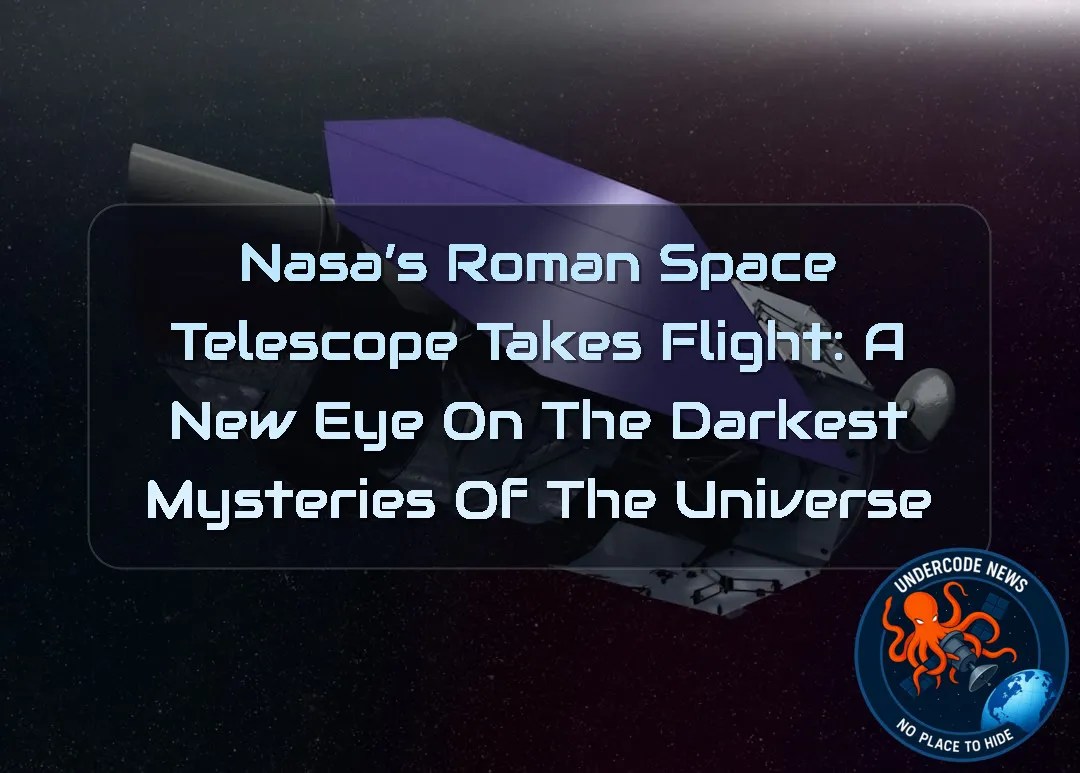
NASA’s Nancy Grace Roman Space Telescope has now taken that step.
After years of engineering, testing, preparation, and increasingly intense launch operations, Roman was cleared to proceed toward liftoff aboard a SpaceX Falcon Heavy from Launch Complex 39A at NASA’s Kennedy Space Center in Florida. The original launch plan targeted 7:26 a.m. EDT on August 30, 2026, and NASA subsequently confirmed that Roman successfully lifted off at that time.
NASA Science
+1
The mission is important not simply because another powerful telescope has reached space, but because Roman is designed to investigate some of the biggest unanswered questions in modern astronomy: What is dark energy? What is dark matter? How did the universe evolve? And how common are planets beyond our solar system?
This is a mission designed to look at the universe on an enormous scale—and potentially change what we think we know about it.
From “Go for Launch” to Liftoff
The Final Green Light
NASA Launch Manager Dr. Denton Gibson gave the Nancy Grace Roman Space Telescope mission the official “go” to proceed toward launch as teams entered the final stages of the countdown.
At that point, the focus shifted from preparation to execution.
Every system had to perform exactly as expected. The spacecraft, rocket, launch infrastructure, weather conditions, communications systems, and ground teams all had to remain synchronized during the final minutes before liftoff. NASA had previously completed its Launch Readiness Review, confirming that the Falcon Heavy, Roman observatory, weather conditions, and supporting teams were ready for the mission.
NASA Science
Internal Power Takes Over
One of the most important milestones in the final countdown was almost invisible to spectators.
Both Falcon Heavy and Roman switched from external ground power to their own internal batteries.
This transition matters because the rocket and spacecraft are moving toward a state in which they must operate independently of launch-pad infrastructure. Once the final stages of the countdown begin, the vehicle increasingly becomes its own self-contained system.
The Final Seconds
NASA outlined a sequence that demonstrated just how carefully choreographed a modern launch has become.
At T-59 seconds, Falcon
At T-45 seconds, the SpaceX launch director verifies the rocket’s “go” status.
At T-20 seconds, the propellant tanks are pressurized for flight.
At T-6 seconds, the engine ignition sequence begins.
Then comes the moment that transforms years of engineering into motion:
Liftoff.
NASA’s official launch timeline also included engine chill, booster separation, boostback burns, second-stage operations, and Roman’s eventual deployment.
NASA Science
Falcon Heavy Brings Extraordinary Power
27 Merlin Engines
The rocket selected for Roman is
Falcon
NASA Science
+1
That enormous thrust is necessary because Roman is not a small satellite designed merely to circle Earth.
Its destination is approximately 1 million miles from Earth, near the second Sun-Earth Lagrange point, known as L2.
A Different Kind of Journey
Roman’s mission is therefore fundamentally different from a typical low-Earth-orbit satellite.
After launch, the spacecraft must separate from the rocket and travel toward its deep-space operating environment.
Once there, Roman will undergo a commissioning process involving deployments, activation, calibration, and testing before beginning its scientific mission. NASA expects this process to take approximately three months.
NASA Science
The launch is only the beginning.
Roman Is Built to See the Universe Differently
A Vast Field of View
The most exciting feature of Roman may not be its sheer image sharpness.
It is the amount of sky it can observe at once.
NASA says Roman’s field of view will be at least 100 times larger than Hubble’s. That means scientists can survey enormous regions of the universe much faster while still producing detailed astronomical observations.
NASA Science
This combination of wide coverage and high-quality imaging could fundamentally change how astronomical surveys are performed.
Mapping Billions of Galaxies
Roman is expected to map billions of galaxies during its mission.
That enormous dataset will give researchers a statistical view of the universe that is difficult to obtain with telescopes designed primarily for narrow, detailed observations.
Instead of asking only, “What does this galaxy look like?” scientists can begin asking much larger questions.
How are galaxies distributed?
How has that distribution changed?
How does dark matter influence cosmic structures?
How has the expansion of the universe evolved?
Roman is designed to help answer those questions.
The Dark Energy Mystery
The Universe Is Not Expanding in a Simple Way
One of the greatest mysteries in modern cosmology is dark energy.
Scientists know that the universe is expanding. They also know that this expansion has been accelerating.
But the physical mechanism responsible for this acceleration remains one of the biggest unanswered questions in science.
Roman will study this problem using several complementary approaches, including large-scale observations of galaxies and cosmic structures.
Why Roman Matters
The importance of Roman is not necessarily that it will immediately “discover” what dark energy is.
Its greater contribution could be providing enough high-quality data to distinguish between competing explanations.
If the behavior of dark energy differs from current theoretical expectations, Roman could expose cracks in today’s cosmological models.
And if observations reinforce existing theories, they could provide stronger evidence that the current framework is correct.
Either outcome would be scientifically valuable.
Dark Matter: The Invisible Architecture of the Cosmos
Something We Cannot See Still Shapes What We See
Dark matter is another major target.
Astronomers cannot directly observe dark matter in the same way they observe stars or galaxies. Instead, they infer its existence from its gravitational influence.
Galaxies rotate in ways that cannot be fully explained by their visible matter.
Light bends around massive structures.
Large cosmic formations behave as though they contain significantly more mass than we can see.
Roman will help scientists investigate these gravitational effects across enormous regions of the universe.
A Cosmic Map
By surveying vast areas of the sky, Roman can help researchers build increasingly sophisticated maps of how matter is distributed throughout cosmic history.
Those maps could reveal how dark matter helped shape the galaxies we see today.
In other words, Roman is not simply photographing the universe.
It is helping scientists reconstruct its invisible architecture.
The Search for Exoplanets
A Telescope for Alien Worlds
Roman will also investigate one of the most exciting subjects in modern astronomy: planets orbiting other stars.
NASA expects
NASA Science
But the significance goes beyond simply increasing the number.
Scientists want to understand how planetary systems form, how common different types of planets are, and what those systems can tell us about the history of our own solar system.
Looking for Planetary Patterns
A large statistical sample is particularly valuable.
Finding one unusual planet is interesting.
Finding thousands or tens of thousands of planets allows researchers to identify patterns.
Those patterns can reveal which types of planetary systems are common, which are unusual, and how planets evolve around different types of stars.
Roman could therefore transform exoplanet research from a collection of individual discoveries into a much broader statistical science.
Roman Will Also Look at Black Holes
Beyond the Headline Discoveries
Dark energy, dark matter, and exoplanets may dominate the headlines, but Roman’s scientific capabilities extend far beyond those subjects.
The telescope will contribute to research involving stars, black holes, galaxies, and the evolution of the universe.
Its wide surveys will create a massive astronomical archive that researchers can use for investigations that cannot necessarily be predicted today.
That is one of the most powerful characteristics of a major scientific observatory.
Some of its most important discoveries may come from questions scientists have not yet thought to ask.
A Telescope That Will Generate an Ocean of Data
Science After the Launch
Getting Roman into space is only the first technological challenge.
The next challenge will be handling the enormous volume of scientific information it produces.
Roman’s surveys are expected to generate vast quantities of data that will eventually become a resource for astronomers around the world.
The mission’s value will therefore extend far beyond NASA’s own research teams.
Researchers, universities, observatories, students, and future generations of scientists will be able to analyze Roman’s observations.
The Public Archive Matters
NASA has emphasized that
NASA
That decision could significantly expand the scientific impact of the mission.
A telescope can make discoveries during its official mission, but its data can continue producing discoveries for decades.
Deep Analysis
Understanding the Launch Sequence
The final seconds of a launch may look simple on television, but they represent an extraordinary chain of automated systems, software checks, mechanical operations, telemetry, and human decisions.
For anyone interested in understanding the engineering side, a simplified conceptual countdown might look like this:
T-60 seconds
|
|– Flight computer final checks
|
T-45 seconds
|
|– Launch director verifies GO
|
T-20 seconds
|
|– Propellant tanks pressurized
|
T-6 seconds
|
|– Engine ignition sequence
|
T-0
|
|– Liftoff
|
T+1:08
|
|– Maximum aerodynamic stress
|
T+2:27
|
|– Side booster separation
|
T+4:15
|
|– Payload fairing separation
|
T+8:28
|
|– First second-stage cutoff
|
T+31:31
|
|– Roman deployment
NASA published these milestones as the planned sequence for the mission.
NASA Science
Monitoring Launch Telemetry
Engineers watching a launch do not simply ask whether the rocket is moving upward.
They monitor thousands of measurements.
Typical telemetry categories include:
Conceptual telemetry monitoring
rocket_status="GO"
engine_status="NOMINAL"
guidance_status="NOMINAL"
stage_status="ACTIVE"
telemetry_link="CONNECTED"
These commands are illustrative rather than actual SpaceX or NASA control commands.
The real systems are far more sophisticated and involve specialized flight computers, redundant sensors, telemetry networks, guidance systems, propulsion controls, and ground infrastructure.
Why Redundancy Matters
Spaceflight is unforgiving.
A small hardware failure can become a mission-ending event.
That is why spacecraft and rockets are designed with multiple layers of redundancy wherever practical.
Engineers attempt to ensure that a single sensor, computer, communication link, or component failure does not automatically destroy the mission.
The objective is not to eliminate every possible failure.
That is impossible.
The objective is to make the overall system resilient enough to survive individual failures.
The Importance of Software
Modern spacecraft are increasingly software-defined machines.
Flight computers control navigation, timing, telemetry, communications, power management, and other critical functions.
The software must operate within strict limits because a spacecraft cannot simply be rebooted by a technician standing beside it.
That makes testing particularly important.
The final countdown is therefore the visible end of a much longer process involving simulations, hardware-in-the-loop testing, software validation, environmental testing, and operational rehearsals.
The L2 Advantage
Roman’s destination near L2 is strategically important.
The second Sun-Earth Lagrange point provides an environment where the spacecraft can maintain a relatively stable relationship with Earth and the Sun while operating in deep space.
This is particularly useful for observatories that need carefully controlled observing conditions.
Roman’s location will allow it to perform its mission while remaining in communication with Earth and following a carefully designed trajectory.
Why This Mission Could Change Astronomy
Bigger Surveys Mean Bigger Questions
Astronomy has entered an era where the limiting factor is increasingly not simply telescope size.
It is also the amount of sky that can be surveyed and the quantity of data that can be analyzed.
Roman is designed around that reality.
Its enormous field of view means it can survey large cosmic regions efficiently.
That makes it particularly powerful for studying phenomena that require statistics rather than isolated observations.
Roman and Hubble Serve Different Roles
It would be misleading to describe Roman as simply a replacement for Hubble.
The two observatories are designed for different scientific strategies.
Hubble became famous for producing spectacular, highly detailed images of individual cosmic targets.
Roman is optimized for wide-field surveys.
One telescope can therefore complement the other.
A large Roman survey might identify an interesting galaxy, transient event, or planetary system, while another observatory could then conduct a much deeper investigation of the target.
Roman Could Find the Unexpected
This may ultimately become the most exciting part of the mission.
Astronomical history is full of discoveries that scientists did not originally anticipate.
Whenever humanity builds a new instrument capable of observing the universe in a new way, unexpected phenomena can emerge.
Roman’s enormous survey volume increases the probability of finding rare events.
It could identify unusual stars, unexpected planetary systems, strange galaxies, transient objects, or phenomena that challenge existing models.
The discoveries nobody predicted may become the most important ones.
What Undercode Say:
1. A Launch Is Only the Beginning
The successful liftoff is emotionally powerful, but
2. The Mission Is About Scale
Roman’s defining characteristic is its ability to survey enormous regions of the universe.
- Data Could Become More Valuable Than Images
The mission will generate datasets that scientists may continue studying long after the primary mission ends.
4. Dark Energy Remains the Great Mystery
Understanding why cosmic expansion accelerates remains one of physics’ biggest unanswered questions.
5. Roman Could Challenge Existing Models
Better measurements could reveal discrepancies that force cosmologists to reconsider current theories.
- Dark Matter Gets a New Investigative Tool
Roman will map cosmic structures in ways that can help scientists understand the invisible matter shaping them.
7. Exoplanet Science Gets a Statistical Boost
Finding huge numbers of new planets will allow researchers to study planetary populations rather than isolated discoveries.
8. Wide-Field Astronomy Is Becoming Essential
The universe is too large for narrow observations alone.
9. Survey Speed Matters
Roman’s ability to observe large areas efficiently can dramatically accelerate certain types of astronomical research.
10. The Mission Complements Hubble
Roman is not simply replacing older space telescopes.
It expands the range of observations scientists can perform.
11. Infrared Vision Is Powerful
Observing in infrared wavelengths can reveal objects and structures that are difficult to study using visible light alone.
12. The Location Matters
Operating near L2 provides Roman with an advantageous environment for its scientific objectives.
- The Rocket Is a Major Part of the Story
Falcon
14. 27 Engines Create Extraordinary Complexity
Coordinating 27 Merlin engines during liftoff requires highly sophisticated propulsion and control systems.
15. Reusability Changes the Equation
The recovery of Falcon Heavy side boosters demonstrates how modern launch systems increasingly combine high performance with reusable hardware.
16. The Countdown Is Highly Automated
Humans remain responsible for major decisions, but computers handle enormous numbers of checks and control operations.
17. Every Second Matters
The T-59, T-45, T-20, and T-6 milestones represent carefully engineered transitions between launch states.
18. Internal Power Is a Critical Transition
Once the rocket and observatory move to internal power, they become increasingly independent of ground systems.
19. Launch Weather Remains a Wild Card
Even the most advanced rocket can be delayed by atmospheric conditions.
20. Spaceflight Still Has Uncertainty
Engineering can reduce risk, but it cannot eliminate it completely.
21. Roman Represents Long-Term Science
The
- Five Years Is Only the Primary Mission
NASA has described a five-year primary mission with a goal of operating for up to 10 years.
NASA
23. Public Data Expands Its Impact
Researchers outside NASA will be able to use Roman’s processed scientific data.
- Students Could Become Part of the Story
Future scientists may analyze Roman observations years after today’s launch.
25. Artificial Intelligence Could Become Important
The enormous datasets produced by modern telescopes are increasingly suitable for machine-learning-assisted discovery.
26. Humans Still Matter
AI can identify patterns, but scientific interpretation requires researchers who understand the underlying physics.
27. Roman Could Find Rare Events
Large surveys increase the chance of catching unusual transient astronomical phenomena.
28. Bigger Does Not Always Mean Better
A telescope’s scientific value depends on how its capabilities match the questions researchers are asking.
29. Roman Is Designed Around Modern Astronomy
Its wide-field capabilities reflect an increasingly data-driven approach to understanding the universe.
30. The Mission Connects Multiple Fields
Cosmology, astrophysics, planetary science, and observational astronomy will all benefit from Roman.
31. One Discovery Could Change Everything
A single unexpected observation can sometimes become more important than thousands of routine measurements.
32. Scientific Archives Have Long Lives
Future researchers may use Roman data for questions that do not even exist today.
33. Space Telescopes Are Time Machines
When Roman observes distant galaxies, it is seeing ancient light that has traveled enormous distances before reaching its instruments.
34. The Universe Leaves Clues Everywhere
Roman’s task is essentially to collect those clues at unprecedented scale.
- The Mission Is a Technology Demonstration Too
Roman demonstrates what modern space observatories can accomplish when optics, computing, propulsion, communications, and data science converge.
36. Launch Day Creates the Headlines
But years of scientific work will determine the mission’s ultimate legacy.
37. The Real Competition Is With Ignorance
Roman is not competing against another telescope as much as it is confronting questions humanity still cannot answer.
38. The Biggest Discoveries May Be Unexpected
History suggests that new instruments often reveal phenomena scientists did not anticipate.
39. Roman Could Reshape Cosmology
If its observations disagree with established models, the implications could extend far beyond astronomy.
- This Is a Telescope Built for the Unknown
And that may be the most exciting thing about it.
✅ The Roman Telescope Was Cleared for Launch
NASA confirmed that Launch Manager Dr. Denton Gibson gave the mission the “go” to proceed toward launch, with Falcon Heavy and Roman moving into the final countdown sequence.
NASA Science
The statement in the original article was therefore accurate at the time it was published.
NASA later confirmed that Roman successfully launched at 7:26 a.m. EDT on August 30, 2026.
NASA Science
✅ Falcon Heavy Was the Launch Vehicle
The Nancy Grace Roman Space Telescope launched aboard a SpaceX Falcon Heavy from Launch Complex 39A at Kennedy Space Center.
NASA confirmed that the
NASA Science
✅ Roman Is Headed Toward L2
NASA states that Roman will travel approximately 1 million miles from Earth toward the second Sun-Earth Lagrange point.
This location will serve as the
NASA Science
+1
✅ Roman Will Study Dark Energy, Dark Matter, and Exoplanets
These are among the
NASA also expects Roman to map billions of galaxies and dramatically expand the number of known exoplanets through its large-scale surveys.
NASA Science
+1
✅ The Launch Timeline Was Real
NASA published detailed milestones covering everything from the final flight-computer checks to booster separation, second-stage operations, and Roman’s deployment.
The timeline demonstrates how precisely coordinated the mission was.
NASA Science
❌ The Original Is No Longer Fully Current
The original text describes the mission as being on the verge of launch.
That was accurate during the countdown, but it is now outdated because NASA has confirmed that Roman already launched successfully and separated from the Falcon Heavy’s second stage.
NASA Science
+1
Prediction
(+1) Roman Will Become One of the Most Important Astronomical Surveys of the Decade
Roman is likely to become an exceptionally valuable scientific asset because its mission combines a huge field of view, infrared observations, deep cosmological surveys, and exoplanet research.
Its ability to survey enormous areas means that the mission could produce discoveries at a scale that is difficult for narrower-field observatories to match.
The most significant results may not arrive immediately.
First will come commissioning, calibration, and early observations.
Then researchers will begin processing increasingly large datasets.
After that, unexpected patterns will start emerging.
(+1) The strongest prediction is that Roman will uncover scientific anomalies that force astronomers to refine at least some existing models of the universe.
Whether those anomalies ultimately concern dark energy, dark matter, galaxy evolution, exoplanets, or something entirely unexpected is impossible to know.
And that uncertainty is precisely why this mission matters.
The Bigger Picture: Humanity Is Building a New Map of the Universe
A New Era of Cosmic Observation
The Nancy Grace Roman Space Telescope represents something larger than another successful rocket launch.
It represents the continuation of a long scientific progression.
Hubble taught humanity how dramatically the universe could change when we saw it from space.
James Webb pushed infrared astronomy into extraordinary new territory.
Roman adds something different: scale.
It is designed to survey enormous portions of the sky while collecting data capable of answering questions about the fundamental structure and history of the cosmos.
The Most Important Photograph May Not Look Beautiful
Roman’s most important contribution may not be a spectacular image suitable for a desktop wallpaper.
It could be a graph.
A statistical distribution.
A subtle gravitational effect.
A strange planetary system.
A discrepancy between theory and observation.
A tiny signal buried inside an enormous dataset.
Science does not always announce its biggest discoveries with dramatic photographs.
Sometimes the universe whispers.
Roman is being built to listen.
The Journey Has Just Begun
The launch has already transformed Roman from a carefully protected spacecraft on Earth into an observatory beginning its journey into deep space.
But the truly exciting chapters are still ahead.
As Roman travels toward L2, engineers will prepare for commissioning.
As the instruments come online, scientists will begin calibrating the observatory.
And once the scientific surveys begin, humanity will start receiving a new view of the universe.
For the next several years, Roman will search the darkness for answers.
And somewhere inside those billions of galaxies, thousands of planetary systems, distant black holes, invisible structures, and ancient cosmic signals, there may be a discovery capable of changing our understanding of reality itself.
NASA Science
+1
▶️ Related Video (76% Match):
🕵️📝Let’s dive deep and fact‑check.
🎓 Live Courses & Certifications:
Join Undercode Academy for Verified Certifications
🚀 Request a Custom Project:
Secure, high-velocity infrastructure and disruptive technological engineering. Contact our engineering team for high-tier development and proprietary systems:
[email protected]
💎 Smart Architecture | 🛡️ Secure by Design | ⭐ Trusted by Thousands
References:
Reported By: science.nasa.gov
Extra Source Hub (Possible Sources for article):
https://www.facebook.com
Wikipedia
OpenAi & Undercode AI
Image Source:
Unsplash
Undercode AI DI v2
🔐JOIN OUR CYBER WORLD [ CVE News • HackMonitor • UndercodeNews ]
📢 Follow UndercodeNews & Stay Tuned:
𝕏 formerly Twitter 🐦 | @ Threads | 🔗 Linkedin | 🦋BlueSky | 🐘Mastodon | 📺Youtube


