
Listen to this Post
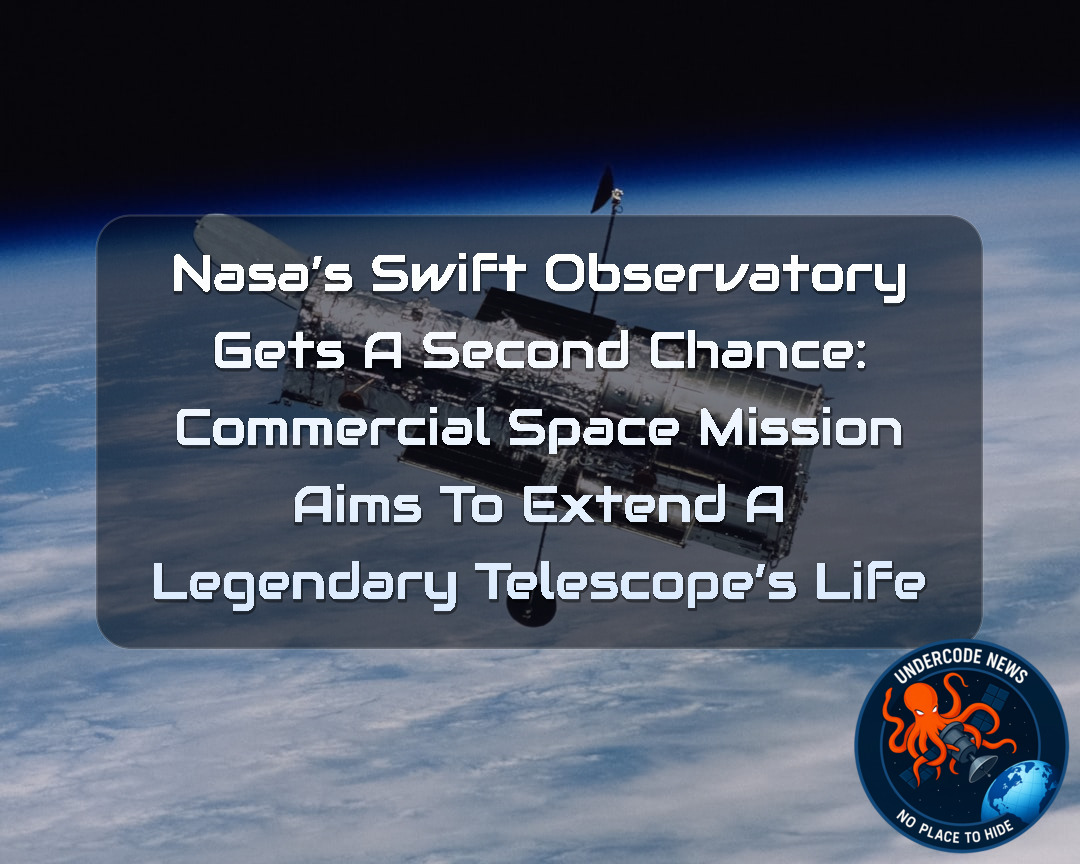 Introduction: A New Era of Spacecraft Servicing Begins
For decades, satellites and space observatories have been treated as disposable once their orbits decay or their fuel runs low. That reality is beginning to change. NASA is preparing for a groundbreaking commercial mission that could redefine how aging spacecraft are maintained in orbit. Instead of replacing a valuable scientific observatory, engineers will attempt something that was once considered nearly impossible: sending a robotic spacecraft to rendezvous with, capture, and boost an existing satellite back into a higher orbit.
The target is the Neil Gehrels Swift Observatory, one of NASA’s most successful space telescopes dedicated to studying the universe’s most energetic cosmic explosions. If successful, the mission will not only extend Swift’s scientific life but also demonstrate that future satellites can be serviced instead of abandoned, potentially transforming the economics and sustainability of space exploration.
Mission Overview: Giving Swift a New Lease on Life
NASA’s commercial orbit-boost mission is scheduled to launch no earlier than June 30 from Kwajalein Atoll in the Marshall Islands. The mission represents a collaboration between NASA and American startup Katalyst Space, whose robotic servicing spacecraft, known as LINK, will attempt one of the most ambitious in-orbit servicing operations ever attempted.
LINK will ride into space aboard a Northrop Grumman Pegasus XL rocket, carrying the technology needed to locate, approach, capture, and carefully reposition the aging Swift Observatory.
Unlike many modern launches, there will be no live broadcast. Instead, NASA plans to publish mission updates through its Swift mission blog as milestones are achieved.
Meet LINK: The Robotic Spacecraft Designed to Rescue Swift
Once deployed into orbit,
Mission controllers must first establish communication with the spacecraft, verify successful deployment of its solar panels, and confirm that its power and communication systems are functioning correctly.
This period, known as commissioning, typically lasts several weeks. During this phase, engineers gradually activate every onboard subsystem, ensuring navigation, propulsion, robotics, and communications operate exactly as expected before attempting the much riskier rendezvous with Swift.
Only after passing these critical tests will LINK begin traveling toward its target.
The Delicate Rendezvous in Orbit
Unlike docking with the International Space Station, Swift was never designed to be serviced.
That means LINK must slowly approach the observatory while continuously imaging its structure. Engineers on Earth will carefully study these images to identify safe locations where the robotic arms can securely attach without damaging delicate scientific instruments.
Every movement must be calculated with extraordinary precision.
The rendezvous alone may require approximately one month, with engineers constantly monitoring telemetry before authorizing each maneuver.
Once LINK reaches the correct position, its robotic arms will gently secure themselves to the observatory.
Boosting Swift Back to a Higher Orbit
After successfully capturing Swift,
Rather than making a dramatic orbital change, the spacecraft will slowly and steadily push Swift into a higher orbit over the course of several months.
The objective is to return the observatory close to the altitude it occupied shortly after its original launch in 2004.
This gradual process minimizes structural stress while ensuring maximum orbital precision.
Once the desired orbit has been achieved, LINK will safely detach and leave Swift operating independently once again.
Restarting Scientific Operations
An orbit boost alone does not immediately return Swift to full operation.
After separation, NASA engineers must restart and recalibrate many onboard systems much like they did following the telescope’s original launch over two decades ago.
This recovery process may require another month or longer before the observatory resumes full scientific observations.
Mission managers emphasize that every stage remains flexible. Engineers may pause operations at any time to evaluate new data, perform additional safety checks, or modify procedures based on spacecraft performance.
Why the Swift Observatory Still Matters
Since its launch in 2004, the Neil Gehrels Swift Observatory has become one of astronomy’s most productive space telescopes.
Designed primarily to detect and rapidly observe gamma-ray bursts, Swift has helped scientists investigate black holes, neutron stars, supernova explosions, gravitational wave events, and countless transient cosmic phenomena.
Its ability to rapidly rotate toward newly detected events has made it one of the fastest-response observatories ever placed into orbit.
Over two decades of operation, Swift has contributed to thousands of scientific publications and remains an essential tool for astronomers worldwide.
Keeping it operational avoids the enormous financial and technical costs of building an entirely new replacement.
Commercial Space Companies Are Becoming
This mission also highlights an important shift within the modern space industry.
Instead of relying exclusively on government-built servicing vehicles, NASA is increasingly partnering with innovative commercial companies capable of developing specialized spacecraft faster and at lower cost.
Katalyst Space represents a new generation of aerospace startups focused on orbital logistics, robotic servicing, and satellite life extension.
If LINK succeeds, future commercial servicing missions could become routine for government, scientific, and commercial satellites alike.
Rather than launching replacement spacecraft every decade, operators may simply send robotic servicing vehicles to repair, refuel, reposition, or upgrade existing assets already in orbit.
Why This Mission Could Change the Future of Spaceflight
Orbital debris has become one of the greatest long-term threats to space exploration.
Every satellite that remains useful for additional years reduces the need for replacement launches and helps improve sustainability in Earth’s increasingly crowded orbital environment.
Robotic servicing also opens possibilities that extend far beyond orbit boosting.
Future spacecraft may perform repairs, install upgraded instruments, replace failed components, refuel satellites, or even assemble massive space telescopes directly in orbit.
The Swift mission serves as a real-world demonstration of technologies that could eventually support lunar infrastructure, Mars exploration missions, and deep-space observatories.
Success here may influence spacecraft design for decades to come.
Deep Analysis: Engineering Perspective with Operational Commands
The LINK mission demonstrates that orbital servicing is transitioning from theoretical engineering into practical operational capability.
Unlike previous docking missions, LINK must interact with a spacecraft never intended for robotic capture.
Relative navigation relies on continuous optical tracking, autonomous guidance, and highly accurate orbital mechanics.
Each maneuver reduces relative velocity to only a few centimeters per second.
Mission planners must continuously compensate for orbital perturbations.
Collision avoidance remains the highest operational priority.
Ground controllers validate every major maneuver before execution.
Solar panel orientation affects power availability throughout the mission.
Thermal control becomes increasingly important during prolonged proximity operations.
Communication windows influence maneuver scheduling.
Fuel margins determine operational flexibility.
Every robotic arm movement requires force monitoring.
Unexpected spacecraft rotation could delay capture.
Image processing software identifies structural attachment points.
Navigation combines GPS, inertial measurement units, and visual tracking.
Software redundancy protects against onboard failures.
Fault detection systems continuously monitor spacecraft health.
Autonomous safety modes allow LINK to retreat if anomalies occur.
Mission simulations were likely performed thousands of times before launch.
Modern robotic servicing depends heavily on artificial intelligence-assisted navigation.
Spacecraft autonomy reduces communication delays.
Cybersecurity also becomes increasingly important for remotely operated vehicles.
Future servicing spacecraft may include modular repair tools.
Fuel-efficient trajectory planning minimizes mission cost.
Orbital servicing reduces long-term space debris generation.
The mission validates future satellite maintenance economics.
Commercial providers could eventually offer servicing as a subscription service.
Satellite manufacturers may begin designing standardized servicing interfaces.
Future observatories could be upgraded instead of replaced.
Long-duration missions become financially more attractive.
Reusable servicing spacecraft may support multiple customers.
Precision robotics continue advancing beyond traditional docking systems.
Machine vision significantly improves autonomous operations.
Real-time telemetry remains critical for mission success.
Ground software continuously evaluates spacecraft dynamics.
The mission strengthens public-private collaboration.
Future deep-space missions could benefit from similar robotic technologies.
Autonomous servicing may become essential around the Moon.
Mars orbiters could eventually receive robotic maintenance.
Long-term orbital infrastructure depends on sustainable servicing.
Linux-based mission operations frequently rely on tools such as:
journalctl -xe
dmesg
top
htop
ip addr
ping
traceroute
netstat -tulpn
ss -tulpn
systemctl status
systemctl restart
tail -f /var/log/syslog
tcpdump
nmap
iostat
vmstat
df -h
free -m
uptime
watch sensors
These operational utilities illustrate the type of monitoring mindset required during complex aerospace missions, where continuous system health verification is just as important as successful spacecraft navigation.
What Undercode Say:
NASA’s Swift orbit-boost mission represents far more than extending the lifespan of a single observatory.
The true significance lies in proving that spacecraft no longer have to become orbital waste simply because their altitude decreases.
Commercial robotics are beginning to reshape how governments think about long-term investments in space.
Instead of replacing billion-dollar assets, maintaining them may soon become the preferred option.
This mission also reflects growing confidence in private aerospace innovation.
Companies like Katalyst Space are entering a market that barely existed a decade ago.
Orbital servicing could become as common as satellite launches.
Future missions may include refueling, hardware replacement, software upgrades, and even scientific instrument installation.
Standardized servicing ports may eventually become mandatory for future satellites.
Insurance companies may lower satellite premiums if servicing becomes available.
Satellite operators could extend missions by many years.
Scientific observatories would gain additional opportunities to produce valuable discoveries.
Military satellites may also benefit from similar technologies.
Earth observation platforms could remain operational significantly longer.
Commercial communication satellites would reduce replacement costs.
Environmental sustainability in orbit becomes increasingly achievable.
Less hardware abandoned in space means fewer collision risks.
This mission also demonstrates confidence in robotic autonomy.
Human astronauts are not required for every complex orbital task.
Artificial intelligence will likely play an expanding role in navigation and servicing.
Precision robotics continue improving every year.
The mission is technically conservative but strategically revolutionary.
Its gradual orbital boost minimizes operational risks.
Mission flexibility shows mature engineering planning.
Pauses for data analysis increase overall mission safety.
Every successful milestone builds industry confidence.
Failures, if encountered, would still generate valuable engineering lessons.
The collaboration between NASA and commercial industry continues accelerating innovation.
Future lunar infrastructure may rely on similar servicing systems.
Mars missions could eventually receive orbital maintenance support.
Deep-space telescopes may become serviceable throughout their operational lives.
The economics of satellite ownership may fundamentally change.
Launch providers could diversify into maintenance services.
Robotic logistics may become a trillion-dollar industry over coming decades.
Swift itself symbolizes scientific resilience.
Rather than retiring an aging observatory, engineers are choosing preservation through innovation.
That philosophy may define the next generation of space exploration.
✅ Fact: The LINK spacecraft is being developed specifically to perform an orbital servicing mission that aims to raise the orbit of NASA’s Neil Gehrels Swift Observatory.
✅ Fact: Swift was originally launched in 2004 and has become one of NASA’s most productive observatories for detecting gamma-ray bursts and other transient astronomical events.
✅ Fact: The mission timeline—including spacecraft commissioning, a month-long rendezvous, several months of orbital boosting, and a post-boost recovery period—remains an estimate, with NASA emphasizing operational flexibility based on real mission conditions.
Prediction
(+1) Robotic satellite servicing will become a standard capability for government and commercial spacecraft within the next decade, dramatically reducing replacement costs and extending mission lifespans.
(+1) Successful completion of the Swift orbit boost will accelerate investment in autonomous orbital maintenance, creating entirely new commercial markets centered on satellite repair, refueling, and upgrades.
(-1) Any unexpected navigation, robotic capture, or propulsion anomaly during this pioneering mission could delay broader industry adoption and lead to stricter engineering certification requirements for future servicing spacecraft.
▶️ Related Video (74% Match):
🕵️📝Let’s dive deep and fact‑check.
🎓 Live Courses & Certifications:
Join Undercode Academy for Verified Certifications
🚀 Request a Custom Project:
Secure, high-velocity infrastructure and disruptive technological engineering. Contact our engineering team for high-tier development and proprietary systems:
[email protected]
💎 Smart Architecture | 🛡️ Secure by Design | ⭐ Trusted by Thousands
References:
Reported By: science.nasa.gov
Extra Source Hub (Possible Sources for article):
https://www.quora.com
Wikipedia
OpenAi & Undercode AI
Image Source:
Unsplash
Undercode AI DI v2
🔐JOIN OUR CYBER WORLD [ CVE News • HackMonitor • UndercodeNews ]
📢 Follow UndercodeNews & Stay Tuned:
𝕏 formerly Twitter 🐦 | @ Threads | 🔗 Linkedin | 🦋BlueSky | 🐘Mastodon | 📺Youtube


