
Listen to this Post
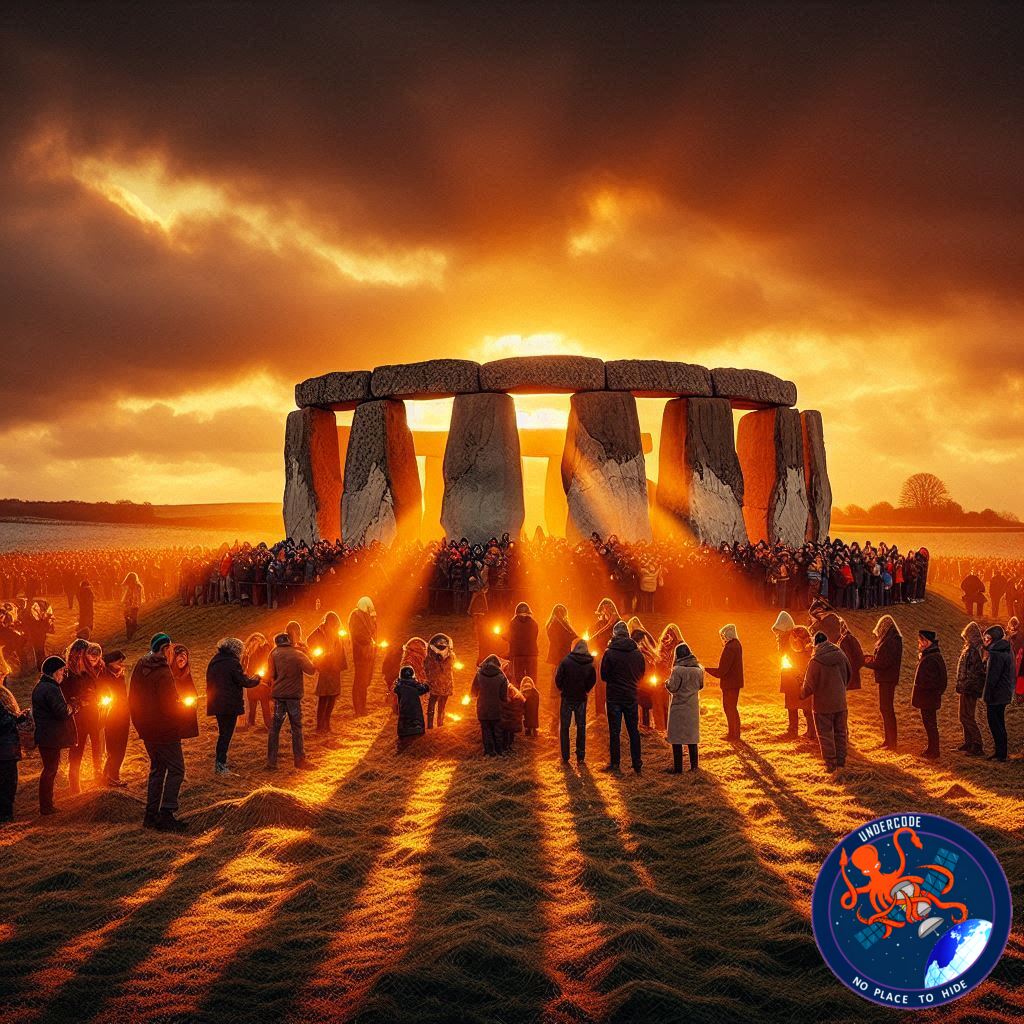
A Sacred Morning at Newgrange
On a cold December morning in Ireland, nearly 2,000 people gathered in quiet anticipation at Newgrange, one of Europe’s most revered prehistoric monuments. The occasion was the winter solstice, a moment that has linked human ritual, astronomy, and belief for more than five millennia. Long before written history, this Neolithic passage tomb was engineered with astonishing precision to capture the first light of the year’s shortest day.
The Ancient Design Behind the Spectacle
Newgrange forms part of the Brú no Bóinne complex, a UNESCO World Heritage site older than Stonehenge and the Egyptian pyramids. Its narrow stone passage leads to a central chamber, crowned by a corbelled roof that has remained watertight for thousands of years. Above the entrance sits a structure known as the roof box, a deliberate architectural feature designed to funnel sunlight into the chamber at dawn on the winter solstice.
Clouds, Light, and a Subtle Triumph
This year, the sky did not fully cooperate. While conditions were mostly clear, low cloud along the eastern horizon partially obscured the sunrise. The sun itself never emerged cleanly above the cloud line at the expected moment. Still, nature offered a compromise. Enough light filtered through the roof box to illuminate the inner chamber, producing the phenomenon that has drawn observers across centuries.
A Brief Illumination with Lasting Impact
As the minutes passed, the beam of pale winter light crept slowly along the stone floor, touching the carved spirals and ancient symbols etched into the chamber walls. The effect lasted only a short time, yet its emotional impact far exceeded its duration. Even muted by clouds, the alignment reaffirmed the remarkable knowledge and intent of Newgrange’s builders.
Restricted Access Preserves the Ritual
Despite the massive turnout outside, only 14 people were permitted inside the chamber at sunrise. The group included two official guides and six winners of the annual free solstice lottery, each accompanied by a guest. This controlled access protects the monument while preserving the intimacy of the experience, echoing the exclusivity the ritual may have held in prehistoric times.
Queues and Quiet Reverence
As clouds lifted later in the morning, visitors queued patiently for a chance to enter the chamber. Though the primary solstice moment had passed, the desire to step inside the ancient structure remained strong. For many, simply standing within stones raised by Neolithic hands offered a tangible connection to distant ancestors.
A Gathering Across Time
The crowd at Newgrange represented more than tourism. It reflected a shared human fascination with cycles of light, darkness, death, and renewal. The winter solstice marks the turning point of the year, when days slowly begin to lengthen again. For ancient communities, this moment carried deep spiritual and practical meaning tied to survival and hope.
A Living Monument
Newgrange is not a relic frozen in time. Each year’s solstice renews its purpose. The monument continues to function exactly as designed, bridging modern science and ancient cosmology. Even under imperfect skies, its message endures.
Main the Original Event
The winter solstice gathering at Newgrange drew approximately 2,000 people to witness a phenomenon engineered more than 5,000 years ago. The Neolithic passage tomb, part of Ireland’s Brú no Bóinne complex, is carefully aligned so that sunlight enters its inner chamber at dawn on the shortest day of the year. Although low cloud on the eastern horizon partially blocked the sunrise, sufficient light passed through the roof box to create the solstice illumination effect. As the morning progressed and clouds lifted, visitors queued for entry into the monument. Access during sunrise was limited to 14 individuals, including two guides and six lottery winners, each accompanied by a guest. Despite challenging weather, the event once again demonstrated the extraordinary astronomical knowledge and architectural skill of Newgrange’s prehistoric builders.
What Undercode Say: Ancient Engineering Meets Modern Awe
The Newgrange solstice event is more than a seasonal curiosity. It is one of the clearest examples of prehistoric precision engineering aligned with astronomical cycles. The builders understood the sun’s annual movement with a level of accuracy that challenges outdated assumptions about Neolithic societies. This was not accidental alignment. It was deliberate, repeatable, and symbolically loaded.
From a technical standpoint, the roof box is the true marvel. Unlike simple door alignment, it isolates sunlight at a very specific angle and date. For 364 days of the year, the chamber remains in darkness. On one morning, light returns. This binary design suggests ritual intent rather than decorative ambition.
Culturally, the solstice illumination likely represented rebirth. In agrarian societies, the return of light after the longest night signaled survival through winter and the promise of future growth. Newgrange functioned as a calendar, a ceremonial center, and possibly a burial site, merging science with spirituality.
Modern reactions mirror ancient ones more than many expect. Visitors describe silence, emotion, and a sense of insignificance when standing inside the chamber. That response highlights how architecture can shape human perception across millennia. The monument still controls light, space, and time, even in an era dominated by screens and artificial illumination.
The lottery system limiting access reflects a modern challenge. Preservation must coexist with public interest. Foot traffic, humidity, and carbon dioxide all pose risks to the structure. Restricting entry is not exclusionary by design. It is protective, ensuring the monument survives future centuries.
There is also a broader lesson in resilience. This year’s partial cloud cover did not negate the event. The builders anticipated variability. Their design captures ambient light, not just direct sunlight. That flexibility hints at empirical testing and generational knowledge passed down orally.
From a scientific lens, Newgrange reinforces that early humans observed nature systematically. They tracked solar positions over decades, perhaps centuries, before committing stone to earth. Such patience contrasts sharply with modern expectations of instant results.
The site’s continued relevance also challenges how progress is measured. Technological sophistication does not always move linearly forward. Some ancient solutions remain unmatched in elegance and durability.
Newgrange stands as evidence that meaning, not just utility, drove early innovation. It was built to be felt as much as seen. That emotional engineering remains intact.
Fact Checker Results
✅ Approximately 2,000 people attended the Newgrange solstice gathering
✅ The monument is aligned to admit light at dawn during the winter solstice
❌ Full sunrise visibility was not achieved due to low cloud cover
Prediction
🌅 Future solstice events at Newgrange will see increased global attention as interest in ancient astronomy grows
🗿 Access restrictions are likely to tighten further to protect the structure
📚 New research may reveal additional astronomical alignments within the Brú no Bóinne complex
🕵️📝✔️Let’s dive deep and fact‑check.
References:
Reported By: www.euronews.com
Extra Source Hub (Possible Sources for article):
https://www.linkedin.com
Wikipedia
OpenAi & Undercode AI
Image Source:
Unsplash
Undercode AI DI v2
Bing
🔐JOIN OUR CYBER WORLD [ CVE News • HackMonitor • UndercodeNews ]
📢 Follow UndercodeNews & Stay Tuned:
𝕏 formerly Twitter 🐦 | @ Threads | 🔗 Linkedin | 🦋BlueSky | 🐘Mastodon


