
Listen to this Post
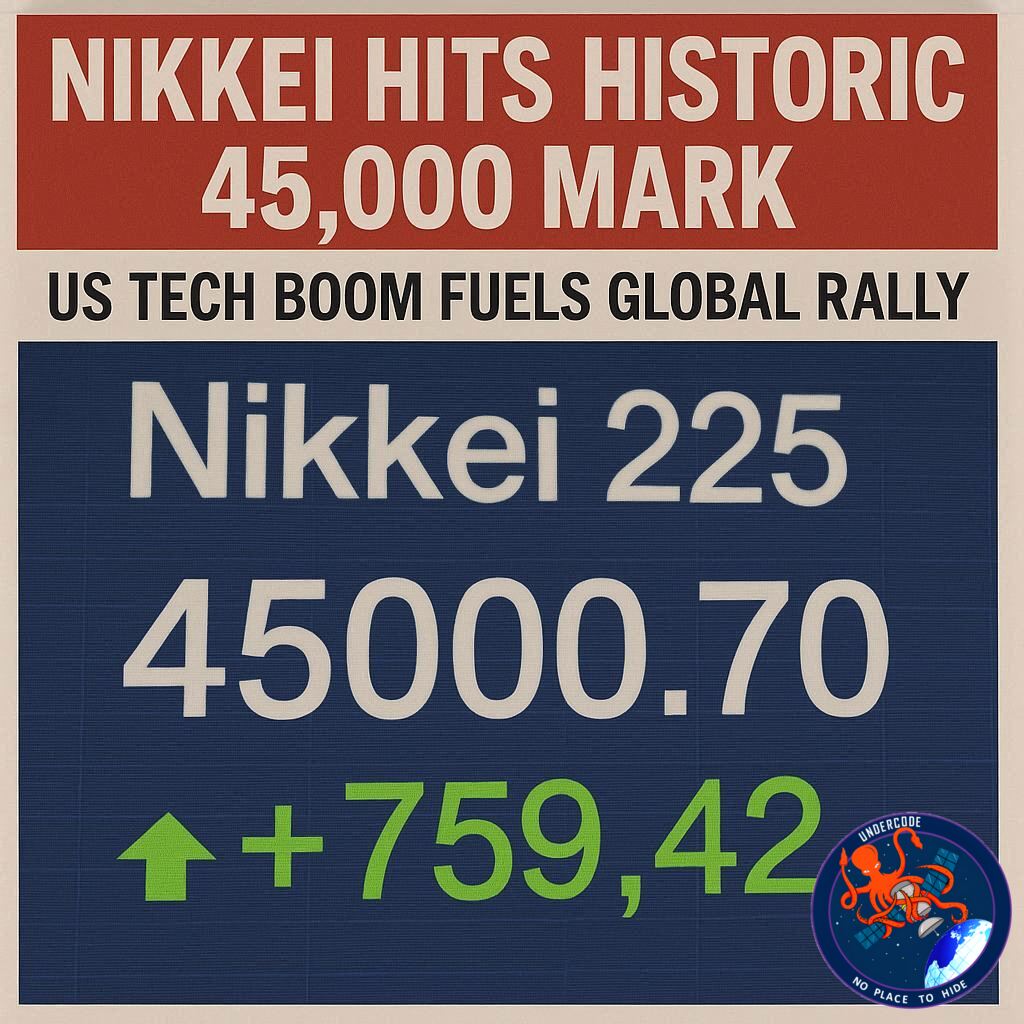
A Historic Surge in Tokyo’s Stock Market
For the first time in history, Japan’s Nikkei Stock Average briefly surpassed the 45,000-point mark on September 16. The milestone comes amid a powerful global rally led by U.S. technology giants, with investors betting big on artificial intelligence (AI) and easing monetary policy expectations.
The Tokyo Stock Exchange saw brisk activity, particularly in AI-related stocks, as investors mirrored optimism from Wall Street. Just one day earlier, U.S. markets closed at record highs, driven by a surge in tech shares. The S\&P 500 index—a benchmark for global institutional investors—ended above 6,600 points for the first time.
Among the standout developments in the U.S., Alphabet, Google’s parent company, reached an astonishing \$3 trillion market capitalization, signaling investor confidence in tech-driven growth. Meanwhile, positive signals from a U.S.-China ministerial meeting and renewed expectations of a significant Federal Reserve rate cut fueled risk appetite worldwide.
Japan, heavily intertwined with global supply chains and technology exports, quickly became a beneficiary of this momentum. The rally underscores not only the strength of Wall Street but also the ripple effects of AI’s economic potential on Asian markets.
What Undercode Say:
The Nikkei’s surge above 45,000 is more than a symbolic milestone—it is a reflection of deeper structural changes in the global economy. Let’s unpack what this means:
First, the rally highlights the dominant role of AI and technology in shaping capital markets. From Alphabet’s record-breaking valuation to Japan’s chip and automation companies gaining traction, investors are clearly betting on digital transformation as the next major growth engine. This AI boom is not just a trend; it’s a reallocation of capital toward sectors seen as the backbone of the future economy.
Second, the U.S. monetary environment plays a decisive role. The expectation of significant Federal Reserve rate cuts is encouraging risk-taking. Cheap money historically drives markets higher, and if the Fed delivers on aggressive easing, we could be looking at an extended bull cycle across both U.S. and Asian equities. However, it’s worth noting that overreliance on monetary policy could inflate asset bubbles, leaving markets vulnerable to sharp corrections.
Third, the U.S.-China dynamic cannot be ignored. A thaw in relations between the two largest economies brings stability to global trade, particularly in semiconductors, rare earths, and supply chain logistics. Japan, sitting strategically between both powers, stands to gain from improved cooperation. Companies like Tokyo Electron, SoftBank, and Sony are likely to see stronger investor flows if tensions remain under control.
Fourth, from a domestic perspective, Japan’s market rise signals a renewed confidence in its corporate sector. The Tokyo Stock Exchange has pushed for better governance and transparency, and global investors are rewarding that effort. The Nikkei’s leap is not just about AI—it’s about Japan becoming a more attractive investment destination overall.
Yet, risks loom. If the AI narrative cools, or if U.S.-China talks collapse, Tokyo could face swift corrections. Similarly, if inflation rebounds and forces the Fed to pause or reverse its dovish stance, liquidity could dry up quickly.
Looking forward, one should ask: Is this a sustainable rally, or are we witnessing early signs of overheating? History reminds us that when markets chase innovation stories too aggressively, corrections are inevitable. But unlike the dot-com bubble, today’s AI sector has tangible revenue streams, massive infrastructure investment, and government backing. That could make this rally more resilient than previous speculative runs.
For investors, the lesson is balance. Exposure to AI-driven companies offers undeniable growth potential, but diversification remains key. Japan’s achievement of 45,000 is a headline-grabber, but it should also be a reminder of how tightly global markets are interconnected—and how quickly sentiment can shift.
🔍 Fact Checker Results
✅ Nikkei crossed 45,000 for the first time on Sept. 16.
✅ Alphabet reached $3 trillion market cap.
✅ S\&P 500 closed above 6,600 points for the first time.
📊 Prediction
If U.S. tech stocks continue their momentum and the Federal Reserve follows through with significant rate cuts, the Nikkei could push beyond 46,000 before year’s end. However, any geopolitical disruption or reversal in AI optimism could trigger a pullback toward the 42,000–43,000 range. Japan’s trajectory will remain closely tied to U.S. tech and global monetary policy in the months ahead.
🕵️📝✔️Let’s dive deep and fact‑check.
References:
Reported By: xtechnikkeicom_bd43054306c4cdeb0f9311be
Extra Source Hub:
https://www.pinterest.com
Wikipedia
OpenAi & Undercode AI
Image Source:
Unsplash
Undercode AI DI v2
🔐JOIN OUR CYBER WORLD [ CVE News • HackMonitor • UndercodeNews ]
📢 Follow UndercodeNews & Stay Tuned:
𝕏 formerly Twitter 🐦 | @ Threads | 🔗 Linkedin | 🦋BlueSky | 🐘Mastodon


