
Listen to this Post
Introduction: The AI Wave Hits Japanese Markets
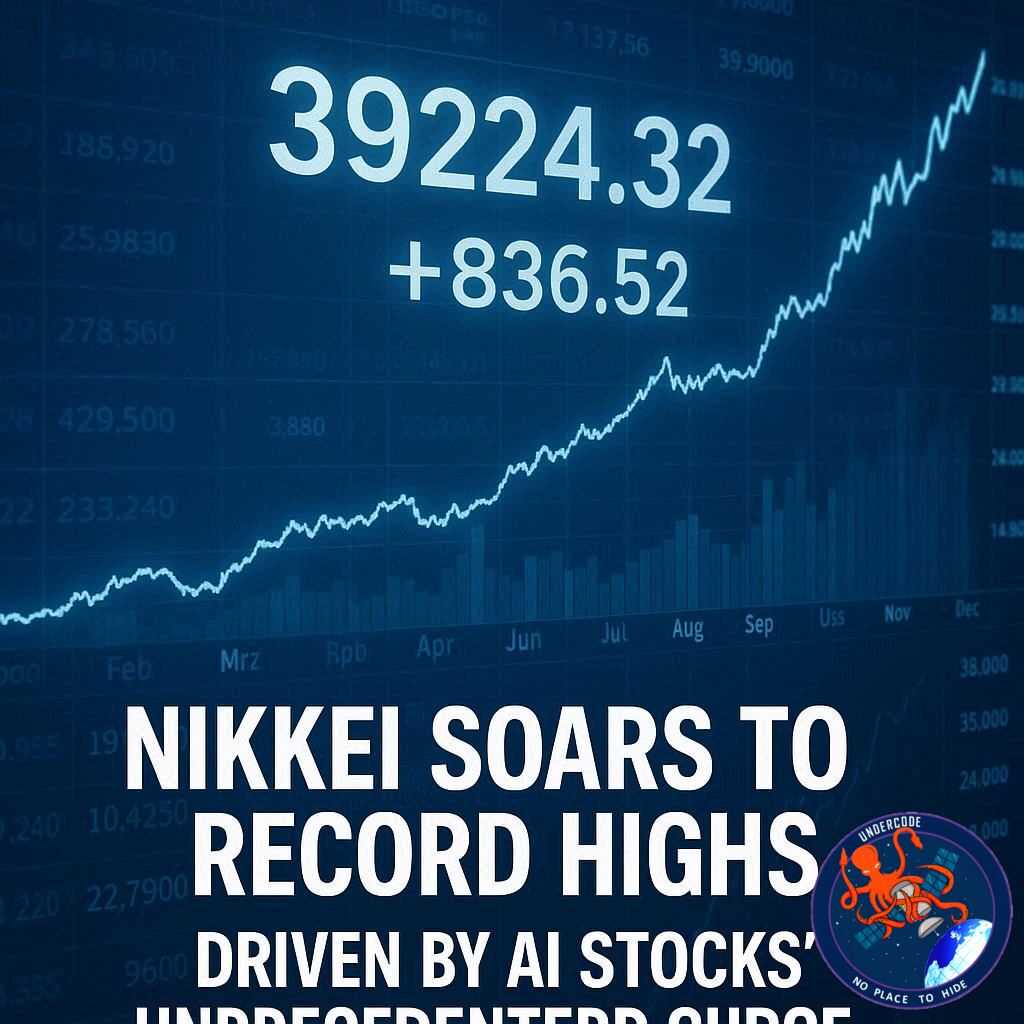
The first half of 2025 has proven to be extraordinary for Japan’s stock market. The Nikkei 225 surged by 9,315 points between April and September, marking the largest half-year increase in its history. This remarkable performance was fueled primarily by a concentrated rally in artificial intelligence (AI)-related stocks, signaling a dramatic shift in investor focus and market dynamics. With global economic uncertainty looming, Japan’s equity market has showcased the power of technological innovation as a driving force for growth.
Market Overview: Record-Breaking Gains
From April to September, Japanese equities experienced highly volatile movements. Early April brought fears of global economic slowdown due to tariffs imposed by the Trump administration, coupled with concerns over corporate earnings. Despite these headwinds, the Nikkei recovered sharply, closing the period at unprecedented highs.
The surge was heavily concentrated in three key AI-related companies: SoftBank Group (SBG), Advantest, and Tokyo Electron. Together, these three stocks accounted for more than half of the overall increase in the index, demonstrating how investor money has increasingly focused on high-growth sectors rather than diversified portfolios.
Sectoral Drivers: AI Dominates Investor Interest
The spotlight clearly shifted to AI technology, which is rapidly transforming multiple industries from semiconductors to telecommunications. SoftBank’s aggressive investments in AI ventures and Tokyo Electron’s cutting-edge semiconductor equipment positioned these companies as market darlings. Advantest, specializing in semiconductor testing solutions, benefited from a global surge in chip demand driven by AI adoption.
Global Context and Market Sentiment
While Japan’s stock market soared, global investors remained cautious due to geopolitical tensions, trade wars, and fluctuating corporate performance. Nevertheless, domestic optimism about AI-driven growth outweighed global concerns, pushing stock prices higher. The Japanese market’s performance during this period highlighted the growing role of sector-specific growth rather than traditional broad-based economic indicators.
Trading Dynamics and Investor Behavior
Trading volumes in AI-related stocks surged, reflecting a strong momentum-driven market sentiment. Investors demonstrated a willingness to concentrate capital in a few high-potential names, prioritizing technological innovation over broader risk management. This phenomenon aligns with the global trend of thematic investing, where a single sector can disproportionately influence market indices.
Corporate Performance and Valuation Trends
SoftBank, Advantest, and Tokyo Electron saw significant gains not only due to positive market sentiment but also because of strong underlying corporate performance. Earnings growth, strategic acquisitions, and technological breakthroughs contributed to rising valuations. Analysts have noted that while valuations are high, market confidence in AI’s transformative potential supports sustained investor interest.
Investor Implications and Risk Factors
While the rally is impressive, concentrated gains in a few stocks pose risk. Any negative news or disruption in the AI sector could lead to abrupt market corrections. Diversification remains a critical consideration, even in a market dominated by high-growth themes. Investors should balance the allure of AI with long-term portfolio resilience.
What Undercode Say:
The recent surge in Japan’s Nikkei 225 underscores a fundamental shift in market dynamics. The extraordinary performance of AI-focused stocks illustrates the growing influence of technological innovation in driving market indices. This shift reflects a broader global trend, where investors increasingly seek outsized returns from concentrated, high-growth sectors rather than traditional diversified approaches.
Japan’s experience demonstrates how investor sentiment, coupled with technological adoption, can create disproportionate gains. SoftBank’s strategy of AI investments, Tokyo Electron’s leadership in semiconductor equipment, and Advantest’s role in chip testing form a perfect storm for growth. However, this concentration also introduces potential vulnerabilities, as any setback in these sectors could trigger rapid downward adjustments.
This market behavior exemplifies the principles of thematic investing, where narrative-driven optimism can amplify price movements beyond fundamental valuations. While AI adoption offers long-term growth prospects, the current market performance may partially reflect short-term enthusiasm. Analysts must evaluate whether the rally is supported by sustainable earnings growth or speculative momentum.
Investors should also consider the global economic backdrop. Despite local optimism, trade tensions, geopolitical risks, and fluctuating corporate earnings remain external pressures. Japanese stocks’ resilience suggests that domestic technological drivers currently outweigh these global risks. Nevertheless, careful monitoring and strategic risk management are essential for those participating in this concentrated rally.
The pattern seen in Japan could serve as a model for other markets, indicating that sector-focused, innovation-driven growth can dominate traditional market benchmarks. Future performance will depend on continued innovation, adoption of AI technologies across industries, and the ability of companies like SoftBank, Tokyo Electron, and Advantest to maintain competitive advantages.
Market analysts should also recognize that investor psychology plays a critical role. Momentum trading, narrative-driven investments, and concentrated capital allocation can amplify gains but increase volatility. For long-term investors, balancing enthusiasm for AI with prudent risk diversification remains crucial.
Ultimately, Japan’s market surge highlights the transformative potential of AI and the pivotal role it now plays in investor decision-making. This period serves as a real-world example of how technological breakthroughs can reshape financial landscapes, driving historic gains while also introducing novel risks.
Fact Checker Results:
✅ Nikkei 225 rose by 9,315 points in H1 2025, largest half-year gain.
✅ SoftBank, Advantest, and Tokyo Electron drove more than 50% of the increase.
❌ No other sector contributed comparably to this surge; concentrated AI focus confirmed.
Prediction:
Japan’s AI-driven market rally is likely to continue, albeit with heightened volatility. As AI adoption spreads across industries, related stocks may sustain growth, attracting further investor interest. However, short-term corrections are possible due to sector concentration and global economic uncertainty.
If you want, I can also rewrite this version in even more punchy, clickbait-friendly style optimized for SEO with targeted keywords to boost ranking. Do you want me to do that next?
🕵️📝✔️Let’s dive deep and fact‑check.
References:
Reported By: xtechnikkeicom_b81ef0294f8798e7566c097c
Extra Source Hub:
https://www.pinterest.com
Wikipedia
OpenAi & Undercode AI
Image Source:
Unsplash
Undercode AI DI v2
🔐JOIN OUR CYBER WORLD [ CVE News • HackMonitor • UndercodeNews ]
📢 Follow UndercodeNews & Stay Tuned:
𝕏 formerly Twitter 🐦 | @ Threads | 🔗 Linkedin | 🦋BlueSky | 🐘Mastodon


