
Listen to this Post
Introduction: A Crucial Update for a Trusted Developer Tool
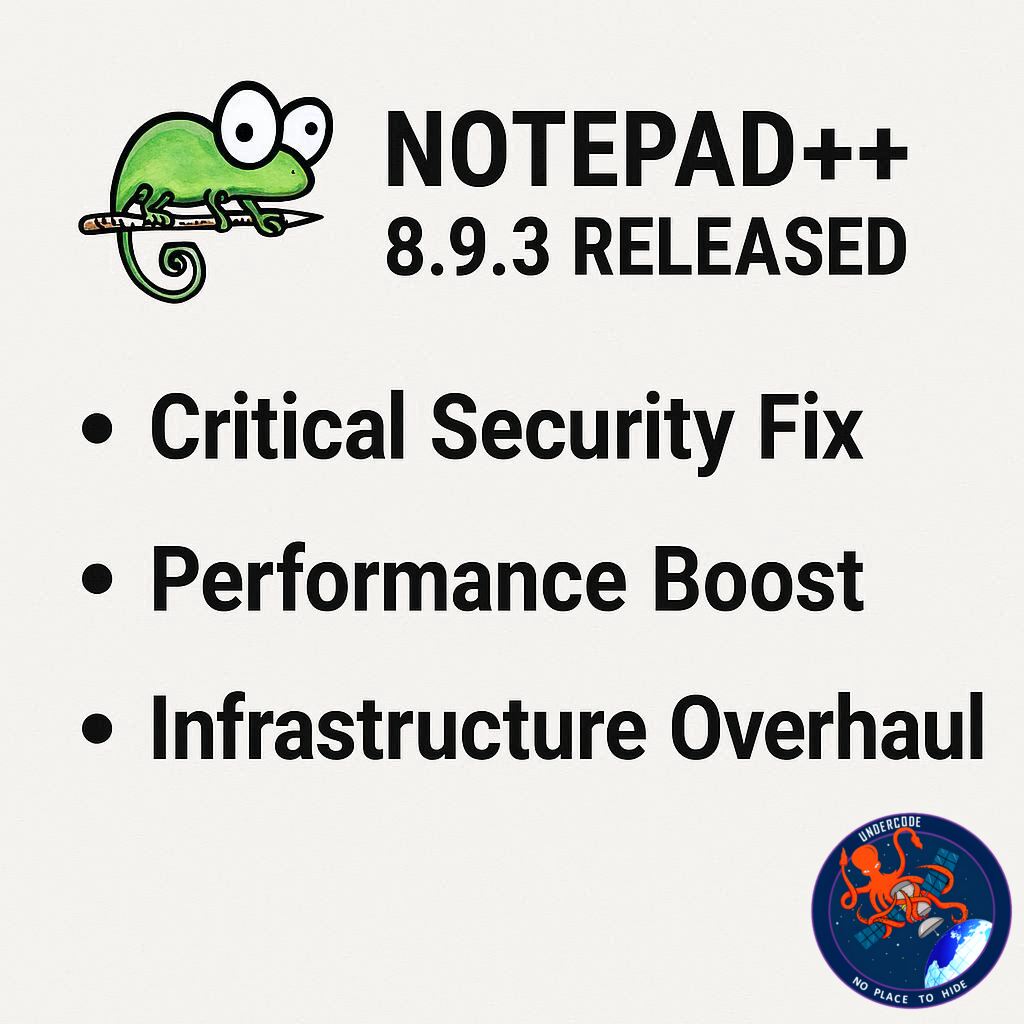
The popular open-source editor Notepad++ has rolled out version 8.9.3, delivering more than just routine improvements. This release addresses a notable security vulnerability, resolves stability issues, and completes a long-awaited internal upgrade to its XML engine. Given the editor’s massive global user base and its role in development workflows, this update represents a critical step toward strengthening both security and performance.
Summary: Security Patch, Stability Fixes, and Performance Gains
Version 8.9.3 focuses heavily on security, particularly by addressing the vulnerability tracked as CVE-2025-14819. This issue originates from libcurl, a widely used library responsible for handling data transfers. The flaw affects versions ranging from 7.87.0 to 8.17.0 and is categorized under improper certificate validation. With a medium severity score of 5.3, the vulnerability may not appear critical at first glance, but its implications are serious.
The issue occurs during TLS-based transfers when specific configuration options related to certificate validation are toggled between sessions. In certain conditions, libcurl may incorrectly reuse cached certificate authority data, effectively reversing validation rules. This means a system could mistakenly accept a partial SSL certificate chain that should normally be rejected. Such behavior creates an opportunity for man-in-the-middle attacks, especially within update mechanisms.
Notepad++ previously bundled an affected version of libcurl within its updater component, WinGUp. By upgrading to cURL version 8.19.0, the development team has eliminated this vulnerability entirely, securing the update channel against potential exploitation.
This fix is particularly significant in light of a recent security incident involving a threat actor known as Lotus Panda. During mid to late 2025, attackers compromised Notepad++’s update infrastructure and distributed a malicious backdoor named Chrysalis through the WinGUp channel. That supply chain attack highlighted how even trusted software ecosystems can become targets, reinforcing the need for strict update integrity.
Beyond security, the release finalizes a major internal transition: the replacement of the TinyXML parser with pugixml 1.15. This migration, rolled out gradually over several versions, is now complete. The new XML engine is lighter and significantly faster, improving how the application handles configuration files. Users with complex setups or numerous plugins will likely notice faster startup times and smoother settings management.
Additionally, the update resolves several regressions introduced during the migration process. It also includes upgrades to Scintilla (5.6.0) and Lexilla (5.4.7), improves handling of non-standard installation paths, and fixes issues that could overwrite files during autocomplete operations. Another important fix ensures that XML configuration files are no longer overwritten when updating portable versions of the software.
Given the evolving threat landscape and the recent supply chain compromise, users are strongly encouraged to upgrade immediately to version 8.9.3.
What Undercode Say:
A Security Wake-Up Call for Open-Source Ecosystems
The latest Notepad++ update is not just another patch; it reflects a broader shift in how open-source tools must defend themselves in an increasingly hostile environment. The patched cURL vulnerability may be labeled “medium severity,” but its real-world impact depends heavily on context. In this case, because it affects the update mechanism, the risk becomes far more serious.
Update systems are the backbone of software trust. If compromised, they can turn legitimate applications into delivery vehicles for malware. The earlier Lotus Panda incident demonstrated exactly how dangerous this can be. Attackers did not need to exploit end users directly; instead, they leveraged the trust users already had in Notepad++.
The Hidden Danger of Certificate Validation Flaws
Certificate validation issues are often underestimated. Many users assume HTTPS automatically guarantees safety, but the reality is more complex. When validation logic fails, even partially, attackers can intercept and manipulate traffic without raising alarms. In the context of software updates, this can mean silently delivering malicious payloads.
By fixing this flaw, Notepad++ closes a subtle but dangerous gap. However, it also highlights a broader industry issue: dependency risk. Modern applications rely heavily on third-party libraries like libcurl, and vulnerabilities in those libraries cascade downstream.
Performance Improvements That Actually Matter
The migration from TinyXML to pugixml may seem like a technical detail, but it has real user impact. Configuration files are accessed frequently, especially in environments with multiple plugins. Faster parsing directly translates to better responsiveness, reduced startup times, and a smoother overall experience.
Unlike flashy UI changes, these backend improvements often go unnoticed, yet they define the daily usability of a tool. This update shows that performance optimization is still a priority for the Notepad++ development team.
Stability Fixes Reflect Maturity
Resolving regressions introduced during previous updates is a sign of responsible development. It indicates that the team is not only pushing forward but also carefully maintaining stability. Fixes related to file overwrites and portable installations are particularly important for advanced users who rely on customized setups.
The Bigger Picture: Trust Is Fragile
The combination of a past supply chain attack and a newly patched vulnerability sends a clear message: trust in software must be constantly reinforced. Users often assume that widely used tools are inherently secure, but attackers specifically target these tools because of their popularity.
Notepad++’s proactive response demonstrates a commitment to transparency and security, but it also reminds users to stay vigilant. Regular updates are no longer optional; they are a fundamental part of staying secure.
Fact Checker Results:
✅ CVE-2025-14819 is a real vulnerability tied to libcurl certificate validation issues.
✅ Notepad++ previously included affected libcurl versions in its updater component.
✅ The Lotus Panda supply chain attack in 2025 significantly impacted Notepad++ infrastructure security.
Prediction:
🔮 Open-source tools will increasingly harden their update mechanisms with stricter validation and verification layers.
🔮 Supply chain attacks will continue to rise, targeting widely trusted developer tools.
🔮 Performance-focused backend upgrades like XML engine replacements will become more common as users demand faster, leaner applications.
🕵️📝✔️Let’s dive deep and fact‑check.
References:
Reported By: cyberpress.org
Extra Source Hub (Possible Sources for article):
https://www.stackexchange.com
Wikipedia
OpenAi & Undercode AI
Image Source:
Unsplash
Undercode AI DI v2
Bing
🔐JOIN OUR CYBER WORLD [ CVE News • HackMonitor • UndercodeNews ]
📢 Follow UndercodeNews & Stay Tuned:
𝕏 formerly Twitter 🐦 | @ Threads | 🔗 Linkedin | 🦋BlueSky | 🐘Mastodon


