
Listen to this Post
Introduction
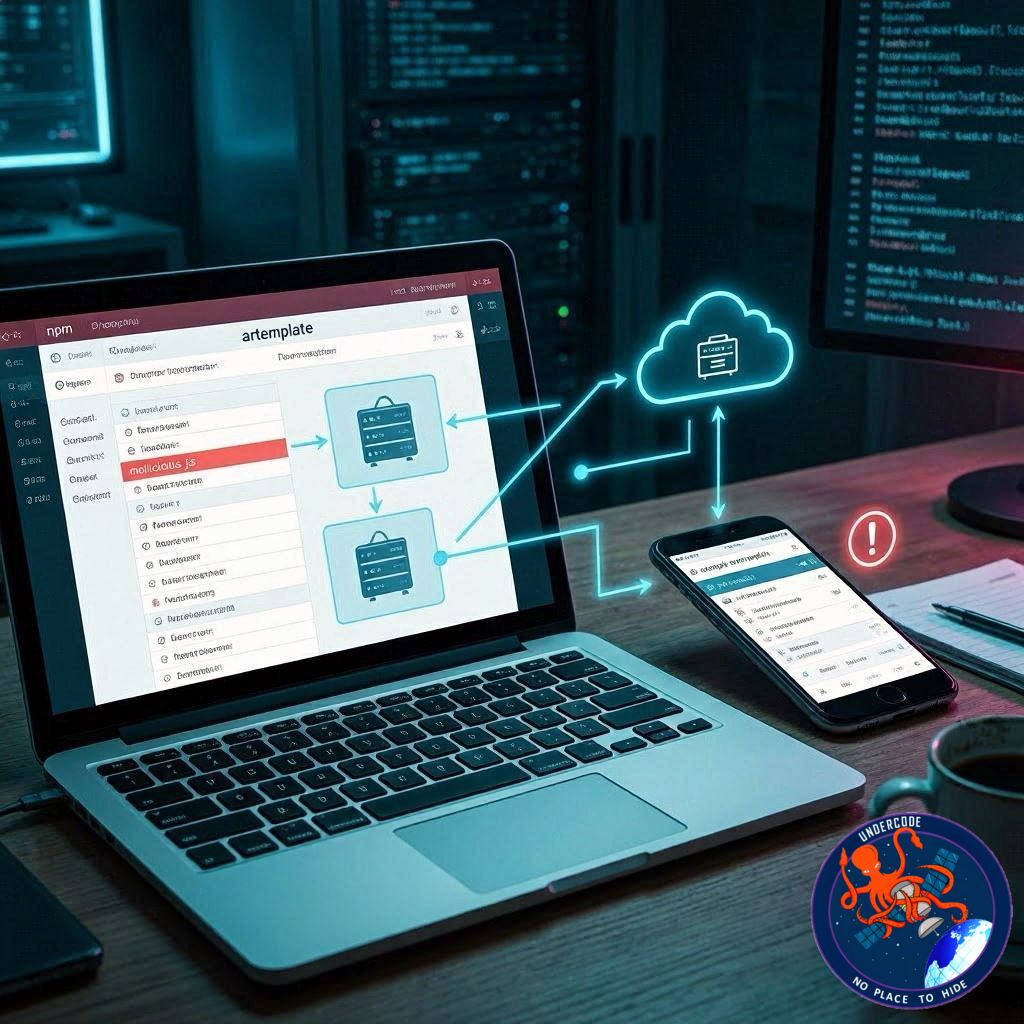
A major security incident has emerged from the JavaScript ecosystem involving the widely used npm package art-template. What was once a trusted frontend templating tool has reportedly been turned into a delivery mechanism for a sophisticated iOS-focused exploitation framework. The attack highlights how supply chain compromises can silently transform legitimate web dependencies into powerful offensive tools capable of targeting millions of end users without immediate detection.
Summary of the Original Incident
The art-template npm package, originally maintained by developer aui, became the center of a suspected supply chain compromise after ownership of the project was transferred to a new maintainer who appeared to have malicious intent. According to threat researchers, the new controller began releasing altered versions of the package that silently injected external JavaScript into websites using the dependency. At the same time, GitHub issues raising concerns about suspicious activity were deleted, suggesting deliberate efforts to suppress scrutiny and delay detection. From a developer perspective, the package still functioned as a normal frontend templating engine, making the compromise extremely difficult to notice at the integration level. However, in the browser, the injected scripts executed automatically, giving attackers full access to user-facing environments such as cookies, local storage, and form inputs. The malicious payload was identified as a heavily obfuscated JavaScript module designed specifically for Safari and WebKit environments, targeting iOS devices ranging from version 11.0 to 17.2 while explicitly avoiding other browsers and newer patched versions. Once executed, the framework began sending periodic beacons to a command and control server, transmitting victim metadata including IP addresses, operating system versions, and campaign identifiers. The system used external IP lookup services to mask malicious traffic as legitimate activity. Researchers also identified multiple anti-analysis techniques, including checks for automation tools, browser rendering capabilities, memory behavior, and sandbox detection. Only genuine Safari environments passed these checks, after which more advanced exploitation preparation began. The framework also performed WebAssembly-based system probing and architecture detection, indicating preparation for deeper browser-level exploitation rather than simple phishing. The payload assigned different operational flags depending on iOS version ranges, with specific targeting of widely used mid-range versions. These flags triggered remote module downloads from encrypted and hidden endpoints using hashed paths and session-based keys, ensuring that exploit components remained inaccessible without proper authorization. The most concerning activity involved a dedicated execution path targeting iOS 16.6 to 17.2 devices, which represents a large population of non-updated iPhones, where a WebAssembly loader was deployed to initiate further payload execution. Security analysts continue to investigate the final stage behavior, which remains partially undisclosed.
What Undercode Say:
This incident is not a simple case of malicious code injection but a structured supply chain compromise designed for long term exploitation.
The attackers did not rush deployment, instead they followed a patient maintainership takeover strategy that allowed trust to be preserved.
This type of attack shows how open source ecosystems can be weaponized without directly hacking a target system.
Instead of exploiting servers directly, the attackers exploited developer trust and package dependency relationships.
Every application using art-template effectively became an unwitting distribution node for malicious JavaScript.
The payload design shows strong awareness of browser internals, especially Safari and WebKit architecture.
Targeting iOS versions between 11 and 17.2 suggests strategic focus on both legacy and still widely active devices.
Avoiding iOS 17.3 and modern browsers indicates that exploit reliability depends on known unpatched vulnerabilities.
The use of anti-analysis techniques suggests the attackers anticipated security researchers would inspect the payload.
Checks against WebDriver, headless environments, and sandbox conditions show defensive coding typical of advanced threat actors.
The use of WebRTC and WebGL fingerprinting demonstrates intent to build highly precise device profiles.
By collecting system-level signals, the framework ensures only real user devices are exploited, not testing environments.
The beaconing pattern every 10 seconds indicates persistent real-time victim tracking rather than one-time exploitation.
Routing data through seemingly legitimate IP lookup services helps reduce suspicion in network monitoring tools.
The modular payload structure suggests a multi-stage attack system where initial infection is only the first layer.
Each version-specific flag acts like a switchboard controlling which exploit chain is delivered.
The use of SHA-256-based remote module retrieval prevents easy reverse engineering of the full attack chain.
This design ensures that analysts only see fragments unless all keys and endpoints are discovered.
The WebAssembly loader indicates a shift toward low-level memory manipulation within the browser.
Such techniques are often associated with attempts to bypass modern browser mitigations like sandboxing and JIT protections.
The focus on Safari/WebKit specifically suggests attackers studied platform-specific memory layouts and execution behavior.
The exclusion of Chrome, Firefox, and Edge implies a precision attack rather than broad malware distribution.
This also reduces noise and increases success rate per infected device.
The compromise of a widely used npm package highlights systemic risk in modern JavaScript dependency chains.
Even small or niche libraries can become high impact attack vectors if widely embedded.
Trust in maintainers becomes a critical security boundary, not just code quality.
This case reinforces that supply chain security is now as important as endpoint security.
Developers may unknowingly import fully operational exploitation frameworks through routine updates.
Security monitoring must extend beyond application code to dependency lifecycle changes.
Open source ecosystems require stronger verification of maintainer transitions and package integrity.
Automated dependency updates can amplify risk when malicious versions are silently introduced.
This incident demonstrates how attackers can hide in plain sight by blending into normal development workflows.
Fact Checker Results
✔ The described technique aligns with known supply chain attack patterns in npm ecosystems
✔ Browser-based JavaScript payload delivery is a realistic and widely used attack method
✔ Advanced fingerprinting and WebAssembly usage are consistent with modern exploit frameworks
Prediction
This type of attack will likely increase as attackers shift from infrastructure targeting to developer ecosystem compromise. Future incidents may involve automated maintainer hijacking, AI-assisted obfuscation, and deeper browser-specific exploit modules. Security tooling will need to evolve toward real-time dependency behavior analysis rather than static package verification alone.
🕵️📝Let’s dive deep and fact‑check.
References:
Reported By: cyberpress.org
Extra Source Hub (Possible Sources for article):
https://www.discord.com
Wikipedia
OpenAi & Undercode AI
Image Source:
Unsplash
Undercode AI DI v2
Bing
🔐JOIN OUR CYBER WORLD [ CVE News • HackMonitor • UndercodeNews ]
📢 Follow UndercodeNews & Stay Tuned:
𝕏 formerly Twitter 🐦 | @ Threads | 🔗 Linkedin | 🦋BlueSky | 🐘Mastodon | 📺Youtube


