
Listen to this Post
Introduction
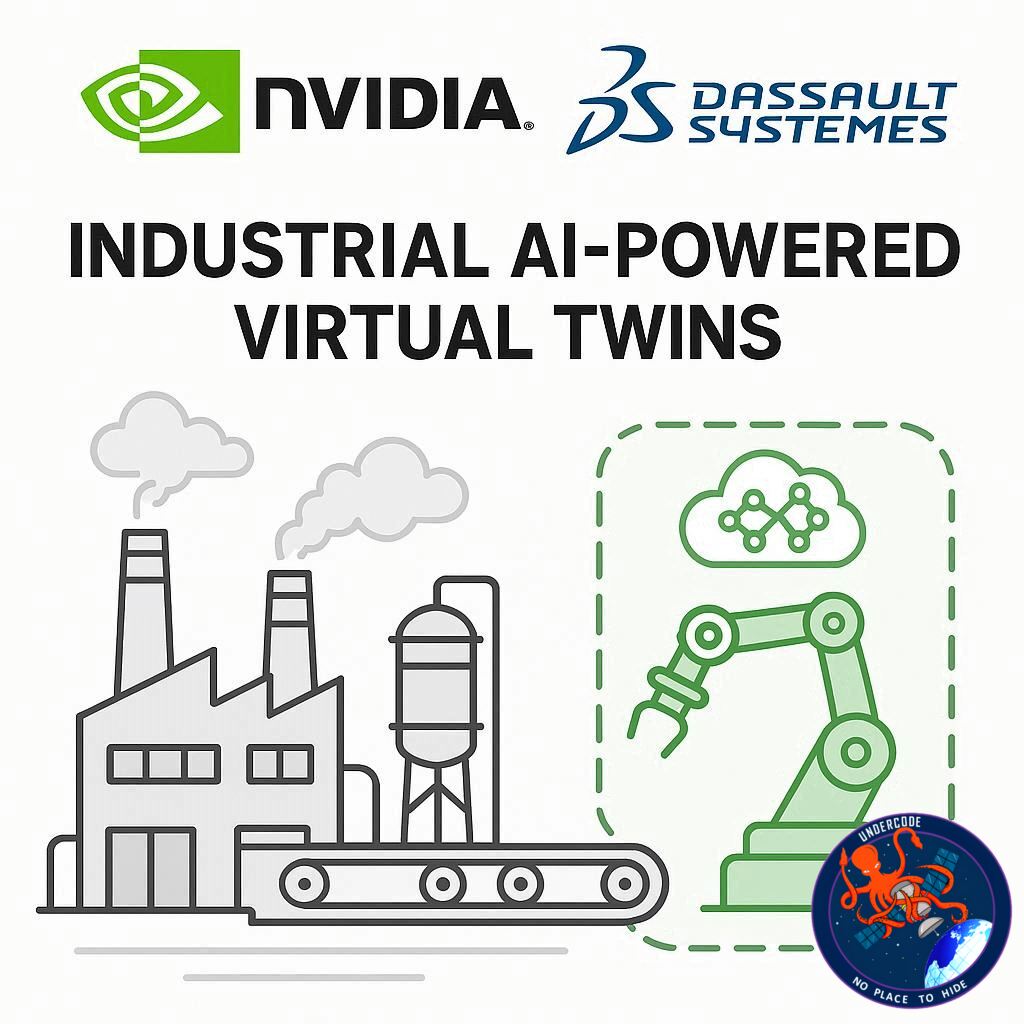
At the intersection of artificial intelligence and industrial design, NVIDIA and Dassault Systèmes have unveiled a bold vision that could redefine how engineers, scientists, and manufacturers work. During the 3DEXPERIENCE World event in Houston, the two tech giants outlined a partnership centered on physics-based “world models,” AI-powered systems capable of simulating products, factories, and even biological processes before they exist in reality. This collaboration promises to accelerate innovation, expand design possibilities, and transform industrial workflows by bringing AI and virtual twin technology together at an unprecedented scale.
From Virtual Twins to Industrial World Models
NVIDIA CEO Jensen Huang and Dassault Systèmes CEO Pascal Daloz emphasized that AI will become as essential as electricity or the internet for industrial processes. This partnership builds on more than 25 years of collaboration between the companies, combining NVIDIA’s accelerated computing and AI libraries with Dassault Systèmes’ 3DEXPERIENCE platform and Virtual Twin technology. The result: a new era where engineers can simulate, iterate, and optimize designs on a scale previously unimaginable—100, 1,000, or even a million times larger than today.
Daloz described virtual twins not merely as software tools, but as “knowledge factories.” By modeling systems grounded in physics, these world models allow engineers to test and validate ideas before building them physically. With over 45 million users globally, Dassault Systèmes is well positioned to integrate NVIDIA’s AI into workflows across engineering, biology, materials science, and manufacturing. This collaboration expands the design space, enabling engineers to explore complex geometries and behaviors earlier in development.
Key Applications Across Industries
The NVIDIA-Dassault Systèmes partnership spans multiple domains, each leveraging AI-driven world models to push innovation forward:
Advancing Biology and Materials Research: NVIDIA BioNeMo and Dassault Systèmes’ BIOVIA models accelerate discovery of new molecules and materials.
AI-Driven Design and Engineering: SIMULIA Virtual Twin Physics Behavior, powered by NVIDIA CUDA-X and AI physics libraries, allows instant, highly accurate predictions.
Virtual Twins for Factories: DELMIA Virtual Twin, integrated with NVIDIA Omniverse, creates autonomous, software-defined production systems.
Virtual Companions for Engineers: The 3DEXPERIENCE agentic platform uses AI companions to provide engineers with actionable insights, expanding their creativity rather than replacing them.
Huang noted that the ultimate frontier in science and engineering lies in learning the “language” of complex systems and generating new possibilities for evaluation in virtual simulations. Factories, once static physical assets, are now evolving into dynamic systems that can be designed, operated, and optimized entirely in software.
Amplifying Human Creativity with AI
The executives emphasized that AI is not meant to replace engineers but to amplify their capabilities. AI companions take on repetitive and exploratory tasks, freeing human designers to innovate and make higher-value decisions. Huang described a future where every designer has a “team of companions,” enabling rapid experimentation and more ambitious design goals. Daloz reinforced that success isn’t about automating the past—it’s about inventing the future.
By integrating NVIDIA’s AI and computing power with Dassault Systèmes’ 3DEXPERIENCE platform, engineers can eliminate costly mistakes, explore unprecedented design possibilities, and accelerate product development cycles. Virtual twins become knowledge factories, transforming how companies innovate and operate across industries.
What Undercode Say:
The NVIDIA-Dassault Systèmes collaboration represents a fundamental shift in industrial computing and design philosophy. By merging accelerated AI computing with physics-based simulations, the partnership is creating a platform where knowledge creation precedes physical production. This reduces risk, shortens time-to-market, and opens entirely new innovation frontiers.
From an analytical standpoint, the fusion of virtual twins with AI companions could redefine engineering hierarchies. Engineers are transitioning from manual operators of CAD systems to orchestrators of AI-driven design ecosystems. This model aligns with trends in digital engineering, where upstream simulation increasingly dictates downstream production and operational efficiency.
In biology and materials science, the implications are particularly profound. AI-driven world models allow scientists to simulate molecular behavior and material interactions with a precision unattainable in lab experiments alone. This accelerates drug discovery, renewable material innovation, and the development of next-generation consumer and industrial products.
Manufacturing stands to gain through AI-enabled, software-defined factories. Factories can be fully simulated, iterated, and optimized in virtual environments before committing to physical changes, reducing operational downtime, material waste, and production errors. The integration of AI companions into these workflows ensures human creativity remains central while operational efficiency soars.
The vision also underscores a larger trend: AI is no longer a supportive tool; it is becoming the infrastructure upon which modern industry operates. Just as electricity enabled mass industrialization, AI-driven world models will enable mass digitization of design, prototyping, and production.
Strategically, this approach could consolidate Dassault Systèmes’ position as a leader in virtual twin technology while giving NVIDIA a dominant role in industrial AI. The partnership also signals a move toward platform-level integration, where multiple industries—automotive, aerospace, life sciences—can leverage the same underlying simulation architecture for domain-specific applications.
Economically, early adopters of these AI-virtual twin systems may achieve significant competitive advantages. By reducing the trial-and-error inherent in traditional engineering and scientific workflows, companies can cut R&D costs, accelerate market entry, and unlock entirely new product categories.
Ethically and socially, this model encourages human-AI collaboration rather than replacement. By positioning AI as a creative partner rather than a substitute, the technology could foster more innovative and inclusive engineering environments.
From a technical standpoint, NVIDIA’s CUDA-X libraries, Omniverse platform, and AI models, combined with Dassault Systèmes’ 3DEXPERIENCE ecosystem, create a scalable architecture capable of handling massive simulations and real-time optimization. This could redefine performance benchmarks for industrial software, moving from reactive design toward predictive, autonomous systems.
The combined impact on education and workforce development is also significant. Engineers trained in AI-augmented design systems will develop skills in managing complex simulations and interpreting AI insights, creating a new generation of digitally empowered professionals.
Ultimately, the collaboration reflects a vision of industrial AI not as a tool but as a foundational platform—a paradigm shift in how the physical and digital worlds intersect. By establishing industry world models, NVIDIA and Dassault Systèmes are effectively building the blueprint for the factories, laboratories, and design studios of tomorrow.
Fact Checker Results
✅ NVIDIA and Dassault Systèmes have a 25+ year collaboration history.
✅ 3DEXPERIENCE platform serves over 45 million users and 400,000 customers globally.
✅ AI-powered virtual twins aim to simulate and optimize products, factories, and biological systems before physical creation.
Prediction
📊 The integration of AI and virtual twins is likely to accelerate global adoption of software-defined factories, expanding to automotive, aerospace, and biotech sectors within the next 5 years. AI companions will become standard for engineers, reshaping workflows and drastically reducing design cycles while fostering innovation in new product categories.
▶️ Related Video (86% Match):
🕵️📝✔️Let’s dive deep and fact‑check.
References:
Reported By: blogs.nvidia.com
Extra Source Hub (Possible Sources for article):
https://www.discord.com
Wikipedia
OpenAi & Undercode AI
Image Source:
Unsplash
Undercode AI DI v2
Bing
🔐JOIN OUR CYBER WORLD [ CVE News • HackMonitor • UndercodeNews ]
📢 Follow UndercodeNews & Stay Tuned:
𝕏 formerly Twitter 🐦 | @ Threads | 🔗 Linkedin | 🦋BlueSky | 🐘Mastodon


